AWS arrives in Tokyo with 1-10ms latency in local area

Amazon Web Services blog announced the arrival of AWS to Tokyo.

Now Open: AWS Region in Tokyo

I have made many visits to Japan over the last several years to speak at conferences and to meet with developers. I really enjoy the people, the strong sense of community, and the cuisine.

Over the years I have learned that there's really no substitute for sitting down, face to face, with customers and potential customers. You can learn things in a single meeting that might not be obvious after a dozen emails. You can also get a sense for the environment in which they (and their users or customers) have to operate. For example, developers in Japan have told me that latency and in-country data storage are of great importance to them.
Here is a cool logo for the Japan AWS users group.

Put it all together and developers in Japan can now build applications that respond very quickly and that store data within the country.

The JAWS-UG (Japan AWS User Group) is another important resource. The group is headquartered in Tokyo, with regional branches in Osaka and other cities. I have spoken at JAWS meetings in Tokyo and Osaka and they are always a lot of fun. I start the meeting with an AWS update. The rest of the meeting is devoted to short "lightning" talks related to AWS or to a product built with AWS. For example, the developer of the Cacoo drawing application spoke at the initial JAWS event in Osaka in late February. Cacoo runs on AWS and features real-time collaborative drawing.

Amazon's Jeff Barr says he can't share the exact location.

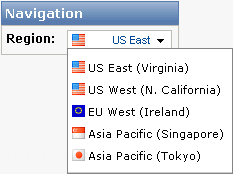
Although I can't share the exact location of the Region with you, I can tell you that private beta testers have been putting it to the test and have reported single digit latency (e.g. 1-10 ms) from locations in and around Tokyo. They were very pleased with the observed latency and performance.

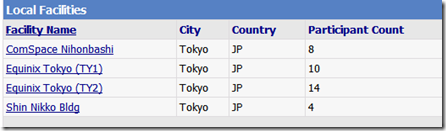
But Amazon's peering point is in Equnix Tokyo.

image

With Equinix listed facilities as

image


Amazon buys Dublin building as future data center

DataCenterDynamics reports on amazon.com’s latest data center move.

Amazon buys Dublin site for data center

Two more data centers under development in the area

Published 9th February, 2011 by Yevgeniy Sverdlik

Amazon boxes shipped

Online retailer and provider of public-cloud servicesAmazon bought a large property in Dublin, Ireland, with plans to turn it into a data center, Independent.ie reported.
The 240,000-sq-ft building is a former storage facility of the supermarket chain Tesco, which moved out more than two years ago. The property, sitting on a 13-acre site had been on the market ever since its last occupant left.

Read more

Google, Amazon, and Netflix comment on uptime 99.999%

NYTimes has a post on uptime.

99.999% Reliable? Don’t Hold Your Breath

By RANDALL STROSS


AT&T’s dial tone set the all-time standard for reliability. It was engineered so that 99.999 percent of the time, you could successfully make a phone call. Five 9s. That works out to being available all but 5.26 minutes a year.

The author was able to get Google.

As for moving to 99.999, well, that may never come. “We don’t believe Five 9s is attainable in a commercial service, if measured correctly,” says Urs Hölzle, senior vice president for operations at Google. The company’s goal for its major services is Four 9s.

Google’s search service almost reaches Five 9s every year, Mr. Hölzle says. By its very nature, it is relatively easy to provide uninterrupted availability for search. There are many redundant copies of Google’s indexes of the Web, and they are spread across many data centers. A Web search does not require constant updating of a user’s personal information in one place and then instantly creating identical copies at other data centers.

Amazon

One of those services, the Simple Storage Service, or S3, allows companies to store data on Amazon’s servers. “We talk of ‘durability’ of data — it’s designed for Eleven-9s durability,” says James Hamilton, a vice president for Amazon Web Services. That works out to a 0.000000001 percent chance of data being lost, at least theoretically.

And threw in a Netflix blog post.

One thing that Google and other companies offering Web services have learned to do is to keep software problems at their end out of the user’s view. John Ciancutti, vice president for personalization technology at Netflix, wrote on the company’s blog in December about lessons learned in moving its systems from its own infrastructure to that of Amazon Web Services. He said Netflix had adopted a “Rambo architecture”: each part of its system is designed to fight its way through on its own, tolerating failure from other systems upon which it normally depends.

“If our recommendations system is down, we degrade the quality of our responses to our customers, but we still respond,” Mr. Ciancutti said. “We’ll show popular titles instead of personalized picks. If our search system is intolerably slow, streaming should still work perfectly fine.”

Watch for availability to be marketed more.

Read more

Estimating the size of Amazon Web Services using instances

Jack of all Clouds has a one year perspective on his method to count the EC2 instances on AWS to gauge the growth of amazon web services.

Recounting EC2 One Year Later

December 29th, 2010  |  Published in Analysis  |  9 Comments

It’s been over a year since my original Anatomy of an EC2 Resource ID post. In what became my little claim to fame in the industry, I uncovered the pattern behind those cryptic IDs AWS assigns to every object allocated (such as an instance, EBS volume, etc.). The discovery revealed that underlying the IDs is a regular serial number that increases with each resource allocated. While this may sound technical and insignificant, it turned out to be very valuable: it enabled, for the first time, a glimpse into the magnitude of Amazon’s cloud.

The numbers gathered in that post back in September 2009 showed that approximately 50,000 instances were being spun up every day on EC2 (in the us-east-1 region). So what’s happened since? I joined forces with CloudKick, providers of a cloud management and monitoring platform, to dig up more data. Here’s what we found: (click to expand to an interactive chart)


Click to open interactive chart

The chart above plots the number of instances launched per day, from mid-2007 till present day. Growth is, well, unmistakable. A couple of peaks dominate the landscape around February and October 2010, peaks which somewhat correlate to availability of new AWS services (see interactive map). The evidence is highly circumstantial though as I find it hard to draw a direct conclusion on how these specific events pushed the daily launch count as high up as 150,000.

Let’s zoom out now and look at EC2′s growth over the years:

What can you determine from these numbers?

Responding to my previous research, a top Amazon official commented that a count of instance launches doesn’t really reflect anything meaningful (like the actual customer base, server count or revenues – all of which we’d all love to figure out). I respond that it’s examining the numbers one year later that provides the real value: it’s like looking at a mysterious dial on your car’s dashboard: even without understanding the exact parameter measured, if it shoots up then there’s a decent chance you’re driving faster.

Watching my frozen kindle post.  It is interesting to see after 5 days traffic is twice the normal amount.  I would assume Amazon sold a significant number of Kindles as Xmas gifts.

image

The numbers alone may not tell you the answer, but they give you a hint on magnitude and direction.

Read more

Apple iPad vs. Kindle

This Xmas our family received an iPad from Grandma.  Grandma has been given our kids iPod Touches, and it seemed the right time to get the kids an iPad.  I have been hesitant to use an iPad as I view it mainly as a consuming device, not a creative device.  It’s been 1 1/2 weeks since I wrote a blog post, and the process of getting my dual displays back in front of me with one screen vertical and the other horizontal, I can get back into researching.

As much as the iPad is a fun device to play with,  I like having two 1920 x 1280 displays to think.

This holiday season was a battle between iPad and Kindles.  the Register comments.

"We're seeing that many of the people who are buying Kindles also own an LCD tablet," said Amazon founder and CEO Jeff Bezos in a canned statement.

Although Bezos didn't refer to the iPad by name – it still being the holidays, direct "in yo' face" trash talking remains rudely unseasonable – it is unlikely that he had the Dell Streak or even the Samsung Galaxy Tab on his mind.

"Customers report using their LCD tablets for games, movies, and web browsing and their Kindles for reading sessions," he continued. "They report preferring Kindle for reading because it weighs less, eliminates battery anxiety with its month-long battery life, and ... works outside in direct sunlight, an important consideration especially for vacation reading."

Part of the speculation is how well the Kindle sold.  Amazon throws out its press release.

Third-Generation Kindle Now the Bestselling Product of All Time on Amazon Worldwide

In just five months, new Kindle replaces 'Harry Potter and the Deathly Hallows' as best-selling product in Amazon's history

SEATTLE, Dec 27, 2010 (BUSINESS WIRE) --(NASDAQ: AMZN)--Amazon.com today announced that the third-generation Kindle is now the bestselling product in Amazon's history, eclipsing "Harry Potter and the Deathly Hallows (Book 7)." The company also announced that on its peak day, Nov. 29, customers ordered more than 13.7 million items worldwide across all product categories, which is a record-breaking 158 items per second.

"We're grateful to the millions of customers who have made the all-new Kindle the bestselling product in the history of Amazon -- surpassing Harry Potter 7," said Jeff Bezos, Amazon.com founder and CEO. "We're seeing that many of the people who are buying Kindles also own an LCD tablet. Customers report using their LCD tablets for games, movies, and web browsing and their Kindles for reading sessions. They report preferring Kindle for reading because it weighs less, eliminates battery anxiety with its month-long battery life, and has the advanced paper-like Pearl e-ink display that reduces eye-strain, doesn't interfere with sleep patterns at bedtime, and works outside in direct sunlight, an important consideration especially for vacation reading. Kindle's $139 price point is a key factor -- it's low enough that people don't have to choose."

So, how many got Kindle’s for Xmas.  No one knows for sure.  But, I have a hint of the volume.  Look at the uptick in hits to my blog post on the frozen kindle.

image

The traffic is three times higher for Dec 25- 26.  I am still amazed there were 1,300 hits to my blog post on 2 days.  How Kindles were turned on for the first time?  The users frustrated for how many minutes, hours, and then Googled “frozen kindle 3”

If you assume a 0.5 % of the people have a problem with 6,341 page views about 12,000,000 sold.  Seems reasonable.

This battle between Apple and Amazon all play well for less paper and shipping costs.  At some point we can expect more studies on how Kindles and iPads are better for the environment.

Happy Holidays.

Read more