Amazon's HW Engineering Product Manager position focuses on delivering new server designs

Amazon has a different approach than I've seen others take.  Opening a product manager position in HW Engineering.

The Product Manager is responsible for the discovery and aggregation of new and emerging technologies in our industries. They collaborate with our engineering staff to define and deliver new server designs for use by all Amazon.com and AWS services. They manage the technical relationships with the key players in our vendor ecosystem, and own the development and execution of our business metrics.

The job is in this group.

The Amazon Hardware & Operating System Engineering team, within the Infrastructure group, provides the server platform for our innovative web service and e-commerce technology platforms. This platform is industry-leading in terms of frugality and operational excellence, and is critical to the success of the AWS business and the thousands of customers who use utility computing today.

How important is AWS to Jeff Bezos if it listed last in the highlights of a quarterly financial results?

Amazon.com posted its quarterly press release.

Amazon.com Announces Second Quarter Sales up 51% to $9.91 Billion

SEATTLE, Jul 26, 2011 (BUSINESS WIRE) —

Amazon.com, Inc. (NASDAQ:AMZN) today announced financial results for its second quarter ended June 30, 2011.

Operating cash flow increased 25% to $3.21 billion for the trailing twelve months, compared with $2.56billion for the trailing twelve months ended June 30, 2010. Free cash flow decreased 8% to $1.83 billion for the trailing twelve months, compared with $1.99 billion for the trailing twelve months ended June 30, 2010.

The market reacted positively.

Amazon.com Tops Profit, Sales Estimates

Amazon.com Inc. (AMZN), the world’s largest online retailer, reported profit and sales that beat analysts’ estimates after its Kindle e-reader and digital-media services helped fuel growth. The shares jumped in late trading.

One interesting fact is AWS is last in the Highlights of quarter.  But, there are three bullet items.

  • Amazon Web Services (AWS) and SAP announced that AWS has been certified as a global technology partner of SAP. Customers can now deploy a variety of SAP solutions in full production environments including SAP(R) Rapid Deployment and SAP(R) BusinessObjects(TM).
  • AWS announced the availability of Amazon Relational Database Service (RDS) for Oracle databases, allowing customers to easily set up, operate and scale fully managed Oracle databases in the cloud.
  • AWS lowered prices for the fifteenth time in four years by eliminating inbound Internet data transfer costs and reducing outbound data transfer costs.

What was #1 with 4 bullet items?  The Kindle.

  • Sales growth of Kindle devices accelerated in second quarter 2011 compared to first quarter 2011.
  • Since AT&T agreed to sponsor screensavers, Kindle 3G with Special Offers is now our bestselling Kindle device - at only $139. With Kindle 3G, there’s no wireless set up and no paying or hunting for Wi-Fi hotspots. Kindle 3G’s always-on global wireless connectivity means that wherever you are, you can download books and periodicals in less than 60 seconds and start reading instantly. Amazon pays for Kindle’s 3G wireless connectivity, which means the convenience of 3G comes with no monthly fees, data plans or annual contracts.
  • Amazon.com announced the launch of Kindle Textbook Rental, offering students savings of up to 80% off textbook list prices. Tens of thousands of textbooks are available for the 2011 school year. In addition, Kindle Textbook Rental offers the ability to customize rental periods to any length between 30 and 360 days, so students only pay for the specific amount of time they need a book.
  • The U.S. Kindle Store now has more than 950,000 books, including New Releases and 110 of 111 New York Times Bestsellers. Over 800,000 of these books are $9.99 or less, including 65 New York Times Bestsellers. Millions of free, out-of-copyright, pre-1923 books are also available to read on Kindle.
  • So how important is AWS to Jeff Bezos?  You know his top priority is The Kindle.

    If California targets Amazon.com Subsidiaries for Sales Taxes, can AWS continue to have locations in CA?

    CNET has an article about Amazon.com distancing itself from its development groups in California.

    California targets Kindle lab in Amazon tax spat

    by Declan McCullagh

    Amazon.com said today that it's reluctantly severing ties with affiliates in California, a move that it hopes will let it continue shipping products to state residents without collecting sales taxes.

    The specific subsidiaries Amazon.com is severing ties with are A9 and Lab126.

    The measure says that any retailer who "through a subsidiary" has any "place of business" in California must collect sales taxes. And--surprise!--Amazon has two subsidiaries in California: A9, in Palo Alto, which works on search technology, and Cupertino-based Lab126, which designed the Kindle and is rumored to be working onmuch more.

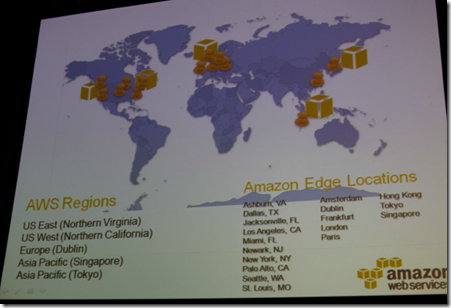
    But, what about AWS's locations in CA?  Does AWS need to severe ties with those sites as well?

    image

    Amazon's Retail business model with customers avoiding sales taxes is an issue that affects Amazon's data center locations which then affects the AWS users as the operation of AWS cannot jeopardize Amazon.com's business model.

    Is AWS's Northern California data centers next on will be spun off?  Ever wonder why Reno is a big distribution center for California?  Because, it is in Nevada along with a bunch of others who don't want to be in California's tax base.

    11 price reductions over 4 years, Amazon Web Service's James Hamilton thoughts on pace of innovation

    James Hamilton is keynoting at SIGMOD Athens and his presentation description has some good ideas to think about.

    Keynote 1: James Hamilton, Amazon Web Services

    Internet Scale Storage

    Abstract

    The pace of innovation in data center design has been rapidly accelerating over the last five years, driven by the mega-service operators. I believe we have seen more infrastructure innovation in the last five years than we did in the previous fifteen. Most very large service operators have teams of experts focused on server design, data center power distribution and redundancy, mechanical designs, real estate acquisition, and network hardware and protocols. At low scale, with only a data or center or two, it would be crazy to have all these full time engineers and specialist focused on infrastructural improvements and expansion. But, at high scale with tens of data centers, it would be crazy not to invest deeply in advancing the state of the art.

    Looking specifically at cloud services, the cost of the infrastructure is the difference between an unsuccessful cloud service and a profitable, self-sustaining business. With continued innovation driving down infrastructure costs, investment capital is available, services can be added and improved, and value can be passed on to customers through price reductions. Amazon Web Services, for example, has had eleven price reductions in four years. I don’t recall that happening in my first twenty years working on enterprise software. It really is an exciting time in our industry.

    Here is anther thing to keep in mind.   From reading this statement it seems Amazon Web Services does not use blades.  If Amazon has determined it shouldn’t use blades why should you?

    · Datacenter Construction Costs

    o Land: <2%

    o Shell: 5 to 9%

    o Architectural: 4 to 7%

    o Mechanical & Electrical: 70 to 85%

    · Summarizing the above list, we get 80% of the costs scaling with power consumption and 10 to 20% scaling with floor space. Reflect on that number and you’ll understand why I think the industry is nuts to be focusing on density. See Why Blade Servers Aren’t the Answer to All Questions for more detail on this point – I think it’s a particularly important one.

    From 2008 James has discussed blades.

    Summary so far: Blade servers allow for very high power density but they cost more than commodity, low power density servers. Why buy blades? They save space and there are legitimate reasons to locate data centers where the floor space is expensive. For those, more density is good. However, very few data center owners with expensive locations are able to credibly explain why all their servers NEED to be there. Many data centers are in poorly chosen locations driven by excessively manual procedures and the human need to see and touch that for which you paid over 100 million dollars. Put your servers where humans don’t want to be. Don’t worry, attrition won’t go up. Servers really don’t care about life style, how good the schools are, and related quality of life issues.

    Here is a simple one liner.

    Density is fine but don’t pay a premium for it unless there is a measurable gain and make sure that the gain can’t be achieved by cheaper means.
    Architecting for Outages, an architect posts on surviving AWS

    Everyone wants to survive a data center outage, but as AWS outage shows, not all do survive.  Here is a post that summarize best practices in SW architecture to survive an outage like AWS.

    Retrospect on recent AWS outage and Resilient Cloud-Based Architecture

    DateThursday, June 9, 2011 at 8:19AM

    A bit over a month ago Amazon experienced its infamous AWS outage in the US East Region. As a cloud evangelist, I was intrigued by the history of the outage as it occurred. There were great posts during and after the outage from those who went down. But more interestingly for me as architect were the detailed posts of those who managed to survive the outage relatively unharmed, such as SimpleGeo, Netflix,SmugMug, SmugMug’s CTO, Twilio, Bizo and others.

    The list of best practices are:

    The main principles, patterns and best practices are:

    • Design for failure
    • Stateless and autonomous services
    • Redundant hot copies spread across zones
    • Spread across several public cloud vendors and/or private cloud
    • Automation and monitoring
    • Avoiding ACID services and leveraging on NoSQL solutions
    • Load balancing

    If this seems daunting, there are new services coming to provide scalability and availability services.

    The emerging solution to this complexity is a new class of application servers that offers to take care of the high availability and scalability concerns of your application, allowing you to focus on your business logic. Forrester calls these "Elastic Application Platforms", and defines them as:

    An application platform that automates elasticity of application transactions, services, and data, delivering high availability and performance using elastic resources.