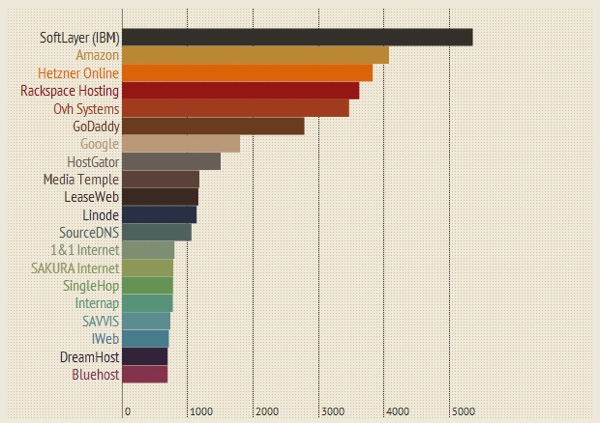
Amazon gets it that inventory should be abstracted to its size to fill space

Almost all the news about Jeff Bezos is the drone for delivering devices.  I am a distribution logistics geek, and what was more interesting to me is how amazon.com understands that utilizing space saves money and time.  In the 60 minutes presentation.

The executives say they can now put twice as much stuff in the space when they allowed the mixing of different skus in the same location.

Twice as much stuff besides taking up less space means there is a sizable time savings in accessing the goods.

The system I worked on at Apple took an order and turned it into the boxes to be shipped, then sort the boxes to be picked easier, and place labels on them.  Box #1 gets the packing list, the rest just get a label.

Amazon shows how they focused on dividing an incoming supply of material into dozens of smaller quantities to be efficiently put in a location.  Think about it if you get 100 books and do things they way most would think you need to put let’s say 20 books on a shelf, then 80 in a box somewhere else.  Amazon takes all 100 books and spreads them, putting them away once in the most efficient place to access them later.

This means all items in amazon.com’s inventory most likely has a universally unique ID.  Besides being efficient, it makes it much easier to catch mistakes.

Flying drones gets the media’s attention.  What got my attention is amazon gets how to manage every single item in its inventory.

Is working in an Amazon Data Center, like working in one of their warehouses?

Working in a data center is not glamorous.  Neither is working in warehouse.  I used to spend lots of times in warehouses at HP and Apple working in logistics.  Big buildings with racks and rack of pallets.  I remember when the Mac 512K was going to be released and people were excited about the product.  I said the Mac 512K is no different than the Mac 128K, same size box, and it weights the same.  All that is different is the sku # and a label.  Many times the servers look like that to people in the data center, it’s another 1U server, what processor it has, RAM, HD, or SSD isn’t that much difference.  How much does it weigh, how much power does it consume.

BBC has a controversial post from a warehouse worker in the UK on the conditions inside the warehouse.

"We are machines, we are robots, we plug our scanner in, we're holding it, but we might as well be plugging it into ourselves", he said.

Prof Marmot, one of Britain's leading experts on stress at work, said the working conditions at the warehouse are "all the bad stuff at once"."We don't think for ourselves, maybe they don't trust us to think for ourselves as human beings, I don't know."

He said: "The characteristics of this type of job, the evidence shows increased risk of mental illness and physical illness."

One of the observations I have made and asked others about. 

“Do you notice that we don’t see people at other data center companies that are ex-Amazon data center staff?"

“We’ll see ex-Microsoft, ex-Google, etc.  But, when was the last time you saw someone who was ex-amazon data center?  Many of us know a person or two who have joined amazon.com and once they are in, they disappear."

One way you could explain is they are so burnt out of working on data centers at amazon.com they don’t want to do it any more.  Maybe the noncompete agreements are too painful.

Any vendor who works on amazon.com projects knows they say nothing about their work for amazon if they want to stay a supplier.  

AWS throws more weight into SSD

Jan 2010 I speculated that SSD’s would be part of AWS.  I was off by when AWS would start using SSD.

When will solid state memory server be an option in AWS instances?

I was having another stimulating conversation in silicon valley last night, and one of the ideas that made sense is for solid state memory servers to be part of the cloud computing option.  It’s just a matter of time.  Amazon has their current instance offerings with a division of performance and memory.

Today AWS announced two more SSD powered services.

One, is a coming soon service I2.

Coming Soon - The I2 Instance Type - High I/O Performance Via SSD

Earlier today, Amazon.com CTO Werner Vogels announced the upcoming I2 instance type from the main stage of AWS re:Invent!

The I2 instances are optimized for high performance random I/O. They are a great fit for transactional systems and NoSQL databases like Cassandra and MongoDB.

The instances use 2.5 GHz intel Xeon E5-2670v2 processors with Turbo mode enabled. They also benefit EC2's new enhanced networking. You will see significantly higher performance (in terms of packets per second), much lower latency, and lower jitter when you launch these instances from within a Virtual Private Cloud (VPC).

We'll be releasing more information at launch time. Here are the basic specs to tide you over until then:

Instance Name vCPU Count RAM 
Instance Storage (SSD)
i2.large 2 15 GiB 1 x 360 GB
i2.xlarge 4 30.5 GiB 1 x 720 GB
i2.2xlarge 8 61 GiB 2 x 720 GB
i2.4xlarge 16 122 GiB 4 x 720 GB
i2.8xlarge 32 244 GiB 8 x 720 GB

The i2.8xlarge instances will be able to deliver 350,000 random read IOPS and 320,000 random write IOPS. Numbers for the other instance types will be proportionally smaller, based on the number of SSD devices associated with the instance.

Stay tuned for more information about the I2 instances.

and EC2 instances with SSD.

A New Generation of EC2 Instances for Compute-Intensive Workloads

Many AWS customers run CPU-bound, compute-intensive workloads on Amazon EC2, often using parallel processing frameworks such as Hadoop to distribute work and collect results. This includes batch data processing, analytics, high-performance scientific computing, 3D rendering, engineering, and simulation.

To date these needs have been met by the existing members of our compute-optimized instance families -- the C1 and CC2 instance types. When compared to EC2's general purpose instance types, the instances in this family have a higher ratio of compute power to memory.

Hello C3
Today we are introducing the C3 family of droids instances. Compared to C1 instances, the C3 instances provide faster processors, approximately double the memory per vCPU and SSD-based instance storage.

As the newest member of our lineup of compute-optimized instances, the C3's were designed to deliver high performance at an economical price. The C3 instances feature per-core performance that bests that provided by any of the other EC2 instance types, at a price-performance ratio that will make them a great fit for many compute-intensive workloads.

Use the Cores
Each virtual core (vCPU) on a C3 instance type is a hardware Hyper-Thread on a 2.8 GHz Intel Xeon E5-2680v2 (Ivy Bridge) processor. There are five members of the C3 family:

Instance Name vCPU Count Total ECU RAM Local Storage Hourly On-Demand
c3.large 2 7 3.75 GiB 2 x 16 GB SSD $0.15
c3.xlarge 4 14 7 GiB 2 x 40 GB SSD $0.30
c3.2xlarge 8 28 15 GiB 2 x 80 GB SSD $0.60
c3.4xlarge 16 55 30 GiB 2 x 160 GB SSD $1.20
c3.8xlarge 32 108 60 GiB 2 x 320 GB SSD $2.40

Protocols
If you launch C3 instances inside of a Virtual Private Cloud and you use an HVM AMI with the proper driver installed, you will also get the benefit of EC2's new enhanced networking. You will see significantly higher performance (in terms of packets per second), much lower latency, and lower jitter.

Getting Technical
As you may have noticed, we are specifying the underlying processor type for new instance types. Armed with this information, you can choose to make use of specialized instructions or to tune your application to exploit other characteristics (e.g. cache behavior) of the actual processor. For example, the processor in the C3 instances supports Intel's AVX (Advanced Vector Extensions) for efficient processing of vector-oriented data in 256-bit chunks.

Some Numbers
In order to measure the real-world performance of the new C3 instances, we launched a 26,496 core cluster and evaluated it against the most recent Top500 scores. This cluster delivered an Rmax of 484.18 teraflops and would land at position 56 in the June 2013 list. Notably, this is over twice the performance of the last cluster that we submitted to Top500. We also built an 8,192 cluster, which delivered an Rmax of 163.9, putting it at position 210 on the Top500 list.

Launch One Now
The C3 instances are available today in the US East (Northern Virginia), US West (Oregon), EU (Ireland), Asia Pacific (Singapore), Asia Pacific (Tokyo), and Asia Pacific (Sydney) Regions. You can choose to launch C3 instances as On-Demand,Reserved Instances, or Spot Instances.

-- Jeff;
Cloud is going to get interesting watching Amazon Web Services compete against IBM

I saw this post that Om Malik reposted.

CIO Magazine: IBM Will Win the War With Amazon

Rob Enderle has been analyst for too long and has mostly been wrong about his favorite target, Apple. And now he has turned his guns on Amazon (Web Services) and points out that IBM is going to win the war with AWS. I think we all have a different definition of winning,  especially considering the troubled cloud effort by IBM. Anyway read the piece, if nothing, for a chuckle!

Talk about two different approaches.  IBM’s business is built on relationships with the CxO to deliver IT services.  Amazon.com is retailer who uses technology the way no other retailer does.  Departments are pulling out their credit cards to use AWS to build IT services that are assumed to be at a lower cost and faster time to market.  In this rush to push out IT services, there are probably many mistakes made from a compliance perspective.  The types of mistakes that can get you fined or in the middle of a lawsuit.

Amazon offsets this by bypassing IT and selling directly to employees. However, IT retains the responsibility for compliance; given enough ammunition, IT generally can block access to any vendor seen as unreliable or unsecure. Expect IBM to start providing IT with the evidence to provide this block and with cost-effective alternatives that IT can use instead.

The CIO article says IBM is ready for a fight.

Don't Bet Against the Old Dog in the Fight

IBM learned early on that fights in any market are often won and lost on perception. The company allocates staff and resource accordingly. In these battles it comes down to who has the most resources and knows the battlefield best. On all vectors, this should be IBM. Amazon may, as the first mover, have the tactical advantage, but IBM has the strategic advantage. At the end of the day, this is IBM's battlefield. It has the best weapons and the appropriate skills.

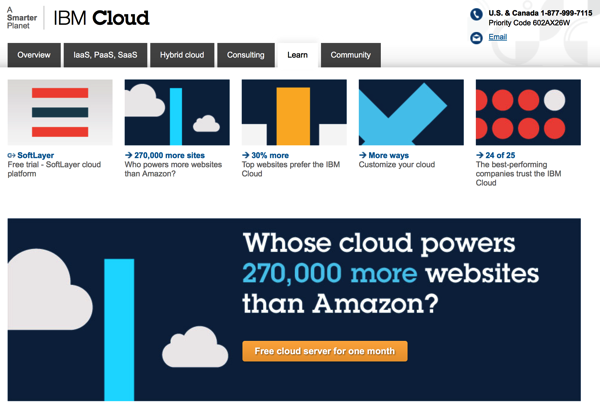
Here is the current state of IBM’s Cloud website. 270,000 more websites than amazon is on IBM’s cloud.

NewImage

NewImage

AWS is not always the right answer for a startup

There is a flawed belief that the Cloud which many times is AWS is the right answer for a startup.  Here is a post friend sent me of someone who went through the numbers and came up with a non-AWS solution.

First, we simply wanted to reduce the number of variables when we needed to troubleshoot this critical layer. For us, audio quality is a top priority, and the fewer layers of virtualization and their parties between us and the user, the better.

Second, and more technically, we were having syncing issues between the time clock on the physical Amazon machines and the time clocks on the OS and virtual layers, which was causing additional delays. Moving to our own physical servers in a data center instantly solved this problem.

Third, the audio/voice layer of our system scales fairly predictably, giving us a fair amount of lead time to order new physical servers. The elasticity of cloud hosting was thus not a priority for us.

Finally, in our own financial analysis we found that when it came to our audio/voice component, our own physical servers would be cheaper than any of the cloud providers we were considering. For our API layer and Web interface, we found the opposite to be true, and so we host these across a few different cloud providers for the sake of redundancy.

That brings up a secondary point: Being open-minded means remembering that it is fine to mix-and-match. Not only is one server solution the best across all startups, it may not even be the best acrossall components of one startup. By thinking of these components’ needs separately, considering all your options, planning for the near future and not for forever, and finding the best fit for you, you can vastly improve the odds that you’ve made a good decision.