Microsoft Embrace, Extend, and Innovate the Data Center Container

DataCenterKnowledge reports on Mike Manos's statement, Microsoft is embracing data centers containers.

The data center container revolution has officially arrived. And Microsoft's cloud computing initiative is driving it.

Microsoft will forego a traditional raised-floor environment in its new data center in Chicago, and will instead fill one floor of the huge facility with up to 220 shipping containers packed with servers, the company said today.

Versus other companies concept demonstrations of data center containers, Microsoft follows its infamous "Embrace, Extend, and Innovate" strategy made public with focus on the Internet in 1994.

In order to build the necessary respect and win the mindshare of the Internet community, I recommend a recipe not unlike the one we’ve used with our TCP/IP efforts: embrace, extend, then innovate. Phase 1 (Embrace): all participants need to establish a solid understanding of the infostructure and the community - determine the needs and the trends of the user base. Only then can we effectively enable Microsoft system products to be great Internet systems. Phase 2 (Extend): establish relationships with the appropriate organizations and corporations with goals similar to ours. Offer well-integrated tools and services compatible with established and popular standards that have been developed in the Internet community. Phase 3 (Innovate): move into a leadership role with new Internet standards as appropriate, enable standard off-the-shelf titles with Internet awareness. Change the rules: Windows Microsoft Data Centers become the next-generation Internet tool of the future.

clip_image002

And the datacenterknowledge article continues

Microsoft is embracing containers as the key to building scalable, energy-efficient cloud computing platforms. The company's bold move is an affirmation of the potential for containers to address the most pressing power, cooling and capacity utilization challenges facing data center operators. The Chicago facility is part of the company’s fleet of next-generation data centers being built to support its Live suite of "software plus services" online applications.

But the design of the Chicago data center will go beyond the optimizations seen in Microsoft’s new facilities in Quincy, Washington and San Antonio.

"The entire first floor of Chicago is going to be containers," Microsoft director of data center services Michael Manos said this morning in his keynote at Data Center World in Las Vegas. "This represents our first container data center. The containers are going to be dropped off and plugged into network cabling and power." The second floor of the immense facility will be a traditional raised-floor data center, Manos said.

"It's a bold step forward," said Manos. "We're trying to address scale with the cloud level services. We were trying to figure the best way to bring capacity online quickly."
Read more

GreenBiz Covers IBM's Green Data Center Announcement

GreenBiz covers IBM's Green Data center with article,

IBM Unveils Austria's First Green Data Center at kika/Leiner

From "Green Philosophy" to "Green IT" at kika/Leiner

March 31, 2008: 05:31 PM EST

IBM (NYSE: IBM) and kika/Leiner today announced the construction of a new energy efficient "green" data center which will reduce electric power consumption by up to 40 percent. The new data center offers kika/Leiner a way to extend their environmental vision beyond traditional business areas.

As kika/Leiner expands throughout central Europe and the Middle East, their need for information technology (IT) services has increased considerably. To meet this demand, the market-leading furniture retailer in Austria turned to IBM to design an energy efficient data center using new "green" technologies that are part of IBM's Project Big Green. The new data center is planned to begin operation in May.

Additional Green Features from IBMs press release:

IBM Unveils Austria's First Green Data Center at kika/Leiner

From "Green Philosophy" to "Green IT" at kika/Leiner

March 31, 2008: 05:31 PM EST

IBM (NYSE: IBM) and kika/Leiner today announced the construction of a new energy efficient "green" data center which will reduce electric power consumption by up to 40 percent. The new data center offers kika/Leiner a way to extend their environmental vision beyond traditional business areas.

As kika/Leiner expands throughout central Europe and the Middle East, their need for information technology (IT) services has increased considerably. To meet this demand, the market-leading furniture retailer in Austria turned to IBM to design an energy efficient data center using new "green" technologies that are part of IBM's Project Big Green. The new data center is planned to begin operation in May.

The building is a free-standing cube with about 1,000 square feet of IT space that fulfils all state-of-the-art technical security requirements of a data center. It is locked, has no windows, is equipped with an automatic fire-extinguishing system, and is protected against flooding. The data center does not contain any working space and entrance is restricted. Free cooling will be used in cold months, meaning the air conditioning for the data center will come directly from the cold outside air. Only on warm days will the data center be automatically cooled.

"kika/Leiner perfectly combines ecology and economy," said Leo Steiner, general manager of IBM Austria. "The additional work and expense for green technology pays off within a few months, and the benefit for the environment pays off from the very first day."

A separate high density computing area ensures the separation of IT equipment with higher or lower heat emissions and optimizes the cooling calculation, capacity and efficiency. This area of the data center features racks with the newest IBM BladeCenter technology. IBM BladeCenter integrates servers, networks, storage and business applications in highly efficient one-inch systems that sit in a rack like books in a shelf. IBM BladeCenter uses up to 24 percent less energy than competitive systems.

IBM Cool Blue technology provides a method to control and monitor BladeCenter power and heat requirements. Hot air from the IT equipment is reduced to room temperature by water-cooled heat exchangers attached to the BladeCenter racks. The high density area covers about a third of the data center IT space and, if required, can be extended. Another third of the data center is space for conventional computing servers with low heat emissions. The last third will remain empty for future expansion.

IBM's partnership with kika/Leiner plays to both companies' beliefs in environmental sustainability. For example, by implementing well-directed lighting and by using energy-saving lights, kika/Leiner managed to reduce its own electric power consumption by 18 percent in Austria in 2007. In new stores in Brünn and Pilsen in the Czech Republic, a completely new lighting concept has been implemented using energy efficient lighting.

Sustainability is paramount to kika/Leiner's "Grüne Linie" (Green Line). Their furniture is made with natural materials and the company provides one of the most distinguished and best known ecological furniture trademarks in Austria. All "Grüne Linie" products are certified with internationally approved environmental seals, including the "Österreichisches Umweltzeichen" (Austrian Environmental Seal of Approval) and the "Europäische Umweltzeichen" (European Environmental Seal of Approval). Consumers are offered more transparency and it also raises the awareness for lasting products. The brand was recently re-launched and is available in 50 kika and Leiner furnishing stores.

Read more

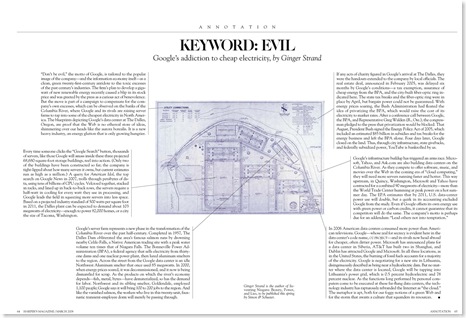
Harper's Magazine- Keyword: Evil, Google's addiction to cheap Electriticity

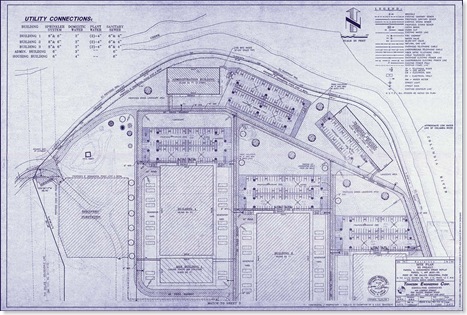
DataCenterKnowledge wrote a post that Harper's Magazine has published a copy of the site plan for Google's data center in The Dalles, OR.

The Dalles

Google The Dalles

In reading the Harper's article (which isn't totally accurate), I was curious what motivated the writer to write and use Keyword Evil Google in her title.  It turns out the Author Ginger Strand lists her obsession as Hydroinfrastructure.  And, she is about to publish a book Inventing Niagara: Beauty, Power, and Lies.

Most of us take infrastructure for granted but we shouldn't; it tells us a lot about ourselves. The massive investment in designing, building and maintaining infrastructure is one of a society's most utopian actions: through it we seek to remake the world. Hydroinfrastructure, for example, shows our conviction that the perfect world has easy access to cold drinks and hot showers. It also links country and city through the flow of one of earth's most elemental substances, demonstrating that the worlds of “nature" and “culture" are not as separate as we often believe.

A great book on infrastructure generally is Infrastructure: The Book of Everything for the Industrial Landscape by Brian Hayes.

I looked up the book she references and it looks like an interesting read.

Read more

Google Demolishes Presbyterian Church, do no evil?

InformationWeek has a picture gallery of Google's data center construction in Council Bluffs, Iowa.  One interesting picture for company with the motto of do no evil is below where a Presbyterian Church will be demolished as part of the construction.  A funny point made by one blogger is do no evil  is an anagram for o no devil seems to be appropriate.

Nearby Presbyterian Church will be demolished.

Photo Gallery: Google's Iowa Data Center Emerges

Nearby Presbyterian Church will be demolished.

Photograph by Joshua White/The Daily Nonpareil

For the curious, the reporter also has pictures of the Google The Dalles facility.

Read more

Cool It! Data Centres writes Economist.com

A good friend, Joe Ternasky sent me the link to this Economist article. This article should work well to get the attention of CxOs.

The data centres that power the internet demand a lot of power. Time, then, to make them more efficient

Google

AS ONE industry falls, another rises. The banks of the Columbia River in Oregon used to be lined with aluminium smelters. Now they are starting to house what might, for want of a better phrase, be called data smelters. The largest has been installed by Google in a city called The Dalles. Microsoft and Yahoo! are not far behind. Google's plant consumes as much power as a town of 200,000 people. And that is why it is there in the first place. The cheap hydroelectricity provided by the Columbia River, which once split apart aluminium oxide in order to supply the world with soft-drinks cans and milk-bottle tops, is now being used to shuffle and store masses of information. Computing is an energy-intensive industry. And the world's biggest internet companies are huge energy consumers—so big that they are contemplating some serious re-engineering in order to curb their demand.

The traditional way of building data centres such as Google's is to link clusters of off-the-shelf server computers together in racks. Hundreds, even thousands, of such servers can be combined to achieve the sort of arithmetical horsepower more usually associated with a supercomputer. But the servers all require energy, of course, and so do the electronic links that enable them to work together. On top of that, once the energy has been used it emerges as heat. The advanced cooling systems required to get rid of this heat demand the consumption of more power still.

All of which is expensive. Though the price of computer hardware continues to plunge, the price of energy has been increasing. The result is that the lifetime cost of running a server now greatly outstrips the cost of buying it. A number of researchers are therefore looking for ways to operate big computer centres like the one at The Dalles more efficiently.

The article continues and discusses energy efficient designs by Lawrence Berkeley National Labs, and IBM.

But, one of the main things this article draws attention to is the point,it is time to make these data centres more energy efficient (greener).  Do you hear the sound of gov't regulation coming?  And, the programs are going to be based on the amount of power you consume, not necessarily the price of your power.  So, even though companies have done like Google, Microsoft, and Yahoo move to cheap power, and economically they have side-stepped the issue of power costs, gov'ts could still require energy savings programs be put in place.  And once this starts you need a conformance system to validate your results, and now you are in EPA type of audit situation.

Read more