Green Data Center Discussion with Ex-Cisco Director WW Real Estate

Had a chance to talk to an old acquaintance, Chris Hampton who gets the issues for a Green Data Center.  Chris was at Cisco for 14 years with his last job as Director of WW Real Estate development. First hand Chris knows what it is like to develop challenging infrastructures facilities in India and China as he was based for a period in Hong Kong, heading up Cisco's Asia building development. Cisco in general owns its buildings, and given its heavy IT use, many facilities had a sizeable IT equipment footprint. It was fun discussing the issues people need to understand and the challenges to get facilities for a sustainable solution.

In our facilities discussion, we got into issues like people rarely think about water use. Chris used as an example he knows water was needed for the cooling chillers, but he had no idea on what the water usage is of the chillers as a percentage of total water use at a facilities, but he should. Interestingly, we both knew of the guys at http://www.weathertrak.com/index.php who provide smart water management solutions, and how their system could give him this information.

image

One of the best things I got out of the conversation with Chris is the need for people to think about ResEx, Resource Expenditures in the same way at Capex and Opex. This is another idea I'll work on writing for a publication as it makes a lot of sense that to go Green people need to think about resource (electricity and water) usage in the same way they think about capital and operating. ResEx is not a known term for the industry, and search doesn't have worthwhile results. The popularity of the ResEx term will be an interesting way to measure whether people are thinking about resource use.

Read more

Digital Realty Trust gets LEED Gold,transforming a 90 old print plant to a Green Data Center

ComputerWorld reports on Digital Realty Trust achieving LEED Gold certification for Data Center upgrade.

Upgrading older hardware with energy-efficient components is an arguably green business choice: By extending the life of your machines rather than trading them in for brand-new ones, you reduce the world's e-waste pile -- while saving yourself some cash. Digital Realty Trust Inc., which owns, acquires and manages technology-related real estate worldwide, took that philosophy a step further. The company transformed part of a 90-year-old printing plant in Chicago into the world's first LEED (Leadership in Energy and Environmental Design) gold-certified data center.

"This project shatters the myth that LEED certification can only be achieved within newer facilities," says Jim Smith, vice president of engineering at Digital Realty.

And, passes on a best practice on monitoring the data center.

Measurements are key

Features of this project include sophisticated tools for measuring energy consumption. "These are not expensive, but they provide critical data that let you understand what is happening in the data center. Every data center should have this, particularly since it is such a small investment and provides such valuable information," Smith said. "Step 1 for energy-efficient operations is always to have a way to measure."

There are also tools outside the facility to monitor the air temperature. "The equipment makes sure the air is clean and helps us improve performance of the ventilation system and improve indoor air quality," he said.

Read more

ComputerWorld Writes on Containers Reshaping IT

ComputerWorld's Eric Lai and Patrick Thibodeau write an article on Container-based systems reshaping IT. ComputerWorld did a thorough job researching this article talking to Microsoft, Gartner, customers, consultants, and suppliers. Personally, I am pleased with what ComputerWorld put together as I spent a couple of hours on the phone with one of the writers adding my opinion to the mix. Given the tone and research of the article, I would expect ComputerWorld to write more on this topic.

I will add this article as a 3 week follow up to the Press and Blog Coverage of Mike Manos's AFCOM keynote and create another PDF showing the mindmap.

Building-block data centers may reshape IT

Container-based systems and other modular data center technologies might help drive a shift to online 'compute clouds.' But that could leave the futures of some IT workers in a fog.

April 21, 2008 (Computerworld) A major transformation in the way that large data centers are built is under way, and the expected changes may have as much impact on IT productivity as the adoption of shipping containers did on operations in the freight industry starting in the late 1950s.

At that time, the shift from putting cargo on individual pallets to packing goods into much larger containers enabled shippers to load and unload vessels exponentially faster, with less labor. Now a similar transition is taking place in some data centers, via the use of container-based systems and other modular technologies.

Advocates say that replacing conventional racks of servers with systems built into shipping containers that can be rolled right into buildings will make it easier to set up data centers and add more processing power as needed. It also could pave the way for expanding the use of "compute clouds" to deliver online IT services -- a development that might result in big changes within corporate IT departments.

Microsoft Corp. is one of the trailblazers of the containerized IT movement. In a suburb of Chicago, the software vendor is building a $500 million, 500,000-square-foot data center that will hold up to 220 shipping containers. Each will arrive preconfigured with racks containing as many as 2,000 servers, along with networking and power-distribution equipment to facilitate the setup process.

Michael Manos, Microsoft's senior director of data center services, said the Lego-like approach being used at the new facility in Northlake, Ill., will help shake up a part of IT that's in need of some change. "Data centers are typically very conservative," Manos said. "If you look at a data center built a year ago and one built 10 years ago, they look very similar."

Consulting firm Gartner Inc. says that building-block designs such as the one Microsoft is implementing will lead to the "industrialization" of IT within megasize data centers. According to Gartner, such facilities will be able to provide the technical infrastructure needed to support compute clouds that can scale on demand as the use of Internet-based application services grows. In fact, Microsoft plans to use the Northlake facility to help meet the processing demands that its Windows Live and Office Live online services are expected to generate.

Read more

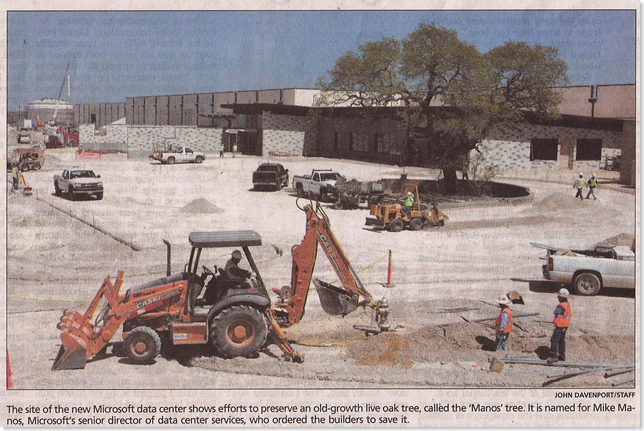
The Manos Tree at Microsoft's San Antonio Data Center

San Antonio Express has an article about Microsoft's Data Center in San Antonio, Model of Efficiency, and tells the story of the Manos Tree.

A lone oak in front of Microsoft's massive new data center in Westover Hills symbolizes the technology company's efforts at green business practices.

It's called the "Manos" tree, named for Mike Manos, Microsoft's senior director of data center services. He ordered Turner Construction, the facility's builders, to save it.

"Microsoft made a commitment to save and preserve the old-growth live oak trees," Manos said. "For the most part, in the area where we constructed the data center, there wasn't any old-growth oaks except for one — dead center in the middle of the construction project."

So Turner's workers built the building around the tree, which covers about as much ground as a sandbox, even putting up concrete barriers at times to save it. They also successfully saved dozens of old oak trees on the perimeter of the 44-acre site. Those trees will help shade the 470,000-square-foot building and reduce cooling costs.
image 

Other Green features mentioned in the article are:

Microsoft's mammoth building looks like a mirror image of its first built-to-suit data center in Quincy, Wash., but it has a lot of incremental improvements over that facility simply because Microsoft has learned through the process how to design the center more efficiently, Manos said. Those improvements include the ways the servers are laid out in the rooms, the lighting in the building and other materials used for construction.

In addition to the conservation of trees, Microsoft has other green initiatives under way, such as plans to use an estimated 6 million to 8 million gallons a month of gray water or recycled water from the San Antonio Water System.

. To create a green data center, Microsoft must run its business efficiently, Manos said.

"When you think about the data center, the big white elephant in the room is the use of power in the data center itself," Manos said. Microsoft says its San Antonio center is the most energy-efficient data center yet. It plans to improve on energy efficiency through the use of high-efficiency servers and power systems. The company also has worked to maximize the efficiency of its cooling systems.

"Every drop of electricity is being utilized in the most significant way," Manos said.

And other data centers are following Microsoft to San Antonio. As Microsoft adds Green data center features like gray water/recycled water cooling systems, others are asked to follow.

Other San Antonio companies with major data centers also have focused on green business practices.

CityNap bills itself as a 100 percent green data center because it buys all of its electricity from CPS Energy's Windtricity program. Rackspace, a Web-hosting company, is moving into new headquarters at the Windsor Park Mall and has undertaken a number of green initiatives as part of that relocation.

Since Microsoft announced its project in January 2007, four other data center projects have announced projects, and Hernandez expects more announcements shortly. He is working with eight more data center prospects.

San Antonio's inexpensive power, excellent telecommunications infrastructure, recycled water program and a stable environment appeals to Microsoft and other technology companies, said Mario Hernandez, president of the San Antonio Economic Development Foundation.

"When you're touted as one of the premier sites for data centers, it sends a message to other companies," Hernandez said. He just got back from meeting with high-tech companies in Los Angeles and San Francisco that wanted to know more about San Antonio's data center industry.

front page picture

Read more

InformationWeek: Microsoft's CBlox, Container Data Center

InformationWeek has an interview with Microsoft's Mike Manos on containerized data centers with CBlox.

Microsoft To Mainstream Containerized Data Centers With C-Blox

The server-packed shipping units allow Microsoft to run its entire $500 million Northlake facility with a continuous staff of little more than 20 or 30 employees.

By J. Nicholas Hoover
InformationWeek
April 8, 2008 05:07 PM

For all the talk Sun Microsystems (NSDQ: JAVA) and Rackable raised about building data centers from stacks of shipping containers, another company, Microsoft (NSDQ: MSFT), is finally delivering one of the first real case studies by building a container-based data center itself.

Several companies have come out with containerized data center products, including Sun's MD S20 (formerly known as Project Blackbox), Rackable's Integrated Concerto Environment Cube (ICE Cube), and Verari's Forest. These have been largely marketed as products suited for portable data center needs and disaster recovery and as additions to existing data centers, but Microsoft is taking a more comprehensive approach.

The first floor of Microsoft's $500 million Northlake, Ill., data center, which is currently under construction, will house between 150 and 220 industry-standard 40-foot shipping containers holding between 1,000 and 2,000 physical servers apiece, or somewhere between 150,000 and 440,000 servers in total. According to Microsoft general manager of data center services Michael Manos, that's as many as 11 times the number of servers a conventional data center that size would have.

"We really look at containers as an opportunity to increase scale and drive even more efficiency into our data centers," Manos said in an interview. "We've upped the unit of storage from one server to a rack of servers to a container."

Microsoft has developed its own specifications that include, for example, configuration for electrical components and the layout of physical servers, for its containers. Those specs make Microsoft's containers different from anything on the market today, and a potential opportunity for future Microsoft products. The containers, which Microsoft calls C-blox, are largely self-contained and will require very little hands-on maintenance.

Microsoft has the PR momentum.  Part of Mike's presentation at AFCOM/Data Center World is the problem with hoarding of information limiting the innovation in data center energy efficiency.

It will be interesting as other companies step up their efforts, and whether they share information. Yahoo is presenting at Uptime Institute's Symposium 2008. Google??? 

Read more