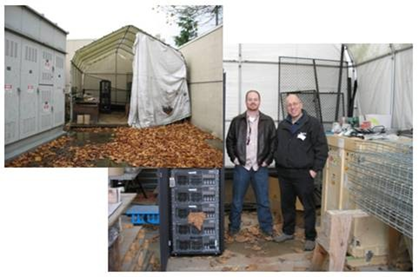
Skanska’s Green Data Center Project

DataCenterKnowledge covers Skanska’s green data center project.

Skanska Hired for $150M Data Center Project

October 20th, 2008 : Rich Miller

Skanska says it has been awarded the construction management assignment for a new, $150 million data center project in the western U.S. for “one of the largest companies in Internet trading.” The facility will be approximately 19,000 square meters, or about 204,000 square feet. Construction has begun and is scheduled for completion in May 2010, according to Skanska, which said its focus on energy efficiency was “decisive” in its selection.

“We have focused on developing our expertise within Green Construction,” says Mike McNally, President, Skanska USA Building. “Our green solution benefits us, the customer and the environment. We strengthen competitiveness for both parties while at the same time reducing environmental impact.”

Skanska is one of the world’s leading construction groups with expertise in construction, development of commercial and residential projects and public-private partnerships. Skanska USA is based in Parsippany, New Jersey and has approximately 4,000 employees.

The original press release is here.

Energy efficient solutions that reduce the emission of greenhouse gases were decisive in selecting Skanska for implementing the project. Skanska has developed a total solution that reduces energy costs for operation and cooling of the facility by up to 60 percent compared with traditional technology.

Read more

Deutsche Bank CIO Prioritizes Facilities Changes, Reduces Energy Costs by 25 - 35%

Deutsche Bank (NYSE:DB), Juan Caballero,VP of IT Infrastructure and Skanska Mission Critical (data center construction/services) gave a joint presentation at Data Center Dynamics Seattle on "The Ultimate Green Move, Fix What you have first".  ZERODOWNTIME magazine followed up with a print article with more details.

Robert Bellantoni, Director of Energy Services - Skanska Mission Critical

It’s not all about new product implementation in the energy efficiency race. Following a very well received presentation at the DatacenterDynamics Seattle conference in August, we asked Bob Bellantoni, Director of Energy Services for Skanska Inc. to expand on their “Fix First” concept.

In response to soaring energy costs and the immediate demands to reduce carbon emissions the Skanska Mission Critical team recently developed and deployed a Data Center Optimization (DCO) program focusing on a ”low tech” approach which is providing immediate improvement of DC efficiency and reduced operational cost.


The “Fix First” concept is based on the needs of current legacy data centers to make immediate and necessary improvements in their operational efficiency without costly retrofit, redesign or timely rebuilding options.


“The fastest way to needed improvement is often apparent and can usually be fixed with minimum cost,” says Bellantoni. “We conduct a physical audit of the as built state of their current cabinets and rack installation. Most legacy data centers are in a ‘mid-life crisis’ mode as a result of an aging design that may have been the bestof- breed at the time, but did not take critical efficiency and rising operating costs into consideration when creating the original design model.”

In the midst of the US Financial crises it is a smart move for Deutsche Bank to improve its PUE by lowering optimizing its existing power and cooling infrastructure early in its effort to green its data center.

image

I am amazed at how much money people will throw money at virtualization projects yet they have no funds allocated to improving the energy efficiency of their data centers.

Skanska and Turner Construction have been listed as top Green building contractors, but it is surprising Skanska has a group that will Green Legacy Data Centers as an alternative to building new ones.

Part of the bag of Tools Bob uses is thermal imaging derived from military applications to identify and document heat loses. How good are these thermal imaging devices? I found this youtube video showing heat detected from the stretching of a rubber band.  Pretty cool, no hot.

Read more

Data Center Tents, Microsoft's Cooling Experiment

Christian Belady has a new post on Intense Computing  or In Tents Computing.

Intense Computing or In Tents Computing?
Introduction

Now that we have introduced you to the concept of Power Usage Effectiveness (PUE) and provided a mechanism to calculate this value, I wanted to talk about an idea that may be considered extreme. But just as the extreme nature of Formula One technology eventually ends up in a Ford Focus (and, as I discovered while commuting to campus the other day, so does the driver!), maybe what we are discussing could one day be a feature of a data center near you.

The Challenge—Achieving the Power of One

The central premise of this post is what would a data center look like with a PUE of 1.0? A PUE of 1.0 essentially means that all the power consumed in the data center generates compute operations and there is no additional cooling or power overhead. OK, so we would have to turn off the techies’ coffee machine (or maybe attach a USB-powered one to a customer’s server. Only joking, some people would call that gaming the metric!)

image

And, Christian closes with qualifier of Microsoft's intent.

In summary, my point is not that we should rush out and build all our data centers under canvas (although I would love to watch Mike Manos’s face if someone did propose putting all the Microsoft data centers into tents). However, I think we should continue to research how we can deploy ultra low cost, power-efficient infrastructure in situations where it makes sense. Areas that would be particularly appropriate are where applications are more resilient to failure and organizations can tolerate minor outages.

We aren’t the only ones working on this approach. You might want to take a look the work that Intel started at the same time as us, here:http://weblog.infoworld.com/sustainableit/archives/2008/09/intel_air_side.html.

I leave it to you to think about where this option could make sense. Our team has already committed itself to investigate these possibilities.

Can Microsoft patent a data center tent?

Read more

Google’s Floating Data Center Ability to Survive a Hurricane? Move it

DataCenterKnowledge points to ZDNet’s Larry Dignan in technical and economic discussion of Google’s floating data center.


Google’s design for floating data centers, described in a patent application, addresses many of the cost issues that make operating a data center so expensive. In Google’s concept, the ocean would provide most of the energy to power and cool the servers and equipment, while also eliminating expenses for real estate and property taxes. As Larry Dignan points out, the design addresses many of the budget-busting features of the modern data center. ”I’d call it brilliant engineering, but the financial engineering could be even more impressive,” Larry writes.

And Rich brings up a good issue of disaster survival.

Would a Google data barge be able to weather a hurricane? Or a tsunami? In the past two weeks hurricanes have struck both the Gulf and Atantic coasts of the U.S., and Hurricane Ike is on track to threaten the western Gulf later this week. At first glance, the Google data barges seem even more exposed than the data center cargo shipsproposed by IDC, which would be docked in harbors. 

The simple answer is to move it. Microsoft could also do the same thing for containers in a data center for a Tornado.  Based on conversations with Google guys who are smart and economically aware, my assumption is they made the tradeoff design decisions and designing in survivability for a Hurricane is not money well spent.

The filing also cites the mobile nature of the floating data center (and particularly the data center containers) as an advantage over traditional data centers. Google notes that “the mooring fields may be moved, such as when demand for computing or telecommunications power moves, when sea conditions change (e.g., seasonally) or when a time period for legal occupation of an area expires.”

Read more

WSJ Cutting Tech’s Energy Bill - IBM, HP, EMC

WSJ has an article on Computing Makers seeing Green (money) in Retooling Client’s Data Centers. Let’s start with the highlights form big names.

IBM surprised Wall Street this year when it said its new "Green Data-Center Services" business -- which redesigns customers' data centers and sells energy-efficient products -- signed $300 million in orders in the 2007 fourth quarter.

IBM Chief Executive Samuel Palmisano recently told analysts that IBM expects more than 70% of the world's biggest companies "will modify their data centers significantly in the next five years" to deal with energy shortfalls and rising costs.

H-P last November bought EYP Mission Critical Facilities Inc., a 350-person engineering firm that specializes in designing data centers. EYP President Rick Einhorn says that while energy efficiency used to be an afterthought when customers requested quotes, today "every request we see has a requirement for energy-efficient design."

Savings can be significant. EMC Corp., a Hopkinton, Mass., provider of storage systems that also has an energy-consulting business, redesigned its own computer rooms to eliminate unneeded equipment and use air-conditioning more efficiently. EMC projects that over three years it will avoid $4 million in costs of energy and expanded floor space.

Virtualization is covered.

Virtualization software is another big trend in power-efficient computing. In the past, companies used a separate physical server for every software application. Frequently, each ran at only 10% of its capacity, while using a full load of electricity. With virtualization, many jobs can be run on a single computer using more of its capacity, which cuts power needs.

Albert Esser, head of power and infrastructure solutions at Dell, says that advising customers how to cut power use through virtualization is an increasingly important part of Dell's $6 billion-a-year services business. He declined to disclose specific amounts.

EMC's VMware Corp., the biggest maker of virtualization software, says that a company that virtualizes 100 servers to run on 20 physical servers can save nearly $67,000 a year in energy costs.

And a small world connection. In the WSJ article Citigroup is mentionedfor its Frankfurt green data center.

Citigroup Inc. is scaling down to 14 major data centers from 52. The financial giant has been building so-called green data centers, including one in Frankfurt, Germany, with an earth-topped, green roof and exterior wall planted with sedum, a dense, succulent plant that retains cooling water in its leaves, shielding the building from the sun's rays and reducing the need for air conditioning.

I blogged about the Citigroup effort back in Dec 10, 2007 identifying the work by Harvey Cobbold.

A group of us had the pleasure of having Harvey Cobbold who is responsible for Citi's Data Center construction on our Green Data Center panel discussion at IT Forum. Behind the scenes of any Green PR release is a team of people who have been working on the project for years. These are the people who are now being recognized by their companies and industry as doing the right thing for the environment.  Great Job Harvey!!!

Read more