InformationWeek: Microsoft's CBlox, Container Data Center

InformationWeek has an interview with Microsoft's Mike Manos on containerized data centers with CBlox.

Microsoft To Mainstream Containerized Data Centers With C-Blox

The server-packed shipping units allow Microsoft to run its entire $500 million Northlake facility with a continuous staff of little more than 20 or 30 employees.

By J. Nicholas Hoover
InformationWeek
April 8, 2008 05:07 PM

For all the talk Sun Microsystems (NSDQ: JAVA) and Rackable raised about building data centers from stacks of shipping containers, another company, Microsoft (NSDQ: MSFT), is finally delivering one of the first real case studies by building a container-based data center itself.

Several companies have come out with containerized data center products, including Sun's MD S20 (formerly known as Project Blackbox), Rackable's Integrated Concerto Environment Cube (ICE Cube), and Verari's Forest. These have been largely marketed as products suited for portable data center needs and disaster recovery and as additions to existing data centers, but Microsoft is taking a more comprehensive approach.

The first floor of Microsoft's $500 million Northlake, Ill., data center, which is currently under construction, will house between 150 and 220 industry-standard 40-foot shipping containers holding between 1,000 and 2,000 physical servers apiece, or somewhere between 150,000 and 440,000 servers in total. According to Microsoft general manager of data center services Michael Manos, that's as many as 11 times the number of servers a conventional data center that size would have.

"We really look at containers as an opportunity to increase scale and drive even more efficiency into our data centers," Manos said in an interview. "We've upped the unit of storage from one server to a rack of servers to a container."

Microsoft has developed its own specifications that include, for example, configuration for electrical components and the layout of physical servers, for its containers. Those specs make Microsoft's containers different from anything on the market today, and a potential opportunity for future Microsoft products. The containers, which Microsoft calls C-blox, are largely self-contained and will require very little hands-on maintenance.

Microsoft has the PR momentum.  Part of Mike's presentation at AFCOM/Data Center World is the problem with hoarding of information limiting the innovation in data center energy efficiency.

It will be interesting as other companies step up their efforts, and whether they share information. Yahoo is presenting at Uptime Institute's Symposium 2008. Google??? 

Read more

Press and Blog Analysis of Mike Manos's AFCOM keynote

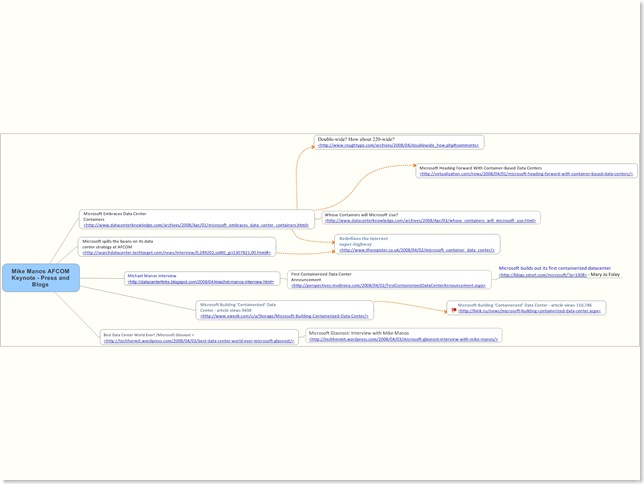
Microsoft's Mike Manos made an amazing presentation at AFCOM's Data Center World, and it was the buzz of the show.  It was fun watching the news spread and the various things written by press and bloggers. I decided to build a relationship mindmap to track the relationships.  DataCenterKnowledge, SearchDataCenter, and DataCenterLinks should be particularly interested in the relationships.

A pdf of the image below is hereDownload mike_manos_afcom_keynote_press_and_blogs.pdf .

DatacenterKnowledge, SearchDataCenter, DataCenterLinks, and EWeek had original reporting which were picked up by others.

DataCenterKnowledge has the widest reference and was picked up by the The Register http://www.theregister.co.uk/2008/04/02/microsoft_container_data_center/.  The Register had a home page placement (see attached pdf www.theregister.co.pdf) with an upper left corner placement, and an attention getting graphic and title.

clip_image002Microsoft meths up data center with 220 containers, Redefines the internet superhighway

John Rath’s DataCenter Links interview with Mike was picked up by MS’s James Hamilton and then Mary Jo Foley read James post, creating her own posting http://blogs.zdnet.com/microsoft/?p=1308 with placement on the news zdnet home page (See attached pdf news.zdnet.pdf)

EWeek had reported on Mike’s keynote http://blogs.zdnet.com/microsoft/?p=1308  and had 9,438 article views. Bink.nu picked up on the eWeek article and posted their own entry http://bink.nu/news/microsoft-building-containerized-data-center.aspx.  The Bink.nu article has 110,786 article views.

Mike Manos AFCOM Keynote - Press and Blogs

Read more

35 employees per Data Center for Microsoft's latest construction vs. Google's 200

In eWeek's interview with Microsoft's Mike Manos, says 35 employees per data center.

The Chicago-area data center is expected to be completed later in the summer of 2008, as are the other three data centers. Each center will employ about 35 people on a 24/7 basis, Manos said.

What is up with Google's 200 employees per data center:

  1. Are they doing this to meet local employment commitments?
  2. Are their data centers higher maintenance than what Microsoft builds?
  3. Are they making up the #'s to fool the rest of us?

Most of us are stumped how and why Google needs so many employees in its data centers.

Read more

Microsoft meths up data center with 220 containers, redefines the internet super-highway

This is interestiing to watch how Microsoft is gaining positive PR in talking about its data centers.  In less than 24 hours, of Mike Manos's keynote he is picked up by data center bloggers, and now The Register writes on this (using Meths to get the attention of its readers) and has the article on the home page is in top left position referring to DataCenterKnowledge and SearchDataCenter.com posts.

The Register ®

image Microsoft meths up data center with 220 containers, Redefines the internet super-highway

Crack open the Natty Light. Microsoft plans to throw a white trash data center rager in Chicago.

Microsoft will cram between 150 and 220 shipping containers filled with data center gear into a new 500,000 square foot facility. This move marks the most significant, public use of the shipping container systems popularized by the likes of Sun Microsystems and Rackable Systems to date.

Microsoft's data center services director Michael Manos revealed the grand plans during a speech at the Data Center World conference in Las Vegas. Fittingly, Data Center Knowledge appears to have grabbed the news first, celebrating Microsoft's ways as the dawn of a new era in compartmentalized, utility computing.

"The entire first floor of Chicago is going to be containers," Manos said. "This represents our first container data center. The containers are going to be dropped off and plugged into network cabling and power.

"It's a bold step forward. We're trying to address scale with the cloud level services. We were trying to figure the best way to bring capacity online quickly."

The second level of Microsoft's data center will stick with the raised floors of yesteryear.

This huge data center build out will aid Microsoft's web-based software delivery efforts. And so the internet super-highway will actually arrive via the physical highway, as Microsoft will rely on large trucks to bring in the gear.

The company has set up a number of centers around the country for similar purposes and is in an arms race of sorts with Google.

Sun and Rackable would appear the most likely suppliers of Microsoft's containers, which we've dubbed white trash data centers much to the chagrin of five Register readers. (This is not a racial slur against white folk but rather an embrace of the Southern, food stamp culture your reporter shares with trailerized people.)

As we read the tea leaves, Sun stands out as Microsoft's data center dealer. That's because Rackable earlier this year said that it only expected to ship between 20 and 50 data center containers in 2008. Surely, the company, already a big hardware supplier to Microsoft, would have tried to show off had it won a 150 container deal.

The containers could afford Microsoft some internal billing and measurement wonderment, according to Manos.

"We're looking at using containers inside our future data centers," he told SearchDataCenter.com. "One of the things we like about them is we can take a bunch of servers and look at the output of that box and look at the power it draws. At the end of the day, we can determine, 'What is the IT productivity of that unit? How many search queries were executed per box? How many emails sent or stored?' You can get into some really interesting metrics. A lot of people say you can't look at the productivity of a data center, but if you compartmentalize it - not as small as the server level, but at some chunk in between - you can measure productivity.

"The data center is a utility function. Everyone uses the common resources without a real understanding of the business impact. I read an article recently that said 30% of IT professionals don't believe power is a challenge, and they're wrong. It's a large component of the operating expenses to running the business. Most of these people aren't exposed to the power bill -- they just don't have the data. If you don't expose how much it costs you to run those facilities, they can't manage to a problem they don't know they have yet. Even if you have a fairly rudimentary chargeback model, once you start measuring it, you can find better ways to measure. I fundamentally believe chargeback has had an effect on Microsoft."

With Yahoo's and Dell's presentation at the Uptime Institute Symposium along with Microsoft, it should be an interesting to watch them maneuver.  Google guys have got to be thinking more about this.

Keynotes will include Microsoft’s chief of data centers, Michael Manos; Dell’s vice president of data center infrastructure, Dr. Albert Esser; and Yahoo’s director of climate and energy strategy, Christina Page, as well as top computing executives from IBM, Intel, Sun Microsystems, VMWare and APC.

Read more

Data Center Container Makes PUE and other performance metrics easy to measure

Nicholas Carr's Rough Type blog jokes about Microsoft's container data centers being a trailer park.  But, he appends his blog later quoting the searchdatacenter interview with Mike Manos and Christian Belady.

UPDATE: There's more on the data center philosophy of the 'Soft Boys in this interview with Manos and one of his colleagues. On the attraction of containers: "One of the things we like about them is we can take a bunch of servers and look at the output of that box and look at the power it draws. At the end of the day, we can determine, 'What is the IT productivity of that unit? How many search queries were executed per box? How many emails sent or stored?' You can get into some really interesting metrics. A lot of people say you can't look at the productivity of a data center, but if you compartmentalize it - not as small as the server level, but at some chunk in between - you can measure productivity."

This is one advantage Microsoft will gain from going down the path of containers in that it will be easy for them to use the containers as a unit of measure for PUE and compute capability metrics. As they update the hardware in a container, they will be able to make comparisons between versions. They will now have 220 possible mini data centers (containers) to experiment on what are the right combinations - storage, memory, processors (AMD/intel), SSD, network configurations, power systems, etc. This is going to let them experiment and have a standard unit of comparison.  This is innovative.

Read more