HP’s POD – Container Data Center

GigaOM has a post on the HP POD (Performance Optimized Data Center) – the Container Data Center.


Exclusive: First Look Inside the HP POD Data Centers
Stacey Higginbotham, Friday, September 26, 2008 at 6:17 PM PTComments (2)

I traveled down to Houston today to check out a data center geek’s version of paradise — the inside of the factory where HP builds their rack-mounted servers and high-value blade systems. I shot plenty of photos that show how a bunch of chips and boards gets assembled into a blade that I will put in a later post, but I also got to take a tour of the inside of HP’s containerized data center, known as a POD. “Tour” isn’t really the right word, since it’s hard to move around inside the 40-foot shipping container filled with racks, but it was pretty sweet to see all that processing power in one place.

Here is the video
2,000 servers in the container.  Does this sound like this container is on its way to Microsoft’s Chicago Container data center?
Read more

Another Company Seriously Evaluating Container Data Center

I met some folks at http://www.continuitysa.co.za/ who have been using shipping containers for years for data centers in South Africa.

image

Mobile Data Centre

The ContinuitySA Mobile Data Centre is a new and dynamic product that will mitigate a number of classic Data Centre hazards.

Each Mobile Data Centre is fully equipped with UPS units and Backup Diesel Generators. Key features of the Mobile Data Centre :

• RAPID IMPLEMENTATION.
• RELATIVELY LOST COST.
• TOTALLY CUSTOMISABLE.
• EASILY CONNECTABLE.
• SELF-CONTAINED AND MOBILE.
• SUPPLEMENTS EXISTING BCM STRATEGY.

Recently, I met an oil and gas company who is seriously evaluating the container data centers from Verari, Dell, HP, and Sun to build data center capacity quickly and cost effective for their clients. I haven't had a chance to to clear any discussion of what they are doing with their PR team, but it was interesting their excitement to use containers.

In the past there has been a huge focus on data centers for financial, but as we all know it is no longer popular to say "I work in the Financial Market." Energy (oil, gas, renewable) is the hot area, and needs compute resources to be deployed quickly.  Repeated words I heard were scalable, modular, quick deployment, and cost effective.

I'll keep my fingers crossed the PR group let's me say more.

Read more

Microsoft’s Container Data Center Changing the Game

As Microsoft gets closer to bringing its Chicago Data Center container on line, and deploys more server containers than are used by they rest of world.  I started speculating on possible outcome as almost all the large server OEMs prepare containers of servers.  Here are a few thoughts on the subject.

  • In the past you bought a server, installed it in a rack.  You could buy a rack full of servers.  But, now you can buy a container full of servers all configure with the exact amount of power and cooling infrastructure required for the servers in the container.
  • A large portion of the power and cooling infrastructure have been packaged with the server container.  The server power and cooling infrastructure is now encapsulated as part of the container.
  • It should be much easier to deliver a power and cooling optimized environment for a container, than a typical white space.  Vendors can make the economic trade-offs of performance in all kinds areas to squeeze the best use of power and cooling energy.
  • Designs can be optimized for different costs data center CAPex costs and OPex costs.  And, could be part of the selection criteria.  Makes sense to pay more for a higher efficiency container if you higher power costs.
  • Microsoft’s strategy of having multiple servers OEMs bid on containers plays to this advantage.  And, is a disadvantage for Google as they would have built the container all on their own and kept the IP.  Which could explain Google’s decisions not to use containers. 
  • Google thinks they are smarter than the server OEMs. 
  • Microsoft thinks the server OEM ecosystem does a better job than they can when it comes to designing server HW, including the right power and cooling infrastructure.
  • As power and cooling CAPex and OPex continue to rise as a % of data center costs, it makes sense to focus on how to reduce CAPex and OPex. Compute will be a commodity, and costs need to be lowered.
  • Does this sound like Cloud Computing’s future? 
Read more

Microsoft's Mike Manos to Present Container Data Center Details

Going over the session program for Data Center Dynamics Chicago on Sept 16, I found the below description of Mike Manos's keynote.


Microsoft’s Chicago Containerized Data Center
Michael Manos, General Manager, Data Center Services - Microsoft

Join this unique Keynote Session, as Microsoft takes us through their Chicago Containerized Datacenter and its C-blox design. Microsoft is embracing containers as the key to building scalable, energy-efficient cloud computing platforms. The company's bold move is an affirmation of the potential for containers to address the most pressing power, cooling and capacity utilization challenges facing data center operators. The Chicago facility is part of the company’s fleet of next-generation data centers being built to support its Live suite of "software plus services" online applications. Microsoft has developed its own specifications that include, for example, configuration for electrical components and the layout of physical servers, for its containers. Those specs make Microsoft’s containers different from anything on the market today, and a potential opportunity for future Microsoft products. The containers, which Microsoft calls C-blox, are largely self-contained and will require very little hands-on maintenance.


The Microsoft Chicago facility is a two floor design where the first floor is a containerized design housing 150 to 220 40’ containers each 1,000 to 1,000 servers. Chicago is large facility with the low end of the ranges yielding 150k serves and the high end running to 440k servers. If you assume 200W/server, the critical load would run between 30MW and 88MW for the half of the data center that is containerized. If you assume a PUE of 1.5, we can estimate the containerized portion of the data center at between 45MW and 132MW total load. It’s a substantial facility.
Container-based data centers allow for better IT reporting all around, users will be able to chart the IT productivity of each unit and get clean statistics on data such as e-mail usage, search queries and any number of other business processes. As the doors are closed, and because of the level of automation in its systems, Microsoft can run them and accept a certain amount of failure over time, which more cost effective to build redundancy and automation into Microsoft’s data center applications and allow some hardware to fail than it would be to physically manage such a large data center. The hands-off approach also means design can be tweaked to allow for maximum cooling and energy efficiency without worrying about how accessible the systems are to human hands. Of course, Microsoft also builds backbones that link power, cooling, and bandwidth among the containers. In the C-blox world, a truck drops off a data center container and then picks it up again in a few years when Microsoft is ready to switch over to new hardware. Administrators will only enter the physical C-blox in the rarest of occasions which will also allow Microsoft to run the entire Northlake facility with a continuous staff of little more than 20 or 30 employees.

I'll be there ready to blog Mike's presentation, but I'll be busy with my own session later.

Fellow press/bloggers you may want to attend the event as well.

Read more

Microsoft Launches Next Generation Data Center in Des Moines, IA – Winning the Data Center PR War?

Microsoft officially announced its choice of Des Moines, IA to launch its next generation data center. News coverage is all over the web.

Here is the video from DesMoinesRegister

The one thing interesting about this announcement is a normal PR event would be the ground breaking where a handful of local officials and company executives smile while holding a shovel of dirt.

But, Microsoft has been able to escalate the status of a data center to a state press release. With logo’d cupcakes to honor the event.

photo

There are tons of press coverage and the blogs have picked up on the Iowa data center as well. Contrast this with Microsoft’s Windows Vista PR team hiring Jerry Seinfeld to get visibility and credibility in the market. A little ironic Microsoft hires a comedian to get respect.

As DataCenterKnowledge wrote about the economic benefits of Google vs. Microsoft. Iowa is the new test area.

Many state and local governments have passed tax incentives to attract a Google data center, hoping it will convert struggling regions into high-tech hubs. It's part of a trend in which more economic development agencies are pursuing data center projects. There's no question that favorable environments can create data center clusters, a trend seen in many technology corridors. But here's the secret: If you're focused on developing a data center cluster in your area, you should be chasing Microsoft, not Google.

My vote is Microsoft will win the Iowa PR data center PR war because:

  1. Microsoft is sharing its data center best practices and the data center industry recognizes this effort.
  2. Microsoft’s Des Moines data center is the launch site for its latest generation of data center design.
  3. Microsoft will hire within the state of Iowa.  Google’s Council Bluffs location will have a large percentage of construction workers and employees coming from Omaha Nebraska.  Why should the state Iowa give tax incentives to help the state of Nebraska? It is only a matter of time before the Iowa tax payers protest Google’s tax breaks.
  4. When you look at the map below showing Chicago, Des Moines, and Council Bluffs. A question comes up why would Microsoft build data centers so close to each other? I have my own theories what Microsoft will do.  These  Microsoft guys are smart.


> map
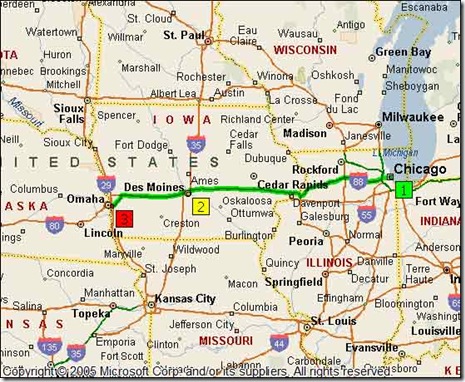
Will there be containers in Des Moines?  ComputerWorld’s Eric Lai says yes.

A Microsoft spokeswoman confirmed that Microsoft plans to house the servers in shipping containers but declined to comment specifically on the size of the facility or the number of servers to be located there.

"We are still in the process of completing the design of the center. Once that is finalized, we will have an estimate for these questions," she wrote via e-mail.

However, Microsoft said its $500 million, 550,000-square-foot data center in Chicago will house up to 220 containers, each filled with as many as 2,000 servers, or 440,000 servers. The software maker said the server-filled containers are easier to transport, set up and maintain than servers on conventional racks, though not all observers agree.

It takes 5 hours to drive a container between Chicago and Des Moines. How’s that for a disaster recovery plan?

One funny thing about this picture

photo

is Gov Chet Culver looks taller and bigger than Mike who is a big guy. Looking up the gov is an college football player so he is probably bigger than Mike.  The gcod thing I found is the governor has an interest in Green.

Culver began his career as an environmental and consumer advocate in the Iowa Attorney General’s Office.

We can expect Microsoft’s Data Center to be as green as can be. There is no hydroelectric for carbon neutral power, but 20% of the power is reported to be coming from renewables.


Read more