If Facebook can host a hack-a-thon for urban planning, why not try a data center plan

Facebook recently held a hack-a-thon for its new campus.

Hoping to Win Over a Town, Facebook Holds Urban Planning "Hack-a-thon"

Facebook is moving from tony Palo Alto to blue-collar Belle Haven, and they want to woo residents with community-oriented design.

Some social networks still function better in the flesh, and so, on Saturday, Facebook played host to a massive “design charrette” that brought four busloads of architects, designers, and urban planners together for an all-day cram session devoted to re-imagining Menlo Park’s Belle Haven community, soon-to-be home of the company’s global headquarters.

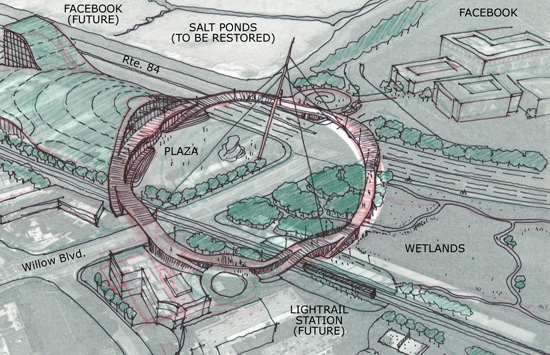
Here are one of the concepts.

We asked him what ideas particularly fired his fancy. “I like the idea of taking advantage of the bay land right next door,” he said. “I like the idea of connecting the rail line, which right now isn’t active. If it was active, we could use that to get Facebook employees to the campus.”

Team Red

[Team Red's "Circle of Friends" concept]

Crowd-sourcing was applied to come up with new ideas.

Facebook says it wants to change the fortress vibe and embrace the community. So to kick things off on Saturday, designers took morning bus tours of the adjacent Belle Haven neighborhood -- several dozen local residents came along to lend their thoughts -- and then broke into Red, Yellow, Blue, and Green teams. Teams of 20 to 40 each rolled up their T-shirts and began cranking out as many hand sketches and digital models as they could before an after-dinner deadline: a show-your-work presentation before a packed assembly of fellow architects, Facebook reps, Menlo Park city officials, and a sprinkling of nearby residents. The day’s mission, as Norman tells it: “creating a sense of community” -- or perhaps, more to the point, to create a larger sense of community, one that very conspicuously features Facebook.

Charette

[Another concept, for a footbridge linking the campus with the surrounding blocks]

Why can’t the same be applied to a data center design?  Too radical of an idea.  Let’s see who likes and dislikes the idea?

Get your Greenpeace #unfriendcoal organic t-shirt

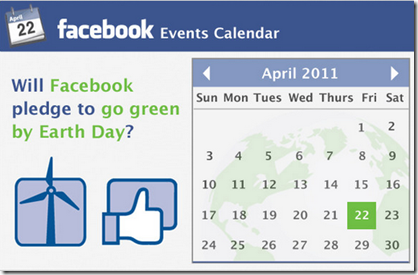
Greenpeace has a site specific for unfriend coal http://www.facebook.com/unfriendcoal.

image

I talked to Greenpeace’s Gary Cook at the suggestion of one of the Internet companies who has an environmental executive who said you should talk to Gary he is a good guy.  Gary was at the Green Grid Tech Forum and we had a good time chatting on green data centers.  I told him the story on how Matt Stansberry broke the Facebook use of PacificCorp’s coal energy source.

By Matt Stansberry, Executive Editor
29 Jan 2010 | SearchDataCenter.com

On Jan. 21, when Jonathan Heiliger, vice president of technical operations atFacebook announced the company would build its first data center, it wasn't a surprise that the Web giant located its facility in Oregon. What is surprising is that it will not avail itself of the region's famous hydroelectric power.

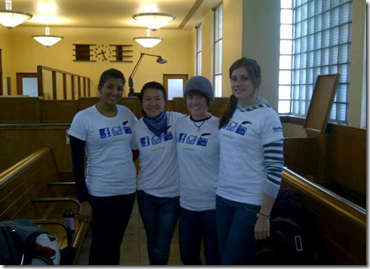
Gary Cook gave me T-shirt which was cool and nice of him.  I asked if I could write a blog entry.  I ran into another environmental friend who has one of the shirts too.  I asked my daughter to model the t-shirt as it looks much better on her than me.

image

image

If you want a t-shirt like these girls and mine.

image

Just send e-mail.

Get an Unfriend Coal campaign t-shirt:
Women's organic t-shirt or Men's organic t-shirt. Free for Facebook staff - just email us from your @fb.com address.

If you are a Facebook employee. Smile

But, watch out Greenpeace will want a picture of you wearing the t-shirt on your Facebook page.

image

image

Prineville local news on Facebook promoting Green Data Center features

Here is a local news spot on KTVZ about Facebook's data center and its green features.

Facebook Prineville: Lot of Data, Lot of Green

'Simplicity Is the Key Here,' says Manager of Huge Data Center

By Adam Aaro, KTVZ.COM

POSTED: 7:17 pm PST February 28, 2011

PrintEmail

PRINEVILLE, Ore. -- To realize just how big Facebook has become, think about this: One out of every 14 people in the world use it.

Now sit back and imagine what it would take to capture and communicate the billions upon billions of status updates, photo albums and friend requests.

Soon, all of that will happen every second of the day inside the company's data center in Prineville, and Facebook says it will do it using some of the most cutting-edge and energy efficient practices in the world.

"It's simplistic. Simplicity is the key here. Complexity creates waste and we have built specifically a simplistic, easy to use, low energy design," Site Manager Ken Patchett said during my recent visit.

Here is a video.  Not a lot new, but interesting to see the story Facebook is building for its April 2011 opening.

After Google Reorg, Data Centers are important to all three top execs

Google announced Larry Page is CEO, replacing Eric Schmidt.

But as Google has grown, managing the business has become more complicated. So Larry, Sergey and I have been talking for a long time about how best to simplify our management structure and speed up decision making—and over the holidays we decided now was the right moment to make some changes to the way we are structured.


For the last 10 years, we have all been equally involved in making decisions. This triumvirate approach has real benefits in terms of shared wisdom, and we will continue to discuss the big decisions among the three of us. But we have also agreed to clarify our individual roles so there’s clear responsibility and accountability at the top of the company.

When you read what Larry's role is leading product development and technology strategy it makes sense that Google's data center group would report to Larry.

Larry will now lead product development and technology strategy, his greatest strengths, and starting from April 4 he will take charge of our day-to-day operations as Google’s Chief Executive Officer. In this new role I know he will merge Google’s technology and business vision brilliantly. I am enormously proud of my last decade as CEO, and I am certain that the next 10 years under Larry will be even better! Larry, in my clear opinion, is ready to lead.

Sergey is working on strategic projects.  But, how can Google develop new products without data center resources.

Sergey has decided to devote his time and energy to strategic projects, in particular working on new products. His title will be Co-Founder. He’s an innovator and entrepreneur to the core, and this role suits him perfectly.

And Eric is working on external projects - deals, partnerships, ... technology thought leadership that are increasingly important.  You need Google's data centers for these deals.


As Executive Chairman, I will focus wherever I can add the greatest value: externally, on the deals, partnerships, customers and broader business relationships, government outreach and technology thought leadership that are increasingly important given Google’s global reach; and internally as an advisor to Larry and Sergey.

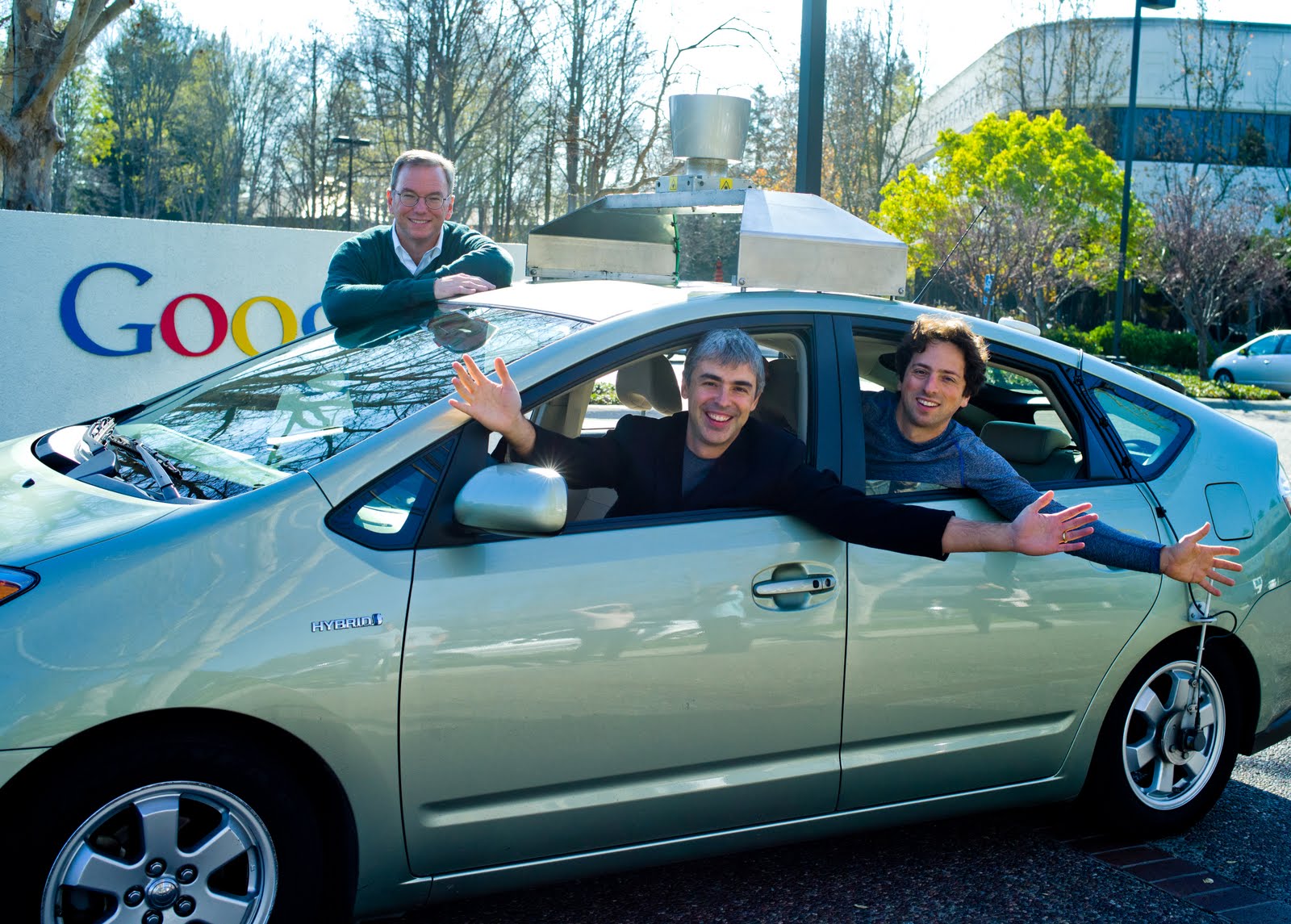
From left to right - Eric, Larry and Sergey in a self-driving car in a photo taken earlier today

So, even though Eric, Larry, and Sergey all have new roles.  They all need Google's data centers.

How many companies do you know need data centers for the three top billionaire executives to do their job?

Read more

How Facebook Ships Code, hints of how their data centers work

My wife and I just watched The Social Network on DVD.  We have a 9 and 6 year old so going out to movies together is rare.

The Social Network Trailer

My wife worked in sales for many companies like IDG, Ziff Davis with clients like Intel, Palm, and Microsoft.  She’s seen the SW developers, but never was really been exposed to their world.  Watching The Social Network was entertaining and it is Hollywood spin on the SW culture.  She was amazed at how the SW developers were portrayed, and their focus on writing code.  The bit of irony is working on the Apple Mac OS team and Microsoft Windows team, I could recognize behaviors that reminded of the days when I was much younger and would work in the same type of mode as Facebook was portrayed. The reality not the Hollywood version.

So what is it like in Facebook Development?  Her is a post on How Facebook Ships Code.

How Facebook Ships Code

January 17, 2011 — yeeguy

I’m fascinated by the way Facebook operates.  It’s a very unique environment, not easily replicated (nor would their system work for all companies, even if they tried).  These are notes gathered from talking with many friends at Facebook about how the company develops and releases software.

Seems like others are also interested in Facebook…   The company’s developer-driven culture is coming under greater public scrutiny and other companies are grappling with if/how to implement developer-driven culture.   The company is pretty secretive about its internal processes, though.  Facebook’s Engineering team releases public Notes on new features and some internal systems, but these are mostly “what” kinds of articles, not “how”…  So it’s not easy for outsiders to see how Facebook is able to innovate and optimize their service so much more effectively than other companies.  In my own attempt as an outsider to understand more about how Facebook operates, I assembled these observations over a period of months.  Out of respect for the privacy of my sources, I’ve removed all names and mention of specific features/products.  And I’ve also waited for over six months to publish these notes, so they’re surely a bit out-of-date.   I hope that releasing these notes will help shed some light on how Facebook has managed to push decision-making “down” in its organization without descending into chaos…  It’s hard to argue with Facebook’s results or the coherence of Facebook’s product offerings.  I think and hope that many consumer internet companies can learn from Facebook’s example.

I have had friends over the last 2 years interview at Facebook, most turn down working at Facebook as they were being recruited for senior engineering manager positions and they couldn’t see how they could do their job and be successful.

The post has lots of information, and here are parts that gives you an idea of how Facebook thinks about its SW which influences hardware and data centers.

engineers generally want to work on infrastructure, scalability and “hard problems” — that’s where all the prestige is.  can be hard to get engineers excited about working on front-end projects and user interfaces.  this is the opposite of what you find in some consumer businesses where everyone wants to work on stuff that customers touch so you can point to a particular user experience and say “I built that.”  At facebook, the back-end stuff like news feed algorithms, ad-targeting algorithms, memcache optimizations, etc. are the juicy projects that engineers want.

Note the above reference can be implied to Apple (consumer business).

Additional information that backs up a focus on infrastructure.

  • as of June 2010, the company has nearly 2000 employees, up from roughly 1100 employees 10 months ago.  Nearly doubling staff in under a year!
  • the two largest teams are Engineering and Ops, with roughly 400-500 team members each.  Between the two they make up about 50% of the company.

More details are explained here in a process for releases.

  • by default all code commits get packaged into weekly releases (tuesdays)
  • with extra effort, changes can go out same day
  • tuesday code releases require all engineers who committed code in that week’s release candidate to be on-site
  • engineers must be present in a specific IRC channel for “roll call” before the release begins or else suffer a public “shaming”
  • ops team runs code releases by gradually rolling code out
    • facebook has around 60,000 servers
    • there are 9 concentric levels for rolling out new code
    • [CORRECTION thx epriest] “The nine push phases are not concentric. There are three concentric phases (p1 = internal release, p2 = small external release, p3 = full external release). The other six phases are auxiliary tiers like our internal tools, video upload hosts, etc.”
    • the smallest level is only 6 servers
    • e.g., new tuesday release is rolled out to 6 servers (level 1), ops team then observes those 6 servers and make sure that they are behaving correctly before rolling forward to the next level.
    • if a release is causing any issues (e.g., throwing errors, etc.) then push is halted.  the engineer who committed the offending changeset is paged to fix the problem.  and then the release starts over again at level 1.
    • so a release may go thru levels repeatedly:  1-2-3-fix. back to 1. 1-2-3-4-5-fix.  back to 1.  1-2-3-4-5-6-7-8-9.
  • ops team is really well-trained, well-respected, and very business-aware.  their server metrics go beyond the usual error logs, load & memory utilization stats — also include user behavior.  E.g., if a new release changes the percentage of users who engage with Facebook features, the ops team will see that in their metrics and may stop a release for that reason so they can investigate.
  • during the release process, ops team uses an IRC-based paging system that can ping individual engineers via Facebook, email, IRC, IM, and SMS if needed to get their attention.  not responding to ops team results in public shaming.
  • once code has rolled out to level 9 and is stable, then done with weekly push.
  • if a feature doesn’t get coded in time for a particular weekly push, it’s not that big a deal (unless there are hard external dependencies) — features will just generally get shipped whenever they’re completed.
  • getting svn-blamed, publicly shamed, or slipping projects too often will result in an engineer getting fired.  ”it’s a very high performance culture”.  people that aren’t productive or aren’t super talented really stick out.  Managers will literally take poor performers aside within 6 months of hiring and say “this just isn’t working out, you’re not a good culture fit”.  this actually applies at every level of the company, even C-level and VP-level hires have been quickly dismissed if they aren’t super productive.
  • [CORRECTION, thx epriest“People do not get called out for introducing bugs. They only get called out if they ask for changes to go out with the release but aren’t around to support them in case something goes wrong (and haven’t found someone to cover for you).”

Note the 60,000 server count is not accurate base on my research and is at least twice with another 1/3 growth in the short term before Prineville DC comes on line.

Would you want to be a senior executive hired for this environment?  Now you can see why a lot of my friends turned down jobs. 
Read more