Google's Lenoir Data Center, 30 megawatts, 708 Lynhaven St SW, Lenoir, NC

There is a common belief you can't find a Google Data Center using Google Maps.  Well here is the Google Lenoir, NC data center at 708 Lynhaven St SW, Lenoir, NC.  Data Center friends estimate the power to be 10 megawatts for the building maybe 15 max.

image

I found the address here, but Lynhaven is misspelled.

This one was in Lenoir, N.C., nestled in the rolling hills of Caldwell County at 708 Lynnhaven St. Never heard of it? That's okay. Google likes it that way, nice and secretive. For perspective, Lenoir is about 70 miles northwest of Charlotte.

Using Bing Maps you can see what the site looked like before construction.

image

The red circled area shows where the substation will go.  Here are substations added to the site.

image

image

Here is a closer view of the data center.

image

The resolution is quite good and you can see the construction is not complete.

image

Mapquest shows the building further along with cars at the support building.

image

South of the site looks like another data center being built.

image

image
Read more

Google’s next Strategic Data Center Purchase in NYC?

Google is rumored close to purchasing 111 8th Ave.


Google Near Purchase of NYC Landmark Building at 111 Eighth Ave.

BySAM GUSTINPosted 6:22 PM 10/27/10

Last month,we told you that the gargantuan 111 Eighth Ave., a building which occupies an entire city block in Chelsea, and which is home to Google's (GOOG) New York headquarters -- is for sale.
Now, it appears that the likely buyer is none other than Google itself. Rumored sale price? A cool $2 billion,accordingto theNew York Post. 111 Eighth Ave. is the former Port Authority headquarters and one of the city's largest buildings, at nearly 3 million square feet.
It also happens to be one of the East Coast's key "telecom hotels" -- centralized locations where groups of communications and networking firms hook up their hardware. Google is already the largest tenant, leasing 500,000 square feet over three floors.

NYDaily says the price may go as high as $2.9 Billion.

Google reportedly to pay four fold increase on $2.9 billion 111 Eighth Avenue building

BY NICOLE CARTER
DAILY NEWS STAFF WRITER

Wednesday, October 27th 2010, 5:22 PM

The building is reportedly the fourth largest office building in the City.

111eigth.com

The building is reportedly the fourth largest office building in the City.

Google is apparently ogling Chelsea’s 111 Eighth Ave. building ... for a mind-blowing $2.9 billion.

Given its carrier hotel status this could be Google’s most expensive data center asset.

Google reportedly already rents 550,000 square feet of space in the building. Because the building is equipped for high-tech businesses, other interested buyers are plenty and include foreign sheiks and wealthy locals, the Observer reports.

Read more

Google has the most Internet Traffic and Data Centers and Servers

Arbor Networks reports on Google’s network traffic.

Google Sets New Internet Traffic Record

by Craig Labovitz

In their earnings call last week, Google announced a record 2010 third-quarter revenue of $7.29 billion (up 23% from last year). The market rejoiced and Google shares shot past $615 giving the company a market cap of more than $195 billion.

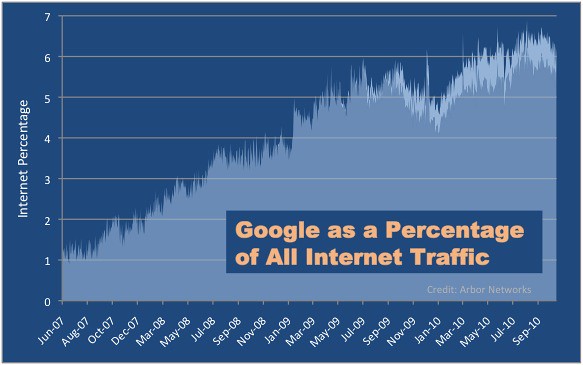
This month, Google broke an equally impressive Internet traffic record — gaining more than 1% of all Internet traffic share since January. If Google were an ISP, as of this month it would rank as the second largest carrier on the planet.

Only one global tier1 provider still carries more traffic than Google (and this ISP also provides a large portion of Google’s transit).

In the graph below, I show a weighted average percentage of Internet traffic contributed by the search / mobile OS / video / cloud giant. As in earlier posts, the Google data comes from 110+ ISPs around the world participating in ATLAS. The multiple shaded colors represent different Google ASN and reflect ongoing global traffic engineering strategies.

googletraffic

If you count caching they are even bigger.

Google now represents an average 6.4% of all Internet traffic around the world. This number grows even larger (to as much as 8-12%) if I include estimates of traffic offloaded by the increasingly common Google Global Cache (GGC) deployments and error in our data due to the extremely high degree of Google edge peering with consumer networks.

Google has more traffic, more data centers and servers than anyone else.

How high can Google go?

Read more

Ray Ozzie posts on Dawn of a New Day, Continuous Services and Connected Devices

Ray Ozzie has started a new blog and posts on Dawn of a New Day.

Dawn of a New Day

To:           Executive Staff and direct reports
Date:         October 28, 2010
From:         Ray Ozzie
Subject:      Dawn of a New Day

Five years ago, having only recently arrived at the company, I wrote The Internet Services Disruption in order to kick off a major change management process across the company.  In the opening section of that memo, I noted that about every five years our industry experiences what appears to be an inflection point that results in great turbulence and change.


Ray finds information about 25 years on Nov 20 1985.

Imagining A “Post-PC” World

One particular day next month, November 20th 2010, represents a significant milestone.  Those of us in the PC industry who placed an early bet on a then-nascent PC graphical UI will toast that day as being the 25thanniversary of the launch of Windows 1.0.


25 years ago I was working at Apple.  Wow look at where Apple is after 25 years and where Microsoft is.  In 1992 I moved from Apple to Microsoft.

image

From 1985 to 1992 here is Apple vs. Microsoft stock.

image

But what are the last 5 years like as Ray is infamous for his e-mail waking up Microsoft.

image

Ray argues for simplicity

Complexity kills. Complexity sucks the life out of users, developers and IT.  Complexity makes products difficult to plan, build, test and use.  Complexity introduces security challenges.  Complexity causes administrator frustration.

And Data Center Services he calls Continuous Services

Continuous services are websites and cloud-based agents that we can rely on for more and more of what we do.  On the back end, they possess attributes enabled by our newfound world of cloud computing: They’re always-available and are capable of unbounded scale.  They’re constantly assimilating & analyzing data from both our real and online worlds.  They’re constantly being refined & improved based on what works, and what doesn’t.  By bringing us all together in new ways, they constantly reshape the social fabric underlying our society, organizations and lives.  From news & entertainment, to transportation, to commerce, to customer service, we and our businesses and governments are being transformed by this new world of services that we rely on to operate flawlessly, 7×24, behind the scenes.

And future are appliance devices.

But there’s one key difference in tomorrow’s devices: they’re relatively simple and fundamentally appliance-likeby design, from birth.  They’re instantly usable, interchangeable, and trivially replaceable without loss.  But being appliance-like doesn’t mean that they’re not also quite capable in terms of storage; rather, it just means that storage has shifted to being more cloud-centric than device-centric.  A world of content – both personal and published – is streamed, cached or synchronized with a world of cloud-based continuous services.

Ray’s vision is centered around always on data center services with a range of simple appliances to connect to the services.

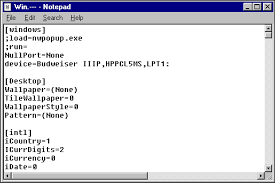
Who wants to go back to a time when editing win.ini or Mac ResEdit?
Ray paints an interesting future where Google, Microsoft, and Apple will compete for Continuous Services and Connected Devices.

Read more

Google TV vs. Apple TV, Microsoft couldn’t last for this battle

The latest move by Google and Apple for the TV experience all require big data centers.  Newsweek covers how these companies are remaking the Tube.

Geek TV

Computer makers take over the tube.

Martin Katz / Xinhua-Landov

For the past few years, tech companies have been trying to find a way to bring the Internet and television to-gether, without much success. Sure, there are lots of little boxes you can attach to your TV that let you download content from the Internet, including Vudu, Roku, TiVo, Boxee, and Apple TV, not to mention game consoles from Microsoft and Sony. Each one gives you a little something different. But no single box gives you the whole Internet.

Now Google is out to replace all those crazy little boxes with Google TV. The software program will come built right into some TV sets and it will basically turn your TV into a computer.

In all the news about Google and Apple there is almost no mention of MSN TV.

image

Because you can’t buy MSN TV anymore.

image

MSN TV is the rebranded WebTV Microsoft acquired.

MSN TV (formerly WebTV) is the name of both a thin client which uses a television for display (rather than a computer monitor), and the online servicethat supports it.

The product and service was developed by WebTV Networks, Inc., a company purchased by Microsoft Corporation and absorbed into MSN (the Microsoft Network). While most thin clients developed in the mid-1990s were positioned as diskless workstations for corporate intranets, WebTV was positioned as a consumer device for web access.

A good friend from my Apple days worked at WebTV which eventually made him a Microsoft employee.  I hired him to help evangelize Windows XP before he moved on to senior architect position in Windows.  Ironically he now works at Google, not on the TV product.

Going back further in time I worked for a short period in the Microsoft Interactive TV team which was run by Craig Mundie.  Craig is the one who drove the acquisition of WebTV.

Microsoft takes notice

In February 1997, in an investor meeting with Microsoft, Steve Perlman was approached by Microsoft's Senior Vice President for Consumer Platforms Division, Craig Mundie. Despite the fact that the initial WebTV sales had been modest, Mundie expressed that Microsoft was impressed with WebTV and saw significant potential both in WebTV's product offering and in applying the technology to other Microsoft consumer and video product offerings

Things have changed a lot in 14 years that WebTV was launched.  The first servers for WebTV were run from their office in an old BMW dealership.

WebTV's online service running from servers in its tiny office, still based in the former BMW dealership

Apple and Google now have some of the top data center infrastructure in the industry.  What has changed in the 14 years is the requirement to use data centers to power the user experience. 

I wonder if part of what contributed to Microsoft’s inability to keep up the MSN/WebTV platform is the lack of data center capabilities during product development.

It is interesting how not to long ago servers were viewed as support devices – file and print servers.   Now servers do the heavy lifting so the client experience is faster, more efficient and more flexible.

Read more