How many patents does Google gain by acquiring Motorola Mobility? 24,500 granted and pending

A good question to ask is how many patents does Google get from Motorola Mobility?

The press release announcing Motorola Mobility is here.

Motorola Mobility is comprised of two industry-leading global technology businesses. The Mobile Devices business is an innovative provider of smartphone devices designed to fit every lifestyle. In 2010, the Mobile Devices business launched 23 smartphones globally, including the highly successful family of DROID™ by Motorola devices as well as BRAVO™, DEFY™, FLIPSIDE™, MILESTONE™ and others. The Home business is one of the largest providers of digital set-top boxes and end-to-end video solutions. Motorola Mobility will leverage the capabilities of both the Mobile Devices and Home businesses to deliver innovative smartphones, tablets, set-tops and other converged devices – as well as content delivery and management, and interactive cloud-based services to consumers in the home and on the go.

And the same press release says what the patent portfolio is.

“With more than 20,000 employees globally, 24,500 patents granted and pending, and a highly recognizable brand, we are able to deliver cutting-edge devices with differentiated software experiences. In addition, we will continue to work aggressively to capitalize on the next generation of converged devices and experiences to provide consumers with more intuitive and personalized services,” Jha added.

Google buys Motorola Mobility, can you imagine the future integration of SW, HW, and data centers?

Google's official blog post announces Google's acquisition of Motorola Mobility.

Supercharging Android: Google to Acquire Motorola Mobility

8/15/2011 04:35:00 AM

Since its launch in November 2007, Android has not only dramatically increased consumer choice but also improved the entire mobile experience for users. Today, more than 150 million Android devices have been activated worldwide—with over 550,000 devices now lit up every day—through a network of about 39 manufacturers and 231 carriers in 123 countries. Given Android’s phenomenal success, we are always looking for new ways to supercharge the Android ecosystem. That is why I am so excited today to announce that we have agreed toacquire Motorola.

Motorola has more than Smartphones.

Motorola is also a market leader in the home devices and video solutions business. With the transition to Internet Protocol, we are excited to work together with Motorola and the industry to support our partners and cooperate with them to accelerate innovation in this space.

And Google gets Motorola's mobile patents.

We recently explained how companies including Microsoft and Apple are banding together in anti-competitive patent attacks on Android. The U.S. Department of Justice had to intervene in the results of one recent patent auction to “protect competition and innovation in the open source software community” and it is currently looking into the results of the Nortel auction. Our acquisition of Motorola will increase competition by strengthening Google’s patent portfolio, which will enable us to better protect Android from anti-competitive threats from Microsoft, Apple and other companies.

I knew I would see Google people when I went to GigaOm Mobilize.  Glad I am going and decided to go to Mobilize instead of another data center conference.

Looking for how Mobile intersects with Data Center at GigaOm Mobilize Conference, Sept 26-27 SF

THURSDAY, AUGUST 11, 2011 AT 8:10AM

Going to a data center show I frequently find I spend more time networking than watching the presentations.  So to learn some new things I saw that GigaOm has aMobilize conference in SF, Sept 26-27 that I decided to attend.

Google posts Sustainable (Green) Data Center Operations Manager position

I don't know how long this job post has been up, but it is worth blogging.

Manager, Sustainable Data Center Operations - Mountain View

...

As the Sustainable Data Center Operations Manager you will be responsible for growing the team that continually raises the bar on sustainability at Google. This includes keeping our commitment to carbon neutrality, advancing efficient computing across the industry, and ensuring Google’s infrastructure, products and services are sustainable. You will provide leadership for Google’s sustainability efforts, defining goals, organizing teams, and working closely with product engineering, operations, policy, and communications teams.

Good Luck to Google to hire a Green Data Center Operations Manager.

Failure Analysis ideas applied to Data Center

James Hamilton has a post on what went wrong at the Fukushima Nuclear power plant.

What Went Wrong at Fukushima Dai-1

As a boater, there are times when I know our survival is 100% dependent upon the weather conditions, the boat, and the state of its equipment. As a consequence, I think hard about human or equipment failure modes and how to mitigate them. I love reading the excellent reporting by the UK Marine Accident Investigation Board. This publication covers human and equipment related failures on commercial shipping, fishing, and recreational boats. I read it carefully and I’ve learned considerably from it.

James makes the point of how he connects his boating mindset to running IT services.

I treat my work in much the same way. At work, human life is not typically at risk but large service failures can be very damaging and require the same care to avoid. As a consequence, at work I also think hard about possible human or equipment failure modes and how to mitigate them.

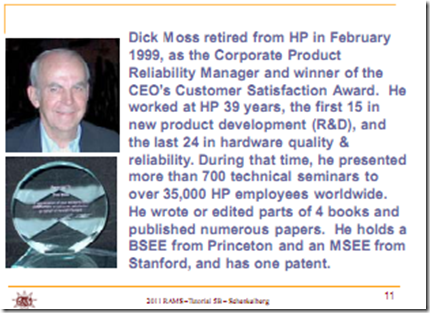
In one of my first jobs I worked at HP I worked in quality engineering and spent a lot of time in Palo Alto using their failure analysis facilities and learned ESD issues from Dick Moss.
image

Discussing Reliability Engineering and Data Centers is not common.  Running a search on "reliability engineer data center" turned up this job post at Google.

The role: Data Center Reliability and Maintenance Engineer

The Data Center Operations team designs and operates one of the largest and most sophisticated power and cooling systems in the world. You should have extensive experience being involved in the large-scale technical operations, and demonstrable problem-solving skills to lead the RCM program for the Data Center team with limited oversight. You should possess excellent communication skills, attention to detail, and the ability to create work process and procedures to enable the collection of highly accurate field operational data. You will have access to reliability data for one of the largest data center footprints globally and be expected to interact with other reliability and software engineers to holistically address the reliability issues and develop a program wide data acquisition system to continually increase reliability and PUE while lowering TCO.

Responsibilities:
  • Develop RCM (reliability centered maintenance) program in collaboration with multiple stakeholders.
  • Perform Reliability Engineering analysis based on field data collected on the critical systems and equipment through the use of proven industry techniques and principles such as RCA (root cause analysis) & FMEA (Failure Modes and Effects Analysis).
  • Present data based Reliability Predictions and Reliability Block Diagrams.
  • Collaborate on the selection of the critical equipment vendors based on past operational data on equipment failures.
  • Spearhead on all RCA effort through collaboration w/equipment vendors.

Urs Hoelzle's keynote at Google European Data Center Summit 2011

James Hamilton has posted his notes on Urs Hoelzle's keynote speech at Google's European Data Center Summit 2011. 

2011 European Data Center Summit

The European Data Center Summit 2011 was held yesterday at SihlCity CinCenter in Zurich. Google Senior VP Urs Hoelzlekicked off the event talking about why data center efficiency was important both economically and socially. He went on to point out that the oft quoted number that US data centers represent is 2% of total energy consumption is usually mis-understood. The actual data point is that 2% of the US energy budget is spent on IT of which the vast majority is client side systems. This is unsurprising but a super important clarification. The full breakdown of this data:

· 2% of US power

o Datacenters: 14%

o Telecom: 37%

o Client Device: 50%

What will get little press is this statement by Urs.

Summarizing: Datacenters consume 0.28% of the annual US energy budget. 72% of these centers are small and medium sized centers that tend towards the lower efficiency levels.