Google sets a high standard, all US Data Centers are ISO 14001 environmental and OHSAS 18001safety Certified

Google has posted on their achieving ISO 14001 and OSHAS 18001 certifications for environmental and safety standards.

NewImage

All of our U.S. owned and operated data centers have received ISO 14001 and OHSAS 18001certification. We’re the first major Internet services company to gain external certification for those high standards at all of our U.S. data centers.

In a nutshell, both standards are built around a very simple concept: Say what you’re going to do, then do what you say—and then keep improving. The standards say what key elements are required, but not how to do it—that part’s up to us. So we set some challenging goals for ourselves, and we asked our auditors to confirm that we’ve followed through on them.
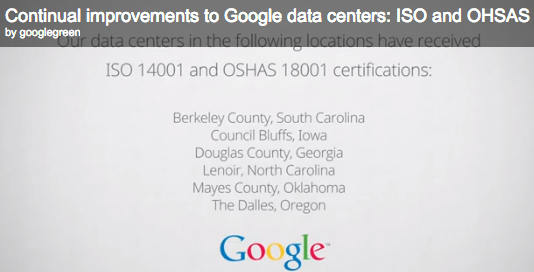
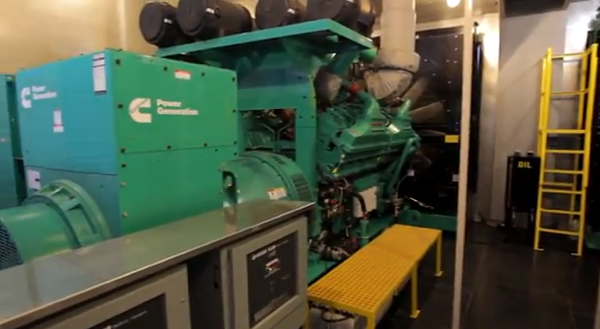
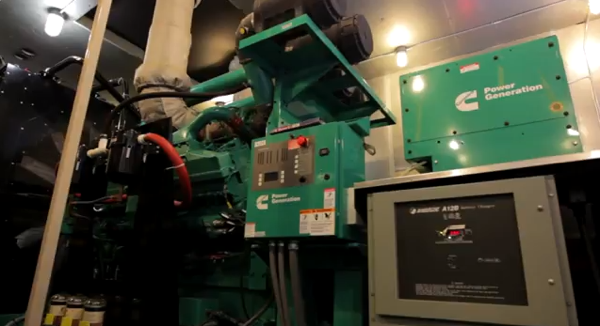
Two improvements listed are in diesel generator maintenance and handling of batteries.

Here’s an example of the kind of improvements we’ve implemented: Like most data centers, ours have emergency backup generators on hand to keep things up and running in case of a power outage. To reduce the environmental impact of these generators, we’ve done two things: first, we minimized the amount of run time and need for maintenance of those generators. Second, we worked with the oil and generator manufacturers to extend the lifetime between oil changes. So far we’ve managed to reduce our oil consumption in those generators by 67 percent.

A second example: each of our servers in the data center has a battery on board to eliminate any interruptions to our power supply. To ensure the safety of the environment and our workers, we devised a system to make sure we handle, package, ship and recycle every single battery properly.

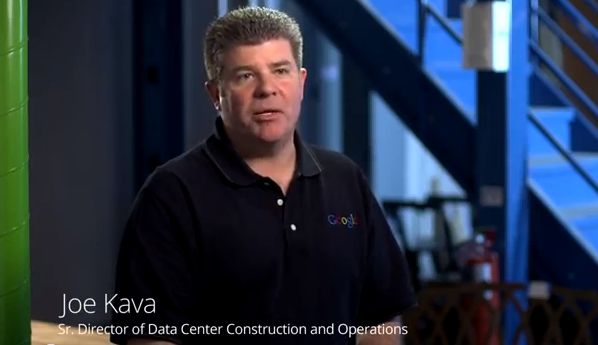
Joe Kava and a few other Googlers are featured in this video discussing the achievement.
NewImage

Check out this Google logo with a tree for letter "l" and moon hovering.
NewImage

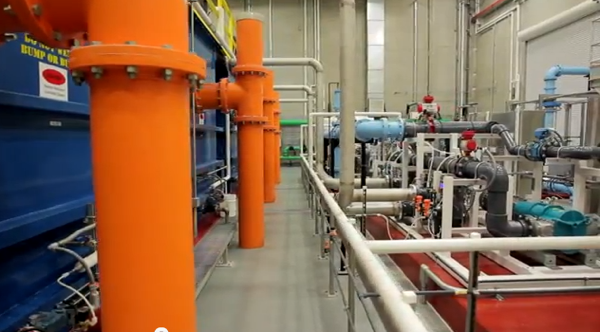
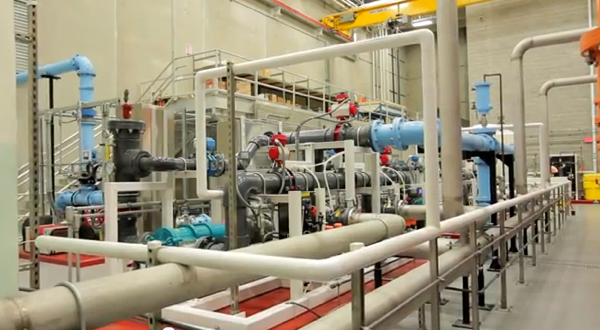
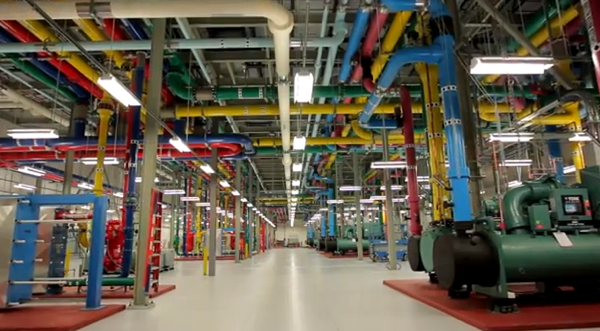
This is the closest to a tour of inside a Google data center many will get.
NewImage

NewImage

NewImage

NewImage

NewImage

NewImage

NewImage

NewImage


What is more important a LEED certification or meeting environmental and safety standards?  Google has hopefully woken up some data center decision makers that there is more to being a green data center than a low PUE and LEED certification.

I am curious on how many views this video will get through out the day.  so far it has 201.
NewImage

29 days, 11K servers of Google Cluster Server data shared with Researchers

Google had a crazy idea a year ago, let's share some of our cluster data to the research community.  In Jan 2010, Google shared 7 hrs of data.

Google Cluster Data


Google faces a large number of technical challenges in the evolution of its applications and infrastructure. In particular, as we increase the size of our compute clusters and scale the work that they process, many issues arise in how to schedule the diversity of work that runs on Google systems.

We have distilled these challenges into the following research topics that we feel are interesting to the academic community and important to Google:
  • Workload characterizations: How can we characterize Google workloads in a way that readily generates synthetic work that is representative of production workloads so that we can run stand alone benchmarks?
  • Predictive models of workload characteristics: What is normal and what is abnormal workload? Are there "signals" that can indicate problems in a time-frame that is possible for automated and/or manual responses?
  • New algorithms for machine assignment: How can we assign tasks to machines so that we make best use of machine resources, avoid excess resource contention on machines, and manage power efficiently?
  • Scalable management of cell work: How should we design the future cell management system to efficiently visualize work in cells, to aid in problem determination, and to provide automation of management tasks?

Now Google has shared 29 days from 11,000 Servers in a Google Cluster.

More Google Cluster Data


Google has a strong interest in promoting high quality systems research, and we believe that providing information about real-life workloads to the academic community can help.

In support of this we published a small (7-hour) sample of resource-usage information from a Google production cluster in 2010 (research blog on Google Cluster Data). Approximately a dozen researchers at UC Berkeley, CMU, Brown, NCSU, and elsewhere have made use of it.

Recently, we released a larger dataset. It covers a longer period of time (29 days) for a larger cell (about 11k machines) and includes significantly more information, including:

  • the original resource requests, to permit scheduling experiments
  • request constraints and machine attriibutes
  • machine availability and failure events
  • some of the reasons for task exits
  • (obfuscated) job and job-submitter names, to help identify repeated or related jobs
  • more types of usage information
  • CPI (cycles per instruction) and memory traffic for some of the machines

Besides the feedback from the the research community, this is a great way for Google to find future hires.

Google vs. Facebook European data center locations

One way to look at Google vs. Facebook European data center locations is to plot on a map the sites.

A - Google Dublin

B- Google Hamina, Finland

C - Google Belgium

D - Facebook Lulea, Sweden

Google has three major data center sites.  In Asia, Google has three future sites - Singapore, Hong Kong, and Taiwan.  Recognize a pattern?  Three is a good number, says GreenM3 :-)

Keep in mind given Google has built its three data centers it most likely looked at sites all over Europe before it picked its three locations.  Think about being in three sites as an option to building one mega site.  I watched an established company follow the advice of the so called data center experts justifying a single site as their first data center.  For less than 10 MW, it can make a lot of sense to have three 3 1/3 MW sites to enable geo redundancy of services.

NewImage

Microsoft comes a long way with Water use in Quincy, Transfers water treatment plant to City of Quincy

When Microsoft's Quincy data center opened, I was able to get a tour of the data center.  One of the questions I asked is how much water does the data center use.  I asked the data center operations staff, they didn't know.  I asked the data center design team, they didn't know either.  And, a response was why do you want to know?  Because I think you use lots of water, and it is an issue in a green data center.

When I went back out to the data center a few months later, the data center operation team said they are storing blow-down water in tanks, and they have 6 months before the tanks fill up.  This problem was not unique to Microsoft as other data center operators had blow-down water that cannot be put into the waste stream.

A water treatment plant was built to reduce the environmental impact.  And now, Microsoft has put a plan in place to transfer the water treatment plant to the City of Quincy.

Microsoft’s Data Center Takes Fresh Approach On Water Reuse

Today we are transferring our $ multi-million water treatment plant to city of Quincy, WA

By: Christian Belady, General Manager of Data Center Advanced Development

Around the globe, water is becoming a scarcer and more valuable commodity, and that’s an important factor for data center operators and cloud service providers to consider as consumers and businesses aggressively adopt cloud-based computing. It’s even more critical that all of us in the industry make sure that beyond building sustainability into our designs, running data centers to higher standardize efficiencies, and measuring impact constantly, that we are helping the industry at large in thinking out of the box.

Today offers one of those opportunities. In Quincy, Washington, we are taking steps to transfer the operations of our Water Treatment Plant, located on our data center site, to the City of Quincy. This project involves innovative agreements for promoting a long term sustainable use of a limited natural resource, water, in a desert area that has the added benefit of supporting the foundation of Quincy and Grant County’s growing economy for years to come. To my knowledge, it is the first known transfer of a water treatment plant to a municipality in our industry and I would like to share why I think this type of collaborative project helps the industry and environment benefit as a whole.


Microsoft’s Quincy, Washington Water Treatment Plant

Google's Joe Kava discussed water use in data centers in its 2009 data center summit.  Joe's presentation on water start at the 9:20 mark.

A green data center has smart water use in addition to efficient power and cooling systems.