Google's Urs Hoelzle OpenFlow Presentation

27 Jan 2014 update.  Complete original slides are here.

http://www.greenm3.com/gdcblog/2014/1/27/complete-slides-for-urs-hoelzles-openflow-talk-at-2012-open.html


James Hamilton has a post that describes what Urs covered. We need to get James a good camera to take pictures of the slides.  It is hard to write and take pictures at the same time though.

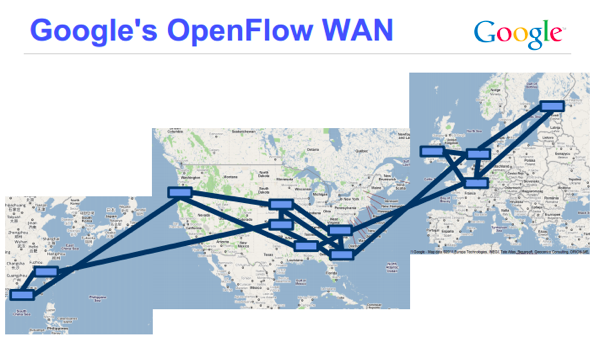
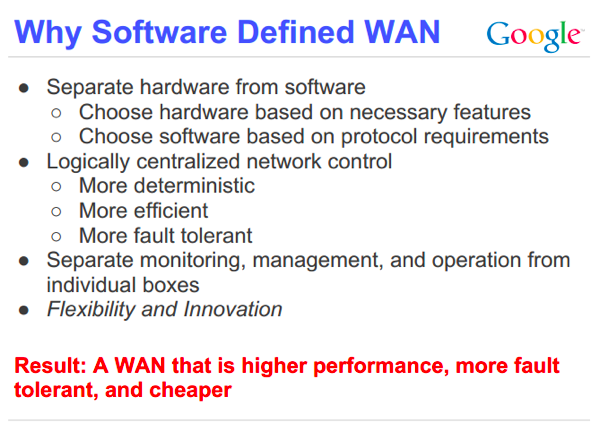
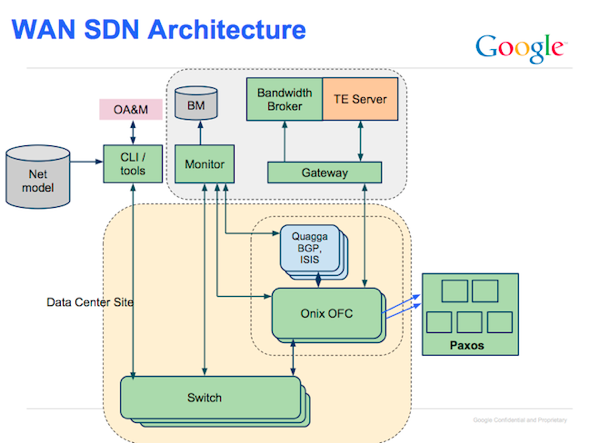
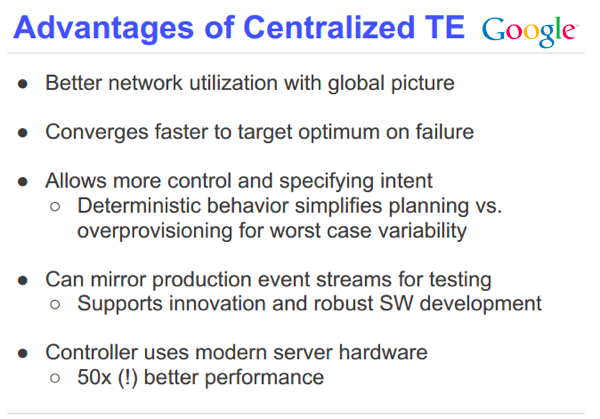
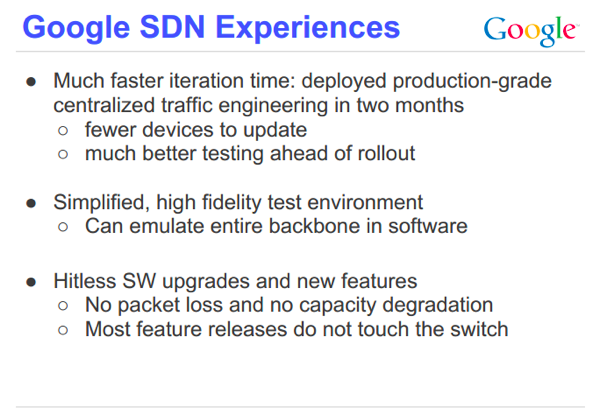
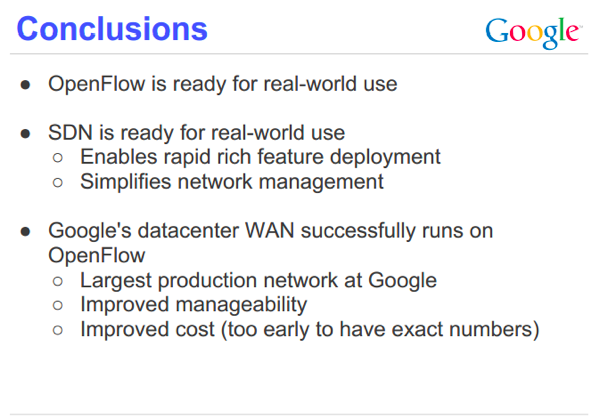
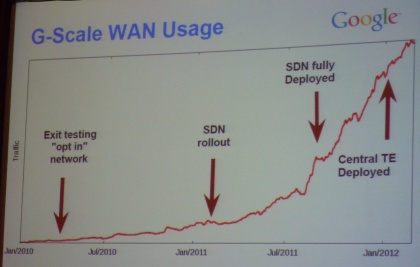
Urs Holzle did the keynote talk at the 2012 Open Networking Summit where he focused on Software Defined Networking in Wide Area Networking. Urs leads the Technical Infrastructure group at Google where he is Senior VP and Technical Fellow. Software defined networking (SDN) is the central management of networking routing decisions rather than depending upon distributed routing algorithms running semi-autonomously on each router.  Essentially what is playing out in the networking world is a replay of what we have seen in the server world across many dimensions. The dimension that is central to the SDN discussion is a datacenter full of 10k to 50k servers are not managed individually by an administrator and the nodes making up the networking fabric shouldn’t be either.

So, I spent some time crawling around to see what slides I could find and throw them together into this blog post.  These slides are not in the exact order that Urs presents them in as I wasn’t there and don’t know for sure. 

I now understand Urs’s presentantion much better and can watch the video while referring to the below and going back to James Hamilton’s notes.

Why all this effort?  Steven Levy’s Wire article says it well.

‘You have all those multiple devices on a network but you’re not really interested in the devices — you’re interested in the fabric, and the functions the network performs for you,’ Hölzle says.

Hölzle says that the idea behind this advance is the most significant change in networking in the entire lifetime of Google.

In the course of his presentation Hölzle will also confirm for the first time that Google — already famous for making its own servers — has been designing and manufacturing much of its own networking equipment as well.

“It’s not hard to build networking hardware,” says Hölzle, in an advance briefing provided exclusively to Wired. “What’s hard is to build the software itself as well.”

In this case, Google has used its software expertise to overturn the current networking paradigm.
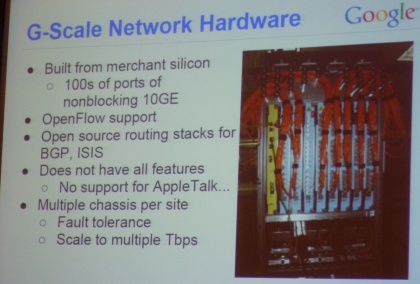
NewImage

NewImage

NewImage

NewImage

NewImage

NewImage

NewImage

NewImage

Google's Urs Hölzle Keynote annoucing Google Compute Engine at Google IO

See the below video to see Urs Hölzle annouce Google Compute Engine at Google IO 2012.

Sundar Pichai introduces Urs as one of the first 10 Google employees, the first VP of engineering, and the person more than any one else responsible for building all of Google's infrastructure (Data Centers, Servers, Network, and Infrastructure SW)

By the way I finally figured out how to embed a video and get it to start at a specific point of time, so this video will play at the 35m30s mark.

NewImage

If you want to see the scale of Google data centers look at how small Urs is compared to the server racks. :-)  

NewImage

The video is the one I referenced with this post.

Google's Compute Engine 600K VMs = 37,500 servers & 15MW of data center power

I am probably wrong on this calculation, but willing to take a stab at what could be.

Google announced its Compute Engine offering this morning.

NewImage

A Genome calculation with 10,000 cores was used as a demo.  If you use an 8 core Intel Xeon with dual processors this is 625 servers.

NewImage

Urs Hoelzle was presenting that there are 771,886 cores ready to run a Google Compute Engine job.

NewImage

Here is a the calculation executed with 600K cores with refreshes in seconds vs. 10 minutes for the 10,000 core system.

NewImage

NewImage

So how many servers would 600K cores be?  If you assume 8 core processors (I was going to assume 10 core processors, but backed off to 8).  The following is pricing info.

NewImage

How many servers could this be?  600,000 Cores/16 cores/server = 37,500 servers.  (assume a virtual core does map to a physical core, note this is not always true)  Assume 350 Watts per server ( 2 processors, 64 GB more of RAM, 2 HD) is 13.125MW of IT power with a PUE of 1.12 you get to 15MW overall data center power consumption

600K cores may seem big.  But, thinking about 37,500 servers and 15MW of power is really impressive at least to the data center geeks.  Oh yeh, there 771,886 cores available which is 48,242 servers, 16.9 MW of IT and 18.9 MW of data center power.

It is impressive to think one whole 20MW of data center capacity is available on demand for a Google Compute Engine job.  Keep in mind this what is available, not the total capacity and being consumed.

Google changes the Product Demo to be like a reality show

Google Glasses was announced and demo'd yesterday.  

It will be interesting to see if Google's Reality style demo changes product launches in the future.

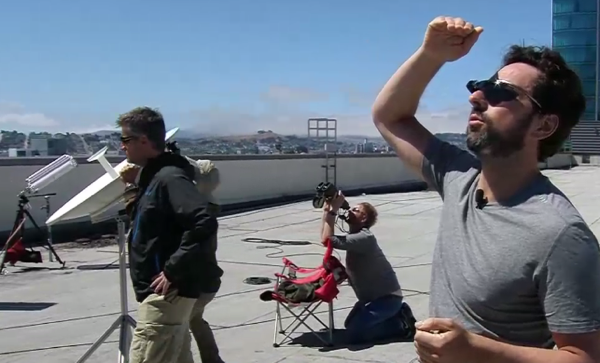
Below is Sergey giving a walk through of some of the behind the scenes. 

He has sun glass lens inserts in the Google Project Glasses.  There are multiple antennas on different frequencies pointing at the blimp.

NewImage

Sergey welcomes the jumpers landing on the roof.

NewImage

Shot of camera crew following the action.

NewImage

NewImage

Google's Future Cloud Service: Project Glasses Demo Video

Google is adding more and more data center capacity.  What are they doing besides search, Youtube, and GMail.

Check out this video for a future Google Cloud Service: Project Glasses.

Here are more details if you would like to read instead of watch.

Google wants developers to take a leap with Project Glass

Sergey Brin’s extreme sports demonstration of Project Glass at Google I/O will likely go down in history as one of the most daring tech conference stunts of all time: The Google co-founder stormed on stage Wednesday, interrupting the regular keynote to show off Google’s wearable computing project by joining a live Hangout session with a bunch of skydivers, who proceeded to jump out of a plane.