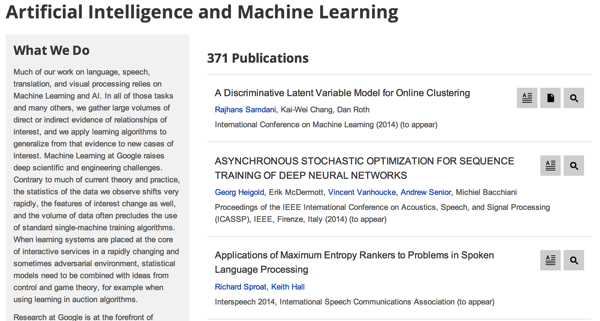
The way some people act, Machine Learning is something new. It is something that has been around for quite a while. To give you an idea Microsoft Research has 622 publications on the subject.
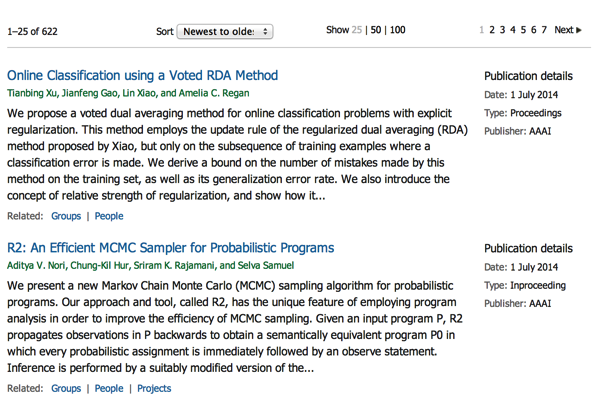
Google has 371 on the same subject.
Your Custom Text Here
The way some people act, Machine Learning is something new. It is something that has been around for quite a while. To give you an idea Microsoft Research has 622 publications on the subject.
Google has 371 on the same subject.
June 9, 2014 the Doodle 4 Google 2014 winner was on the home page. All of you google search users saw it. For those Bing users, this is what was on the page. What is it? It is a water purification thing drawn by 11 year old Audrey Zhang when she learned not everyone has clean water.
"To make the world a better place, I invented a transformative water purifier. It takes in dirty and polluted water from rivers, lakes, and even oceans, then massively transforms the water into clean, safe and sanitary water, when humans and animals drink this water, they will live a healthier life."
- Audrey Zhang, 11
Here is a video for the contest.
A week ago I was able to interview Google’s Joe Kava, VP of Data Centers regarding Better Data Centers through Machine Learning. The media coverage is good and almost everyone focuses on the potential for lower power consumption.
Google has put its neural network technology to work on the dull but worthy problem of minimizing the power consumption of its gargantuan data centers.
One of the topics I was able to discuss with Joe is the idea that accurately prediction of PUE and a mathematical model of the mechanical systems enables Google to focus on the Peak Demand during the billing period to reduce overall charges. The above quote says power consumption is dull. What is focusing on peak power demand? Crazy. Or you understand a variable cost of running your data center. :-)
How you get billed is complicated and varies widely depending
on your specific contract, but it’s important for you to understand your tariff. Without knowing exactly how you're billed for energy, it's difficult to prioritize which energy savings measures will have the biggest impact.
...
In many cases, electricity use is metered (and you are charged) in two ways by your utility: first, based on your total consumption in a given month, and second, your demand, based on the highest capacity you required during the given billing period, typically a 15-minute interval during that billing cycle.
To use an analogy, think about consumption as the number that registers on your car’s odometer – to tell you how far you’ve driven – and demand as what is captured on your speedometer at the moment when you hit your max speed. Consumption is your overall electricity use, and demand is your peak intensity, or maximum “speed.”
National Grid does a great job explaining this: "The price we pay for anything we buy contains the cost of the product plus profit, plus the cost of making the product available for sale, or overhead.” They suggest that demand is akin to an overhead expense and note that “this is in contrast to charges…customers pay for the electricity itself, or the ‘cost of product,’ largely made up of fuel costs incurred in the actual generation of energy. Both consumption and demand charges are part of every electricity consumer’s service bill.”
When you think about the ROI of reducing your energy consumption the business people should understand the overall consumption and the peak demand of its operations. Unfortunately it is all too common for people to focus only on the $/kWhr.
Google can look at the peak power consumption and see if there are ways the PUE could be improved to reduce the peak power for the billing period.
Here are tips that can help you shave peak demand.
Depending on your rate structure, peak demand charges can represent up to 30% of your utility bill. Certain industries, like manufacturing and heavy industrials, typically experience much higher peaks in demand due largely to the start-up of energy-intensive equipment, making it even more imperative to find ways to reduce this charge – but regardless of your industry, taking steps to reduce demand charges will save money.
...
Consider no or low-cost energy efficiency adjustments you can make immediately. When you start up your operations in the morning, don't just flip the switch on all of your high intensity equipment. Consider a staged start-up: turn on one piece of equipment at a time, create a schedule where the heaviest intensity equipment doesn’t all operate at full tilt simultaneously, and think about what equipment can be run at a lower intensity without adverse effect. You may use more kWh – resulting in greater energy consumption or a higher “energy odometer” reading as discussed above – but you'll ultimately save on demand charges and your energy bill overall will be lower.
I was curious on how Google’s Data Center Machine Learning news would spread.
At 1a on May 28, 2014 google posted on its main company blog with this kind of traffic over the past two days.
The following are three posts that went live at 1a PT May 28, 2014 as well with the google post and they were able to interview Joe Kava, VP of Data Centers
http://gigaom.com/2014/05/28/google-is-harnessing-machine-learning-to-cut-data-center-energy/
Google’s head of data center operations, Joe Kava, says that the company is now rolling out the machine learning model for use on all of its data centers. Gao has spent about a year building it, testing it out and letting it learn and become more accurate. Kava says the model is using unsupervised learning, so Gao didn’t have to specificy the interactions between the data is — the model will learn those interactions over time.
http://www.datacenterknowledge.com/archives/2014/05/28/google-using-machine-learning-boost-data-center-efficiency/
http://www.wired.com/2014/05/google-data-center-ai/
The Wired article spun the machine learning as an Artificial Brain which gave them more traffic than others.
But as I wrote Google’s machine learning is not really AI the way people would think.
BTW, in looking at the other articles, I realized my mistake. In my post at 1a on May 28, I was a total nerd and got focused on the technology and didn’t mention Joe Kava’s name in my post even though I had interviewed him. Damn.
Throughout the day the rest of the tech media were able to add their own posts. I don’t know about you, but I am pretty impressed that Google was able to execute a media strategy that got the range of tech media to post on its Going Beyond PUE with Machine Learning. PUE is not something widely discussed beyond the data center crowd.
Note the ComputerWeekly post was at the event where Joe Kava Keynoted and got 10 minutes of Joe’s time.
My 10 minutes with Google's datacentre VP
ComputerWeekly.com (blog) - May 28, 2014Google's Joe Kava speaking at the Google EU Data Center Summit (Photo credit: Tom Raftery) ... Google's network division, which is the size of a medium enterprise, had a technology refresh and by spending between $25,000 and $50,000 per site, we could improve their high availability features and improve their PUEs from 2.2 to 1.5. The savings ... As more volumes of data are created and as mass adoption of the cloud takes place, naturally it will require IT to think about datacentres and its efficiency differently.Google Blog: Better Data Centers Through Machine Learning
PCBDesign007 - May 28, 2014It's no secret that we're obsessed with saving energy. For over a decade we've been designing and building data centers that use half the energy of a typicaldata center, and we're always looking for ways to reduce our energy use even further. In our pursuit ...Google is improving its data centers with the power of machine learning
GeekWire - May 28, 2014google-datacenter-tech-05 In its continuing quest to improve the efficiency of its data centers, Google has found a new solution: machine learning. Jim Gao, an engineer on the company's data center team, has been hard at work on building a model of how ...Google crafts neural network to watch over its data centers
Register - May 28, 2014The project began as one of Google's vaunted "20 per cent projects" by engineer Jim Gao, who decided to apply machine learning to the problem of predicting how the power usage effectiveness of Google's data centers would change in response to tweaking ...Google's Machine Learning: It's About More Than Spotting Cats
Wall Street Journal (blog) - May 28, 2014Google said in a blog post Wednesday that it is using so-called neural networks to reduce energy usage in its data centers. These computer brains are able to recognize patterns in the huge amounts of data they are fed and “learn” how things like air ...Google data centers get smarter all on their own -- no humans required
VentureBeat - May 28, 2014While most of us were thinking that research would turn out speech recognition consumer products, it actually turns out that Google has applied its neural networks to the challenge of making its vast data centers run as efficiently as possible, preventing the ...Google AI improves datacentre energy efficiency
ComputerWeekly.com - May 28, 2014“Realising that we could be doing more with the data coming out of datacentres, Jim studied machine learning and started building models to predict – and improve – datacentre performance.” The team's machine learning model behaves like other machine ...Google taps machine learning technology to zap data center electricity costs
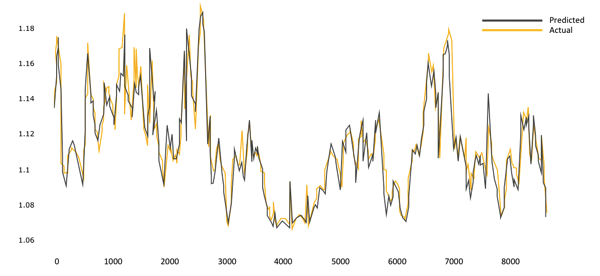
Network World (blog) - May 28, 2014Google is using machine learning technology to forecast - with an astounding 99.6% accuracy -- the energy usage in its data centers and automatically shift power to certain sites when needed. Using a machine learning system developed by its self ...Google's machine-learning data centers make themselves more efficient
Ars Technica - May 28, 2014Google's data centers are famous for their efficient use of power, and now they're (literally) getting even smarter about how they consume electricity. Google today explained how it uses neural networks, a form of machine learning, to drive energy usage in its ...Google is harnessing machine learning to cut data center energy
Bayoubuzz - May 28, 2014Leave it to Google to have an engineer so brainy he hacks out machine learning models in his 20 percent time. Google says that recently it's been using machine learning — developed by data center engineer Jim Gao (his Googler nickname is “Boy Wonder”) ...Google turns to machine learning to build a better datacentre
ZDNet - May 28, 2014"The application of machine learning algorithms to existing monitoring data provides an opportunity to significantly improve DC operating efficiency," Google'sJim Gao, a mechanical engineer and data analyst, wrote in a paper online. "A typical large-scale ... These models can accurately predict datacentre PUE and be used to automatically flag problems if a centre deviates too far from the model's forecast, identify energy saving opportunities and test new configurations to improve the centre's efficiency. "This type of ...
I threw two posts(1st post and 2nd post) up on Google’s use of Machine Language in the Data Center and said I would write more. Well here is another one.
Does Google’s Data Center Machine Language Model have a debug mode? The current system describes the use of data collected every 5 minutes over about 2 years.
184,435 time samples at 5 minute resolution (approximately 2 years of operational data
One of the methods almost no one does is debug their mechanical systems as if you were debugging software.
Debugging is a methodical process of finding and reducing the number of bugs, or defects, in a computer program or a piece of electronic hardware, thus making it behave as expected. Debugging tends to be harder when various subsystems are tightly coupled, as changes in one may cause bugs to emerge in another.
What would debugging mode look like in DCMLM (my own acronym for Data Center Machine Language Model)? You are seeing performance that looks like the subsystem is not performing as expected. Change the sampling rate to 1 second. Hopefully the controller will function correctly at a higher sample rate. The controller may work fine, but the transport bus may not. With the 1 second fidelity make changes to settings and collect data. Repeat changes. Compare results. Create other stress cases.
What will you see? From the time you make the changes in a setting how long does it take for you to achieve the desired state. At the 5 minute sampling you cannot see the transition and the possibly delays. Was the transition smooth or a step function. Was there an overshoot in value and then corrections?
The controllers have code running in them, sensors go bad, wiring connections are intermittent. How do you find these problems? Being able to go into Debug mode could be useful.
If Google was able to compare detailed operations of two different installations of the same mechanical system, then they could find whether there was a problem that is unique to a site. Or they may simply compare the same system at different points of time.