Google's Alabama DC has 198 posts with one post talking to Urs Hölzle and Joe Kava

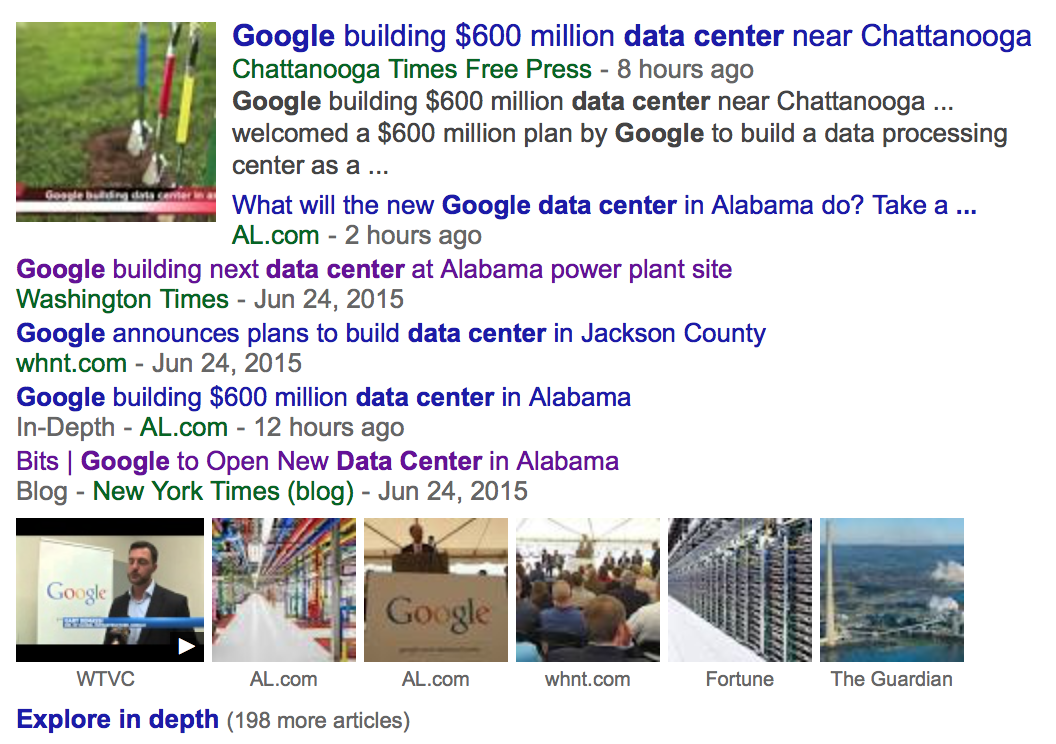
Google yesterday announced its new Alabama DC and coverage is significant with 198 posts.
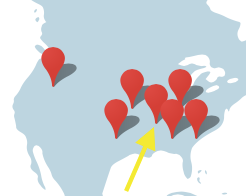
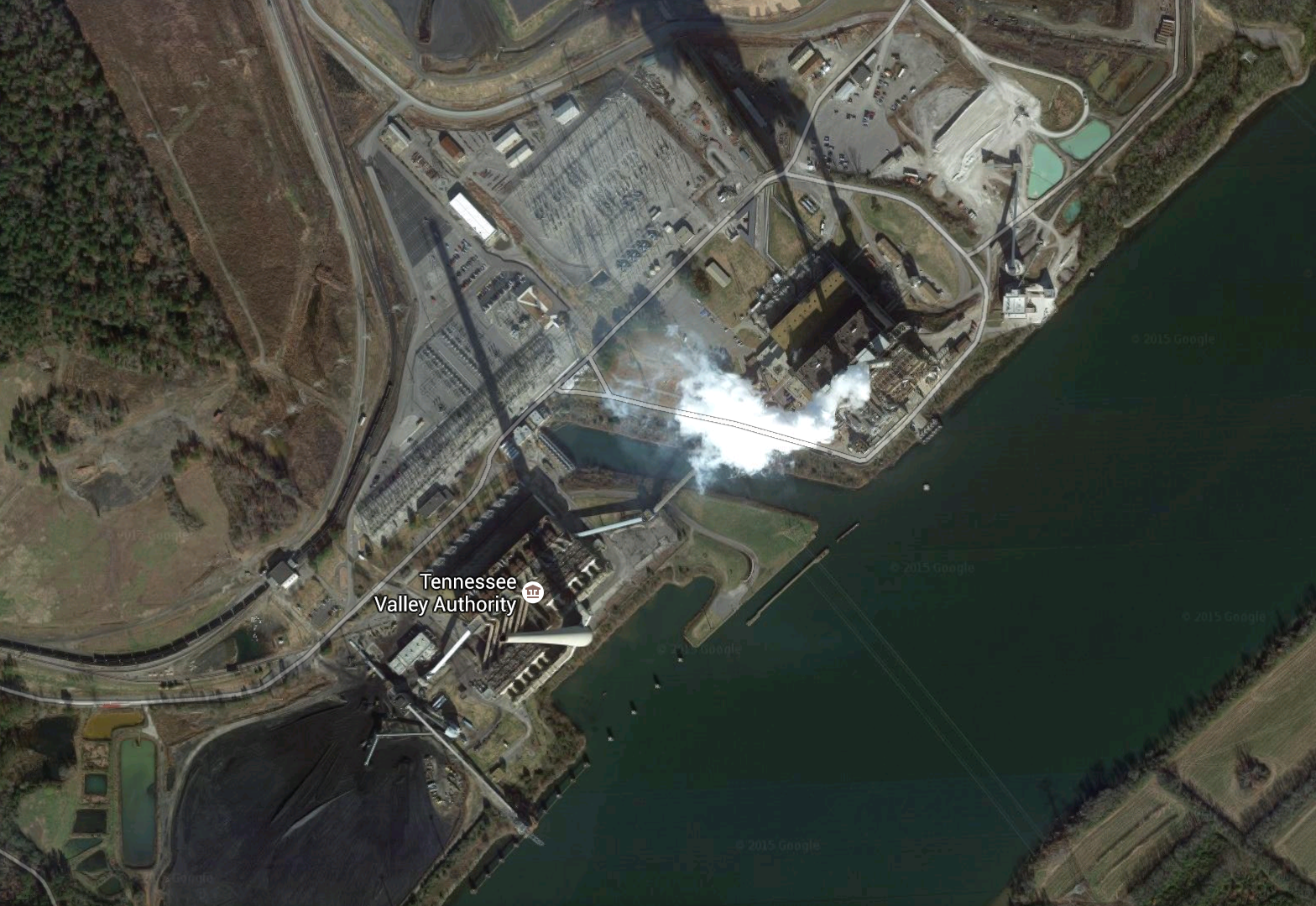
Google has been expanding capacity in LATAM, EU, and APAC for years since it has made a land purchase in the US.  When you look at the location of the Jackson County Alabama DC in the middle of the cluster of 5 existing facilities I would place bets that Google could build more at this one site than any other.  How big?  The Alabama site originally had 8 coal fired units.  The last one produced 460MW.  Times 8 that is almost 4GW of power transmission infrastructure and water to cool down the plant.
The official Google post is here.  http://googleblog.blogspot.com/2015/06/a-power-plant-for-internet-our-newest.html

What is not in the Google post are some quotes from Google's Urs Hoelzle and Joe Kava which the NYTimes covered.  http://bits.blogs.nytimes.com/2015/06/24/google-to-open-new-data-center-in-alabama/

Urs says...

“Data centers are attractive customers” to power suppliers, said Urs Hölzle, Google’s senior vice president for technical infrastructure. In turn, he said, “bringing in alternative power was important to us.”

“In the next 12 months, we will look at plausible projects,” he said. While wind power appears to be the furthest along in producing energy cheaply, he noted that Google had already done a solar energy project in South Africa.

Joe says

“We are looking to do a similar type of approach as Finland” in Alabama, said Joe Kava, who leads data center construction at Google. Like many Google sites, he said, Alabama will be “a campus model with multiple buildings.”

Google appears to be on something of a construction binge, with data center expansions in the United States, Singapore, and Belgium just over the last few months. This may be partly because of demand, and partly to risk management on Google’s part. By having several construction projects underway, Mr. Kava said, the chances of a shortfall in overall capacity from a slowdown at one project were minimized.

The Alabama site could be the biggest Google data center location until they buy a bigger one.

Where will Spanish Language News grow as Google News shuts down in Spain?

Spain's government has implemented a Google Tax on Google News and Google on Dec 16th will be shutting down its news.google.es site.

But sadly, as a result of a new Spanish law, we’ll shortly have to close Google News in Spain. Let me explain why. This new legislation requires every Spanish publication to charge services like Google News for showing even the smallest snippet from their publications, whether they want to or not. As Google News itself makes no money (we do not show any advertising on the site) this new approach is simply not sustainable. So it’s with real sadness that on 16 December (before the new law comes into effect in January) we’ll remove Spanish publishers from Google News, and close Google News in Spain.
— http://googlepolicyeurope.blogspot.com/2014/12/an-update-on-google-news-in-spain.html

Media like the Washington Post cover the news of Google News shutting down.

Earlier this year, Spain passed a rather egregious amendment to its copyright law (to take effect in the New Year), purportedly as some kind of anti-piracy move, but more aptly called the “Google tax” by some observers. The law gives Internet publishers a right to compensation for the use of “snippets” of their content by news aggregator sites (like Google News). And not just a right to compensation: an inalienable right to compensation, one that publishers cannot waive or bargain away (in return, say, for being included in the new aggregator listings).
— http://www.washingtonpost.com/news/volokh-conspiracy/wp/2014/12/11/google-news-to-move-out-of-spain/

Out of curiosity I looked up what % of the spanish speaking population is in Spain.  11%.  Mexico has over twice the spanish speaking population than Spain and could take up the slack of Spanish news that disappears from Google News.  Columbia and Argentina are close to Spain.

So it is quite possible that Spain disappearing from Google News will be something that will be a non event to most and the biggest impact is in Spain.  Seems like it would be easy for Spain users who want to still use Google News in Spanish to switch from news.google.es to something like Mexico http://news.google.com.mx/


Mexico De facto[3] 120,286,655 Academia Mexicana de la Lengua Mexican Spanish
Spain De jure[4] 47,737,941 Real Academia Española Peninsular Spanish
Colombia De jure[5] 46,245,297 Academia Colombiana de la Lengua Colombian Spanish
Argentina De facto[6] 43,024,374 Academia Argentina de Letras Rioplatense Spanish
Peru De jure[7] 30,147,935 Academia Peruana de la Lengua Peruvian Coast Spanish
Venezuela De jure[8] 28,868,486 Academia Venezolana de la Lengua Venezuelan Spanish
Chile De facto[9] 17,363,894 Academia Chilena de la Lengua Chilean Spanish
Ecuador De jure[10] 15,654,411 Academia Ecuatoriana de la Lengua Ecuadorian Spanish
Guatemala De jure[11] 14,647,083 Academia Guatemalteca de la Lengua Guatemalan Spanish
Cuba De jure[12] 11,047,251 Academia Cubana de la Lengua Cuban Spanish
— http://en.wikipedia.org/wiki/List_of_countries_where_Spanish_is_an_official_language


The Cloud Battle, A War to Sell Data Center Bits - Amazon, Google, Microsoft

This time of year is turning into a Cloud Battle, a war between Amazon, Google, and Microsoft to deliver bits as a service from data centers. iPhone vs. Android is a battle of mobile bits.  OS X vs. Windows 7/8/10 is a battle of desktop bits.  The Cloud is a battle to deliver bits as a service from data centers.

Microsoft had their cloud, and Google just finished theirs.  Next week is AWS Reinvent.  The media covers the battles.

Google's Newest Attack On Amazon

When I read so many of the media articles though I think they are focused on how big fleet is or the latest technology.  Huh?  Like this article makes the point of measuring the naval power by the tonnage of the fleet misses the point.

Measuring Naval Power: Bigger Ain’t Always Better

...

Navies were largely symmetrical in those thrilling days of yesteryear. That simplified matters. Size was a decent proxy for fighting power when battle fleets made up largely of capital ships bearing big guns squared off. That was before the era — an era that persists to this day — when small craft could carry armament comparable to that of capital ships. A destroyer couldn’t tote big guns back then. A lowly missile boat or sub can fire munitions comparable to those of a capital ship today — and to the same deadly effect.

I have got a chance to close hand see how executives at Google (Urs Hoelzle), Amazon (Werner Vogel), and Microsoft (Scott Guthrie) perform at Gigaom Structure on stage and behind.  It’s kind of like seeing the Generals/Admirals of the military.

This is not a simple battle where more servers and more MW of data center capacity win the war.  How well your team operates using the technology which in the case of the bits (software) was created by other team members is so important.

I think I could write a whole book on the battles between between Google, Amazon, and Microsoft. In fact, I am sure there is someone who has already made a book proposal for this.  Unfortunately or fortunately, I am too busy working on other things to document things in an entertaining way to sell a book.  What I can do is watch as an observer to see strategies being played.

The Cloud Battle may be one of the most interesting technology wars fought with billions of dollars of data centers and IT equipment and 10,000s of development staff, reaching around the world.

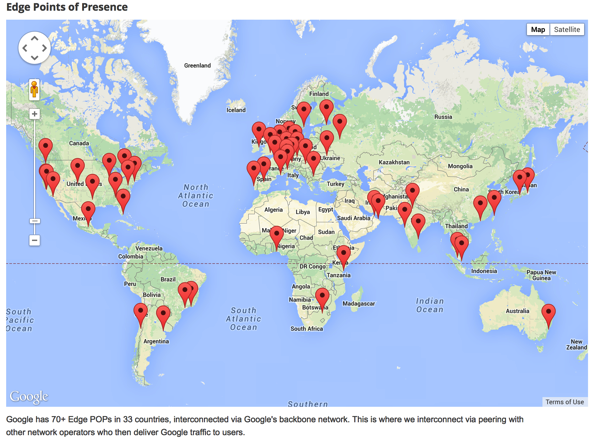
Below is Google’s Points of Presence.

NewImage

Oh, one point I do want to make that I forgot is.  Just like Sun Tzu the Art of War Point 18.  “All warfare is based on deception”  The good know how to deceive the enemy and they can use the media to spread the deception.  Don’t believe everything you read.

18. All warfare is based on deception.

Google's Focus on Performance improves Data Center PUE 8 - 25%, finding the hidden story in the data

Google announced its use of Machine Learning to improve its data center PUE in May 2014 and I posted on the release.  At 7x24 Exchange Fall 2014 event, 25 years of 7x24 Exchange were celebrated and Google’s Joe Kava, VP of Data Centers presented on “Google - beyond the PUE Plateau.”  The keynote is one of the more interesting and insightful presentations made as Google shared information on its experience deploying Machine Learning to its data center fleet.  One of the questions from the audience was “how was the first data center chosen to use Machine Learning?”  A special guest in the presentation was the data center mechanical engineer who spearheaded the project, Jim Gao.  His answer.  The data center that has most clean data to work with.

NewImage.png
NewImage.png

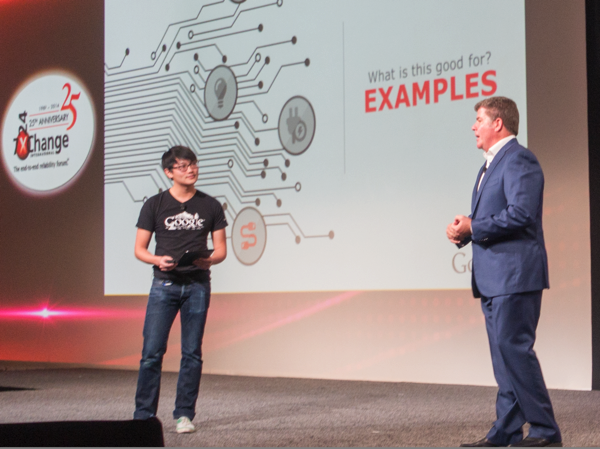
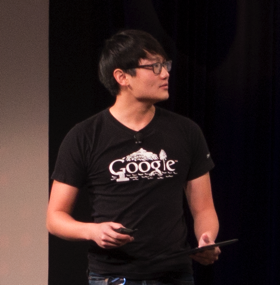
Jim Gao and Joe Kava, 7x24 Exchange Fall Conference.

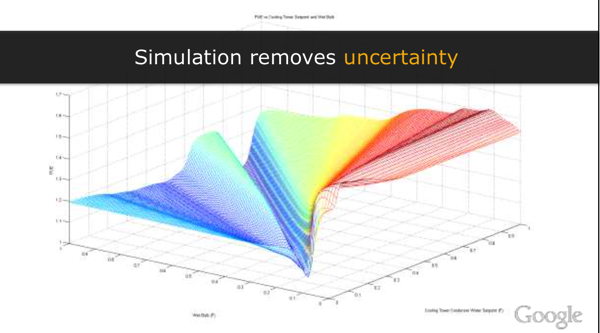
So what can this 25 year old mechanical engineer do with Machine Learning?  Below is data showing PUE, Wet Bulb, and Cooling Temperature across a range. The Blue areas are good, green not as good, yellow and red are bad.

NewImage.png
NewImage.png

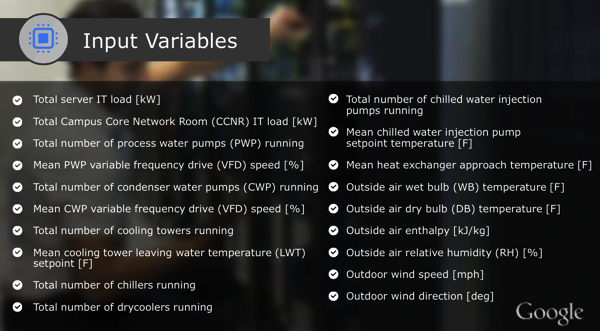
Some of you may be saying big deal.  I can figure out how to run the mechanical systems with a low PUE at a given wet bulb temperature to hit a given cooling temperature.  Well the above was a graph to illustrate what can be seen looking at performance data.  What is beyond our ability to see is working out the best way to run your mechanical systems with 19 Input Variables.  The below are the 19 inputs to the Predictive PUE Machine Learning system to figure out the lowest energy consumption.

NewImage.png
NewImage.png

FYI, this predictive PUE system does not have autonomous control over mechanical systems.  It does provide information to the data center facility engineering teams on how they can improve PUE performance.  The predictive PUE model is 99.6% accurate.  Jim and Joe discussed how Google looked for a high degree of confidence in order to trust the numbers, and the human operators are an important part of the process like UPS drivers on their route.  UPS is famous for creating better routes for its drivers, but I bet they were not even close to the % savings Google achieved.

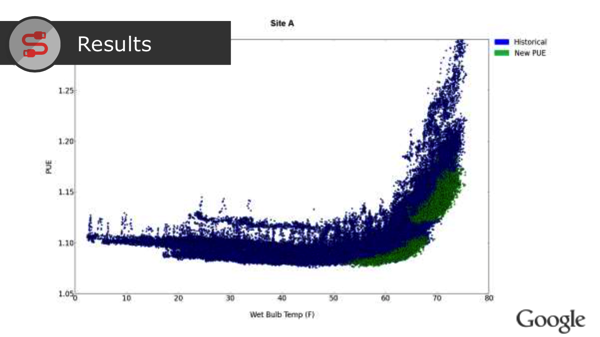
So how good are the results?  Google achieved from 8% to 25% reduction in its energy used to cool the data center with an average of 15%.  Who wouldn’t be excited to save an average of 15% on their cooling energy costs by providing new settings to run the mechanical plant?  Below is an example of what was historical PUE (blue) and New PUE (green) for a site.

NewImage.png
NewImage.png

One of the risks Google took in this presentation is they let a 25 year old mechanical engineer get on stage.  Was the risk of the kid presenting?  No, Jim was as polished as many who have presented for years.  The risk was everyone at 7x24 Exchange knew who Jim was and they could try and see if he would consider leaving Google.  :-)

NewImage.png
NewImage.png

The idea of using Machine Learning in data centers is new and have shown what can be discovered in the data.  It’s like there was a hidden story there waiting to be told.  Does you data center staff look for hidden stories in the data?  Shouldn’t you if you can save between 8-25% of the energy in systems.

15+ years of Google Data Center Executives

I wrote a popular post on 10 years of Microsoft data center executives.  Writing about Google’s data center executives is a good follow up.

Google’s current Data Center executive leadership are Urs Hoelzle, Ben Treynor, and Joe Kava.  Urs has no LinkedIn profile, but he does have a wikipedia post and has been with Google since the beginning being Google employee #8.  The data center group is part of Ben Treynor’s organization. Ben joined Google in 2003.  VP of Data Centers is Joe Kava, joining Google in 2008.  

Urs posted on its Google datacenter in 1999.

Shared publicly  -  Feb 4, 2014
 
 
15 years ago (on Feb 1st, 1999) I first set foot in a Google datacenter. Well, not really -- in the Google cage in the Exodus datacenter in Santa Clara.  Larry had led me there for a tour (I wasn't an employee yet) and it was my first time in any datacenter.  And you couldn't really "set foot" in the first Google cage because it was tiny (7'x4', 2.5 sqm) and filled with about 30 PCs on shelves.  a1 through a24 were the main servers to build and serve the index and c1 through c4 were the crawl machines.
 

It is not easy to find who were people who were data center executives from 1999 to 2003.  Ben Treynor in 2003 was the start of the site reliability engineering at Google and according to Ben’s linkedin profile he picked up the data center group in 2010 and in 2014 is responsible for the Google Cloud.

Vice President, Engineering

Google

October 2003 – Present (11 years 1 month)Mountain View, CA

Responsibilities:
Site Reliability Engineering: 2003-present
Global Networking: backbone, egress, datacenter, and corporate: 2004-present
Global Datacenters: construction, engineering & operations: 2010-present
Global Servers: operations 2010-present
Google Cloud: 2014-present

Joe Kava has been the consistent presenter from Google on what is happening in the data center group, presenting at 7x24 Exchange, Uptime Symposium, Datacenter Dynamics, and many other industry events.

Vice President - Data Centers

Google

April 2008 – Present (6 years 7 months)Mountain View, California

Responsible for design, engineering, construction, operations and sustainability for Google's global data centers.