HP Labs announces 3 Green IT projects - Sustainable Data Center, Replacing Copper with Light, and Modeling/Measuring Energy & Resource Use

HP Labs has a press release on their 3 new Green IT initiatives.  This is part of the battle between HP and IBM for green data center solutions in the enterprise. Much of what is mentioned in this press release are the same type of things I've seen the IBM guys talk about.

HP today announced new research initiatives from HP Labs, the company’s central research arm, aimed at developing new technologies and business models that leave a lighter carbon footprint.

Initially, HP Labs will focus its research in sustainability on three major projects, including: an industry-first initiative to reduce the carbon footprint of data centers by 75 percent; groundbreaking research to replace copper wiring in servers with laser light beams; and tools for measuring and managing the amount of energy used to develop products.

Sustainability is one of five major research themes of the newly redesigned HP Labs, which recently refocused its efforts to address the most complex challenges facing technology customers in the next decade.

“HP’s long-standing commitment to the environment is second to none in the technology industry. Today, HP Labs extends our dedication with these important research initiatives that will advance the state of the art in sustainable IT,” said Prith Banerjee, senior vice president, research, and director, HP Labs. “HP Labs will lead the industry in developing the technology that could dramatically reduce energy consumption and the carbon footprint of entire industries.”

It is good to see the efforts in optical networking to replace copper is a priority.

Photonic interconnections make it possible to fit dozens, and eventually hundreds, of processors on server system chips. In addition, the optical connections are 20 times more efficient than what is on the market today and will save companies multiple gigawatts of power annually, thus driving down IT costs. The photonic interconnects, which range in distance from 100 meters to 100 nanometers, also enable more flexible system configurations that can be quickly redeployed based on business needs.

Read more

More Details on Dell's XS23 server used in Cloud Computing, HPC, & Containers, designed for high energy efficiency

Dell has more details on its XS23 Cloud Server.  Seems like this is the kind of server's good for containers as well.

XS23 Cloud Server

Tue. May. 13, 2008

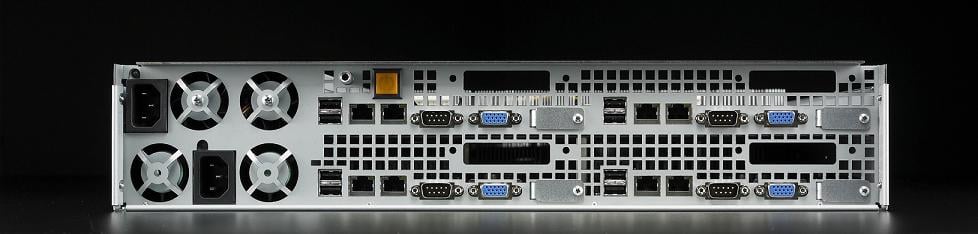
There has been some recent press around some of the equipment we’ve developed in our cloud computing group. The core of our business is essentially a consulting and design service and developing new products for customers is a big part of the fun. Because these aren’t mainstream PowerEdge systems, we don’t get the chance to show them off as much as we’d like. Our group has been talking for some time about “optimized designs” for cloud and hyperscale computing without showing what that can really mean, so it’s time to unveil something that’s come out of the lab.  Pictured here is one of our favorites: the XS23.

image

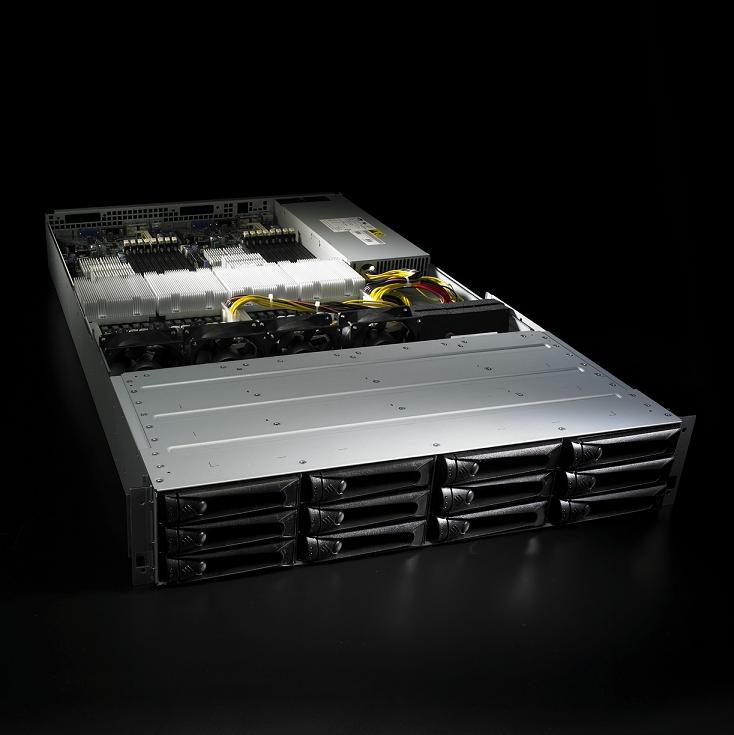
XS23 front – twelve 3.5” SAS or SATA drives; 3 per server

This product was designed for a customer that needed maximum compute density, a healthy amount of local disk and, of course, lowest power draw possible. Our architecture team threw all that in the blender and out came a 2U standard rack mount chassis that houses four dual-socket servers and twelve 3.5” hot plug drives.

image

The energy efficiency design is driven by customer requirements. Yippeee!!! Cloud Computing and HPC customers are driving the requirements for Greener HW designs.

This was expressly designed for an environment with high node failure tolerance - a cloud application. By designing out a lot of the capabilities that weren’t required (like redundant power) we were able to deliver the performance and power profile required. Efficiencies are gained by shared resources - as seen in a lot of general purpose designs available today. We think the key to designing the perfect cloud server is knowing where to stop and also what not to build in. This is a function of each customer’s unique design goals.

Read more

Microsoft's Data Center Purchases Influencing Hardware Efficiencies, Dell joins Container Vendor List

Data Center Knowledge and The Register report on Dell joining the Container list of suppliers, Rackable, Sun, and Verari.

Dell Inc. (DELL) is building a data center in a shipping container for a customer, and will follow with a container product line. "We have (a container system) in the works for a customer," a Dell insider told The Register. "We are looking at that space very, very closely." The Register's Ashlee Vance said it appears Dell has "geared up a container for Microsoft's late April RFP."

The "data center in a box" concept has been embraced by Microsoft, which plans to pack between 150 and 220 40-foot containers into the first floor of its new Chicago data center. Microsoft executives say the new facility will house up to 300,000 servers.

Dell joins a growing herd of hardware vendors offering container solutions, including Sun Microsystems (JAVA), Rackable (RACK) and Verari Systems all report strong interest in their container products. Last month IBM said its new iDataPlex series of cloud computing servers is being offered in a 40-foot trailer, marking IBM's first foray into container-based systems.

Dell squeezes cloud into a shipping container

By Ashlee Vance in Santa Clara More by this author

9 May 2008 19:22

® [Printer] [Mobile]

Exclusive Sun Microsystems endured a lot of ribbing when it first popped out a data center in a shipping container. Now, however, it looks like all the majors are heading in that direction, including Dell, which The Register has learned has a containerized data center in development.

"We have (a container system) in the works for a customer," said a Dell insider. "We are looking at that space very, very closely."

All of the focus on containers is highlighting an interesting change Microsoft has made on the Data Center hardware industry. In the past, Microsoft has written hardware specification documents like this one.

This publication is the first in the Hardware Support and Directions for Windows Server series, which shares the Microsoft intention and investment direction for support of specific hardware technologies in current and future releases of the Windows Server operating system. This series focuses on Windows Server features that are relevant to the hardware capabilities of a server.

This is soft pitch to server OEMs and other hardware vendors to build good Windows Server boxes. This document will not drive big changes.

Given the purchasing by Microsoft's data center properties (search, hotmail, maps,etc.) are now driving Server OEMs with custom RFPs like the CBlox RFP, OEMs are building exactly what Microsoft wants to run a more efficient data center. And, versus Google's model of requiring exclusive designs no one else in the industry can purchase, the Microsoft skus spill into the rest of the market.

To confirm the idea, here is speculation on ask.com's sku being marketed by Dell.

One system, however, really caught our attention and is worth some ink now. It's the XS23, which regular folk cannot buy.

Dell refuses to comment on the server publicly, although we managed to work some information about the hardware out of source.

The XS23 squeezes 4 two-socket servers (in a 2X2 stack) in a 2U chassis along with twelve 3.5 inch SAS/SATA drives across the front of the system. It was designed for a search company, which we believe was Ask.com.

As we understand it, the disk to DIMM count was very important for this search customer, who wanted three drives for every server. This design was enough for the unnamed customer to buy tens of thousands of systems, according to our source.

The Dell system consumes 25 per cent less space than your general purpose blades, which do about 16 two-socket servers in 10U. Dell, of course, stripped out the redundant power supplies and fans to get that density, but these cloud folks have software that can deal with failures just fine.

We even managed to obtain a couple photos of the XS23. The big daddy shots are here and here.
One of the most valuable lists would be Microsoft's data center equipment RFPs and the equipment they chose, but don't hold your breath waiting for Microsoft to make this publicly available. It would be a PR disaster with almost every Server OEM screaming. 

Read more

Network Vendors compete for Green Data Center Market at Interop

Whenever I talk about Green efforts in the data center, I try talking to the network guys, but the response is usually the power costs for our network are not significant. Well at Interop Green IT has arrived with Nortel pushing the competition.

ComputerWorld reports on Interop and Green IT's Appeal.

May 2, 2008 (Computerworld) LAS VEGAS -- Green IT was a major theme at Interop this week, as vendors outbid one another on how well their networking gear could lower power consumption to help save the planet.

Some of the green IT claims were not-so-veiled attacks on the biggest switching and routing vendor, Cisco Systems Inc. In response to comments from competitors, Marie Hattar, Cisco's vice president of network systems and security, demurred in an interview, "We didn't want to go with the 'greenwashing' treatment."

Hattar's comment aside, Nortel Networks Corp. cited a January study by The Tolly Group Inc. that said some of Nortel's networking gear uses 50% less power than Cisco gear. Joel Hackney, president of enterprise solutions at Nortel, said in an interview that Tolly and other studies have shown Nortel data center gear, in addition to being more energy-efficient, can offer 20 times the performance and seven times the resiliency (meaning submilliseconds of recovery time from an outage) of Cisco's and other competing products.

The market even has vendors developing network measurement tools.

The assessment of green IT was picked up by at least one other vendor, Calabasas, Calif.-based Ixia, which demonstrated a proof-of-concept testing system for measuring power efficiency in relation to network and application load. Areg Alimian, technical product manager at Ixia, said tools are lacking for making such measurements. The company is providing the technology used by Miercom in its Certified Green testing process.

Cisco believes in the Green Messaging as well.  See the Al Gore and John Chambers webcast.

Al Gore, John Chambers and Sue Bostrom will come together in a virtual unified communications environment before a live audience of technology leaders to examine the critical role that innovation can play in mitigating climate change. The virtual discussion will also be streamed live via a webcast session for general viewing.
This event marks a technological breakthrough showcasing a new way of communicating and collaborating in which the panelists will appear as if they are in the same room even though they will be thousands of miles apart. This unique virtual discussion will take place via the Cisco TelePresence system with John Chambers, Al Gore and Sue Bostrom addressing live audiences simultaneously in London, England, Orlando, Fla.,and several other locations around the world.

Read more

Sun buys Processor Startup to improve performance and power consumption

Sun purchased processor start-up Montalvo systems for asynchronous processor core technology, potentially improving performance and power consumption. The ideas makes sense to mix different processor core technologies to meet the different needs.

Montalvo is believed to be working on a low-power processor that aims to compete with chips from Intel and Advanced Micro Devices. The unique feature of Montalvo's design is the use of asynchronous processor cores. Instead of multiple, identical cores found in Intel's chips, Montalvo reportedly plans to use different types of cores, some more powerful than others, on the same chip to improve performance and keep power consumption low.

Read more