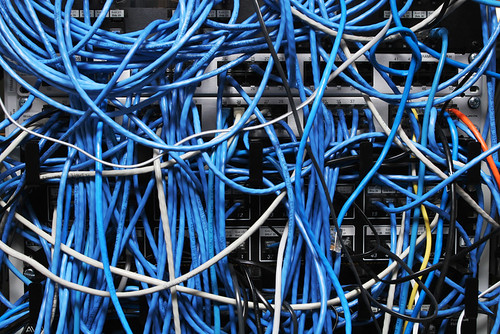
Spring Cleaning in the Data Center, address that cable mess

The general rule of thumb is network gear comprises 10% of the power use in the data center, but the network cannot affect your power consumption by throttling IO on servers, and blocking air flow.

We've all seen this photo as cable nightmare with a massive cooling impact to the IT equipment.

cable_mess.jpg

As part of the conversation I had with Rackforce's Brian Fry was their strategy to use Cisco Nexus switches with only two cables per server.

Cisco has their own article on the cable problem that is closer to what can occur than the above photo.

Cisco Helping Untangle the Data Center

Cleaning up the cable mess is not a pleasant task, but it does have huge impacts.

Experts estimate that as much as 15 percent of the cost of data center equipment now goes to cabling. Multiple networks with their own sets of cables force data centers to buy extra equipment just to manage all the necessary connections, Borovick says.

More cables also means more energy demands. Cisco estimates companies can trim 20 to 30 percent off their power bill by simply reducing the number of cables and other equipment connecting their servers.

Industry experts also say that more simplicity in cabling is necessary for virtualization, the great hope for modernizing data centers for 21st century communications. "You need to clean up before you can move," Borovick says.

She says the situation has gotten out of control because the data center has evolved as three technological islands of different networks and various servers and data storage systems, each with their own communications technologies.

As it gets close to the first day of Summer, you've postponed the spring cleaning at home.  Cable messes are one of those things that get postponed as well.

Read more

Ubuntu's Founder saw questions being asked about ARM in server and cloud tracks

Mark Shuttleworth writes a post that got my attention.

At our last UDS in Belgium it was notable how many people were interested in the ARM architecture. There have always been sessions at UDS about lightweight environments for the consumer electronics and embedded community, but this felt tangibly different. I saw questions being asked about ARM in server and cloud tracks, for example, and in desktop tracks. That’s new.

Who is Mark Shuttleworth?

Biography

Mark is founder of the Ubuntu Project, an enterprise Linux distribution that is freely available worldwide and has both cutting-edge desktop and enterprise server editions, and has become very popular.

The founder of Ubuntu felt tangible different at the Ubuntu Developer Summit seeing enthusiasm for ARM based Servers and Cloud Computing.

And Mark is excited about the Linaro announcement.

So I’m very excited at today’s announcement of Linaro, an initiative by the ARM partner ecosystem including Freescale, IBM, Samsung, ST-Ericsson and TI, to accelerate and unify the field of Linux on ARM. That is going to make it much easier for developers to target ARM generally, and build solutions that can work with the amazing diversity of ARM hardware that exists today.

Linaro is using open source ideas, and Mark plans to keep Ubuntu in sync with Linaro.

Linaro is impressively open: www.linaro.org has details of open engineering summits, an open wiki, mailing lists etc. The teams behind the work are committed to upstreaming their output so it will appear in all the distributions, sooner or later. The images produced will all be royalty free. And we’re working closely with the Linaro team, so the cadence of the releases will be rigorous, with a six month cycle that enables Linaro to include all work that happens in Ubuntu in each release of Linaro. There isn’t a “whole new distribution”, because a lot of the work will happen upstream, and where bits are needed, they will be derived from Ubuntu and Debian, which is quite familiar to many developers.

For more information about Linaro here is an executive PDF.

image

And Mark does an excellent job of pointing out the value of Linaro.

The nature of the work seems to break down into four different areas.

First, there are teams focused on enabling specific new hardware from each of the participating vendors. Over time, we’ll see real convergence in the kernel used, with work like Grant Likely’s device tree forming the fabric by which differences can be accommodated in a unified kernel. As an aside, we think we can harness the same effort in Ubuntu on other architectures as well as ARM to solve many of the thorny problems in linux audio support.

Second, there are teams focused on the middleware which is common to all platforms: choosing APIs and ensuring that those are properly maintained and documented so that people can deliver any different user experience with best-of-breed open tools.

Third, there are teams focused on advancing the state of the art. For example, these teams might accelerate the evolution of the compiler technology, or the graphics subsystem, or provide new APIs for multitouch gestures, or geolocation. That work benefits the entire ecosystem equally.

And finally, there are teams aimed at providing out of the box “heads” for different user experiences. By “head” we mean a particular user experience, which might range from the minimalist (console, for developers) to the sophisticated (like KDE for a netbook). Over time, as more partners join, the set of supported “heads” will grow – ideally in future you’ll be able to bring up a Gnome head, or a KDE head, or a Chrome OS head, or an Android head, or a MeeGo head, trivially. We already have goot precedent for this in Ubuntu with support for KDE, Gnome, LXE and server heads, so everyone’s confident this will work well.

The diversity in the Linux ecosystem is fantastic. In part, Linaro grows that diversity: there’s a new name that folks need to be aware of and think about. But importantly, Linaro also serves to simplify and unify pieces of the ecosystem that have historically been hard to bring together. If you know Ubuntu, then you’ll find Linaro instantly familiar: we’ll share repositories to a very large extent, so things that “just work” in Ubuntu will “just work” with Linaro too.

When you read this and go back to Mark's learning about the interest for ARM Servers, do you have any doubt Linux ARM Servers will be coming soon to the data center?

Read more

Green the Data Center with a Network Storage Solution, Flash Memory RAID array - 80% less power and 70% less servers

Greening the Data  Center is dominated in marketing messages by the big brands - Intel, HP, IBM, and EMC/VMware.  But, some of the greenest solutions are coming from small companies that introduce disruptive technologies.  As many of you know the Storage Systems can be big power users in the data center, requiring special power distribution for the high power density which then requires extra cooling.  Many of you would like to throw those storage systems out if you could.

How about if for the same cost as an EMC or NetApp storage solution you could consume 80% less power, shrink a rack of storage to 3U of space, and improve the server performance potentially removing 70% of the servers?  Violin memory announced their new storage solution.

image

MOUNTAIN VIEW, Calif. — May 25, 2010 — Violin Memory, Inc., provider of the world’s fastest and most scalable memory arrays, today announced the availability of the Violin Memory 3200 Flash Memory Array. The Violin 3200 is a redundant, modular 3U memory array that scales from 500GB to 10 Terabyte SLC NAND Flash and provides the industry’s best price/performance attributes using patent-pending Flash RAID technology.

...

“We are delighted by the customer response to the Violin 3000 series and our new Memory Array data center equipment category.” said Don Basile, CEO of Violin Memory. “The aggregation of flash modules into a Memory Array allows much higher performance and spike-free latency for enterprise applications – Database, data warehousing, VMware as well as custom applications all benefit from the order of magnitude price/performance improvements of Violin’s flash array technology.”

Versus SSD memory solution that are installed in PCIe slots like Virident and Fusion-IO which are useful for solutions like memcache, the Violin Memory solution looks like a NAS storage device and can improve the performance of a wider range of solutions like good old relational databases. 

Here is a top view of the 3000 Series Violin Memory storage appliance.

image

BTW, a bunch of the exec team at Violin Memory came from Fusion-IO, so if you were looking at Fusion-IO you should think about adding Violin memory to your eval list.  Violin Memory has the potential to be used in a lot more scenarios.

The Violin Memory is disruptive to the Server License model for those who make money on the number of processors, so you can expect resistance to a NAND Flash memory array.

I'll be meeting with Violin Memory tomorrow, so I should have more technical details in a future post.

Read more

Part 2, Why I didn't buy an iPad, CNET blogger shares his frustration

I wrote on Apri 30 that I got a Thinkpad X200 TabletPC instead of an iPad 3G.  The traffic I had on this post was above average. So, in the spirit of CNET news sharing his post on iPad experience, I'll write a little comparison.

CNET News blogger Brooke Crothers shares his iPad caveat.

by Brooke Crothers

Here's my second take on the iPad: Prospective buyers be warned; it's not a solution to any burning computing problem I know of. At least not yet.

As I wrote last week, with the glaring exception of no Adobe Flash support, I like the iPad's design. At the risk of repeating what many others have said: It's gorgeous, sleek, very portable, and easy to use.

Here is the picture of Brooke's iPad with the stand and keyboard.

image

(Credit: Brooke Crothers)

Here is my Thinkpad X200 Tablet with a Logitech MK605 stand, keyboard, and mouse.  It's nice having the mouse.  I have a logitech web cam which is better than I thought for skype calls.  CDRW/DVD is in the dock.  Video out.  A total of 6 USB ports.

Plus the screen is 8 inches above the desk vs. iPad at desk height.

And, Pen input.

image

Brooke shares some of his frustrations.

Now the bad news. Though I've tried to use the iPad as much as possible, that's getting harder and harder to do. In addition to porting it around the house to read news, watch videos, and do e-mail, I've endeavored to use it on the road too (I have the 3G version). So far, it has turned out to be only marginally useful.

My X200 Tablet is great.  No complaints.  I don't have the battery life of the iPad, but I am rarely away from power that long.

Brooke is more frustrated as he tries to use the iPad instead of a laptop.

It seems--so far, at least--that more often than not I'm banging into its limitations, which usually sends me scurrying back to my laptop. "Hmm, I could be doing this a lot more easily on my laptop?" is usually what comes to mind. Not always, but usually.

The problem is that too many things are done more efficiently on a laptop. And I won't go through the obvious laundry list of what most people use a portable computer for.

That said, I understand I'm overreaching: It's not meant to serve as a laptop replacement. And, further, I understand that there are plenty of people who use the iPad as an e-reader, gaming device, and generally as an enhanced platform for iPhone/iPod apps, as just some examples.

I am sure there are plenty of Mac lovers who are now carrying an iPhone, iPad and MacBook Pro when they travel.

For those of you who think the iPad is in a class by itself.  The NY Yankees classify the iPad as a laptop and are not allowed in the stadium.


Yankees ban iPad

by Chris Matyszczyk

Wherever you feel the need to have your iPad, I am happy. So, it seems, is the TSA. The New York Yankees, though, seem to float on a different boat.

A report from Yahoo Sports suggests that the Yankees have decided in all their infinite, historic wisdom that the iPad falls under its "No laptops" policy.

Spacekatgal, a poster on the IGN boards and who first caught Yahoo Sports' attention, said: "The security people told me it was not allowed and I was turned away at the gates. Why on earth would they have this policy? Terrorism concerns? I couldn't get an answer. I snuck it in under my jacket...I bring it to Fenway all the time and they don't care."

Yes, Boston's hallowed home is renowned for its relaxed and friendly demeanor. And the old "under the jacket" trick was first perfected by Stephen Colbert at the Grammys.

I know the Giants don't score many runs, but this was a little strange.

(Credit: Chris Matyszczyk/CNET)

Read more

Gaming Priorities shifting to overall experience vs. performance, Mac more stable than Windows

I found this article about Mac vs. Windows gaming performance, quoting Gabe Newell, making some points that my Apple friends and Mac users will take pleasure in vs. Windows.  The full podcast interview is here.

image

Also, said Newelll,"what's sort of surprising is how much more stable our games are on the Mac." Looking at the early data available from the Steam client, "the Mac is five times more stable than Windows" when using the metric of minutes played versus number of crashes.

Gaming is a segment normally focused on the graphics and processer performance.  System stability is not as high a priority as systems are over-clocked and liquid cooled to dissipate the heat.  Kind of sounds like some data centers with higher density computing and cooling problems.

Gabe Newell is the Founder of Valve Software.

Valve is the creator of Steam, the world’s largest online gaming platform. Steam turns any PC (and soon any Mac) into a gaming powerhouse by providing instant access to a huge library of titles, and by automatically keeping a user’s games completely up to date. With an active user-base of over 25 million, Steam also connects gamers with each other, making it easy to find friends, keep track of each other’s gaming activity, and easily play games together. Since its inception as a service for updating Valve’s own game Counter-Strike, Steam has grown to become a service used world-wide, translated into 21 languages, and with content servers on every continent (save Antarctica, but we’re sure that’s just a matter of time).

Who is Gabe Newell?

After dropping out of Harvard University[1] Newell spent thirteen years working for Microsoft Corporation, ultimately becoming a "Microsoft Millionaire." Newell has described himself as "producer on the first three releases of Windows".

Gabe makes the point that it is less about graphics performance and shifting to a focus on services, less about pixels and more about micro transactions and identity.

Newell remarked during the podcast that graphics performance is much less of a concern overall compared to finding ways to offer a better user experience, such as the greater stability on the Mac. "I think we're starting to enter a period where graphics performance is sort of a solved problem," Newell said. "We're moving away from loss-leading graphics approaches [of consoles] toward more of a service platform. It's less about pixels per second and more about micro-transactions and identity."

If gaming is making this shift to stop being obsessed about graphics and processor performance, does it make sense for data centers to take this same approach as well?

This article particular interesting personally because Gabe Newell was my first interview at Microsoft in 1992 and I was interviewing in Microsoft Mail group. Gabe took one look at my Apple and HP experience on my resume and said "you need to be talking to the Microsoft TrueType group."  I told him, I had enough of TrueType and fonts and was looking to do something different.  Gabe said, "no you are going to interview with TrueType group we are changing your interview schedule now."  My next interview was with Peter Pathe who was my Microsoft hiring manager and coincidentally I am having lunch with next week.

His may not be a household name as Microsoft (NSDQ:MSFT) names go. But Peter Pathe is a big mover and shaker.

After 215 years with the company, he's getting ready to retire and this Microsoft Press Pass Q&A shows off what he's done for the Big M. For one thing, ubiquitous Microsoft Word was Pathe's baby for 15 years.

Gabe Newell was a hard-core Microsoft Windows guy at one time and is now saying the Mac OS X is five times more reliable than Windows.  Who knows maybe after 18 years, I can get a chance to talk to Gabe about his servers in data centers for Steam gaming.

Read more