2x Storage and Performance for less cost, a greener storage solution?

StorageMojo has a post on Backblaze’s most recent open source storage solution.

2 years ago Backblaze, an online backup provider, open-sourced their storage pod design: 45 drives in a box (see Build a RAID 6 array for $100/TB). Now they’re back with v2: 45 3TB drives in a box with higher performance.

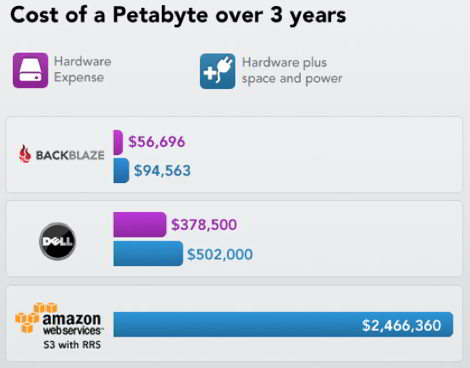
Backblaze uses this device for their storage service, and compare their costs vs. AWS S3.

And the savings over renting cloud storage can be substantial as this Backblaze chart suggests:

True, Amazon provides many more services, but if you need petabytes for mini-bucks, this is hard to beat.

Backblaze blog discusses its own savings.

Density Matters – Double the Storage in the Same Enclosure

We upgraded the hard drives inside the 4U sheet metal pod enclosure to store twice as much data in the same space. After the cost of filling a rack with pods, one datacenter rack containing 10 pods costs Backblaze about $2,100 per month to operate, roughly divided equally into thirds for physical space rental, bandwidth, and electricity. Doubling the density saves us half of the money spent on both physical space and electricity. The picture below is from our datacenter, showing 15 petabytes racked in a single row of cabinets. The newest cabinets squeeze one petabyte into three-quarters of a single cabinet for $56,696.

Backblaze Storage Servers in Datacenter

Our online backup cloud storage is our largest cost, and we are obsessed with providing a service that remains secure, reliable and, above all, inexpensive. We’ve seen competitors unable to react to these demands who were forced to exit the market, like Iron Mountain, or raise prices, like Mozy and Carbonite. Controlling the hardware design has allowed us to keep prices low

Is Seamicro SM1000 series the mainframe of the Web2.0 data centers?

There has been a bunch of press on Seamicro's latest SM1000 product.  The press release is here.

SeaMicro Introduces the SM10000-64HD, Setting Industry Record for Energy Efficiency and Compute Density

July 17, 2011

With 384 Intel® Atom™ Dual-core 1.66 GHz Processors; 768 64-bit Cores and 1,275 GHz in a 10 Rack Unit System

SUNNYVALE, Calif., July 18, 2011 – SeaMicro™, the Silicon Valley pioneer of low power server technology, today announced the immediate availability of the world’s most energy efficient 64-bit x86 server: the SM10000-64HD™. SeaMicro has once again defined best in class by improving its own compute density record by 150 percent and increasing its own industry leading compute per-watt metric by 20 percent. The new SM10000-64HD replaces 60 traditional servers, four top of rack switches, four terminal servers and a load balancer while using one-fourth the power and taking one-sixth space—all without requiring any changes to software.

I have been talking to a couple of people who have hands on experience with the Seamicro boxes.  One way to think about the Seamicro box is as if it is different type of mainframe.

Mainframes are designed to handle very high volume input and output (I/O) and emphasize throughput computing. Since the mid-1960s, mainframe designs have included several subsidiary computers (called channels or peripheral processors) which manage the I/O devices, leaving the CPU free to deal only with high-speed memory. It is common in mainframe shops to deal with massive databases and files. Gigabyte to terabyte-size record files are not unusual.[5] Compared to a typical PC, mainframes commonly have hundreds to thousands of times as much data storage online, and can access it much faster.[citation needed] Other server families also offload I/O processing and emphasize throughput computing.

Thanks the processor and high volume server wars, the data center in dominated by Intel Xeon based servers typically running in 2 processor configuration.  Few 4, 8, 16 processor configurations are sold.  For Big Iron for Amazon.com and eBay type of loads there are the Sun Servers for big Oracle databases, but Sun no longer has the presence in data centers it used to.

SPARC Enterprise M9000 Server

Oracle's most scalable mission-critical server for the largest, most demanding workloads

Designed for mission-critical environments, Oracle's SPARC Enterprise M9000 server delivers massive scalability, with up to 64 processors and 256 cores for the most demanding virtualization, consolidation, and multi-hosting deployments.

SPARC Enterprise M9000

Now the problem with a mainframe metaphor is mainframes are considered dying, but look how IBM has extended the life of the mainframe.

The safe thing to do for a Web 2.0 company is to continue down the path of low cost dual processor servers, networked with top of rack gigabit switches.

Even though some look at Seamicro in terms of the Intel Atom processor, I pay more attention to how Seamicro is solving the IO and networking issues that are typical bottlenecks for throughput.  Consider this job posting at Seamicro.

SeaMicro is looking for an experienced Senior Hardware Design Engineer to architect and implement a flexible and scalable networking solution for its next generation data center products. This is an excellent opportunity for high-energy candidates who can take a complex networking solution from conception, through execution, to first customer shipment.

Qualifications:

  • 10+ years of experience in high-performance/high-bandwidth micro-architecture
  • 10+ years of experience in Verilog RTL development, with some experience in design/development of networking chips
  • Experience with designs based on network processors, 10G interfaces, and DDR memory controllers desirable
  • Solid understanding of L2 Ethernet switching protocols including VLAN, Broadcast/Multicast, and LACP is a plus
  • Working knowledge of IPv4, IPv6, ACLs, and QOS

A better heat exchanger for that hot processor, The Sandia cooler

CNET reports on what they call a fanless heat exchanger.

Fanless heat sink design promises cooler, quieter CPUs

by Rich Brown

As a product category, CPU cooling hardware tends to offer few worthwhile developments, but a new heat sink concept from Sandia National Laboratories seems to offer tremendous promise for computers, as well as cooling appliances. Designed by researcher Jeffrey Koplow, the new "Sandia Cooler" does away with a separate fan component, and instead relies on the heat sink itself to disperse heated air.

The Sandia Labs press release is here.

Sandia’s “Cooler” technology offers fundamental breakthrough in heat transfer for microelectronics, other cooling applications

Jeff Koplow

Sandia’s Jeff Koplow makes an adjustment to an earlier prototype of his Air Bearing Heat Exchanger invention. The technology, as known as the “Sandia Cooler,” will significantly reduce the energy needed to cool the processor chips in data centers and large-scale computing environments.(Photo by Dino Vournas) Click on the thumbnail for a high-resolution image.

Licensing opportunities now available

LIVERMORE, Calif. — Sandia National Laboratories has developed a new technology with the potential to dramatically alter the air-cooling landscape in computing and microelectronics, and lab officials are now seeking licensees in the electronics chip cooling field to license and commercialize the device.

The “Sandia Cooler,” also known as the “Air Bearing Heat Exchanger,” is a novel, proprietary air-cooling invention developed by Sandia researcher Jeff Koplow, who was recently selected by the National Academy of Engineering (NAE) to take part in the NAE’s 17th annual U.S. Frontiers of Engineering symposium.


The benefits of the Sandia Cooler are on this site which doesn't list servers.

Benefits Dramatic increase in cooling performance without resorting to exotic methods
10x smaller than current state-of-the-art CPU coolers
Exceptionally quiet operation
Immune to dust fouling
Simple, rugged, and cost-competitive design
Provides increased energy

efficiency Applications and Industries Laptops
High performance "gaming" PCs
Home video game boxes
Various other electronic devices

If you are interested in the patent application go here.

Sandia Cooler - A Fundamentally New Approach to Air-cooled Heat Exchangers for Electronics Chip Cooling

Solicitation Number: 11_360

Agency: Department of Energy
Office: Sandia Corp. (DOE Contractor)
Location: Sandia National Laboratories

Synopsis:

Added: Jun 17, 2011 1:00 pm

Sandia National Laboratories seeks licensees for patent application #12/185,570 [title "Heat Exchanger Device and Method for Heat Transfer or Removal"; inventor Jeff Koplow; filing date Aug. 4, 2008; US Patent Application Publication #2009/1099997 A1; SD #10948]. This patent application involves a novel, proprietary air-cooled heat exchanger technology, known as the "Sandia Cooler" or alternatively the "Air Bearing Heat Exchanger". The current solicitation regards licensing opportunities in the field of electronics chip cooling. Sandia will be establishing a separate process for exploring partnering and/or licensing opportunities in other fields.

Rather listen to Experienced Robotics Expert than President Obama, for example...

President Obama made the news with his media event at CMU announcing manufacturing’s comeback and role robotics can play, but I didn’t really learn much.  Did you?

Obama forecasts manufacturing comeback

June 24, 2011|By Alex Mooney, CNN White House Producer

President Barack Obama — whose poll numbers have dipped in recent weeks amid a stubbornly sluggish economic recovery — touted the hard-hit manufacturing sector Friday, saying the country’s best production days may well lie ahead.

“We are inventors, we are makers, and we are doers. If we want a robust growing economy, we need a robust manufacturing sector,” Obama told a crowd at Carnegie Mellon University, the school founded by steel industrialist Andrew Carnegie nearly 100 years ago.

The president’s speech followed a tour through the National Robotics Engineering Center at Carnegie Mellon, which the White House describes as a national effort to encourage investment from industry, universities, and the federal government in emerging manufacturing technologies.

President Obama’s media event was fluffy with little technical content.  Especially compared to the hour I spent on the same day listening to Hugh Durrant-Whyte, CEO of NICTA, ex research director at Australia’s robotics efforts.

Hugh Durrant-Whyte

Research Director
Professor of Mechatronic Engineering, Appointed 1995

At the Australian Centre for Field Robotics, USYD

My research focuses on two main areas; navigation of autonomous vehicles and senor data fusion.
In navigation I pioneered the application of Kalman filter and target-tracking methods to the problem of robot localisation. This has had substantial impact in robotics; Many operational mobile robots now use these methods for localisation. I also introduced the revolutionary Simultaneous Localisation and Mapping (SLAM) method. Interest in SLAM is now exploding. My research work is now focused on general probabilistic SLAM problems appropriate to very unstructured, outdoor and underwater, environments.
In data fusion I introduced and pioneered decentralised data fusion algorithms based on the information filter. While I initially undertook this work in the early 1990s, these algorithms are now being used as the theoretical underpinning for many new concepts in network-centric warfare systems. The ACFR now receives considerable funding from overseas defence companies in the UK and US for the development and implementation of this theory. New research work is broadening the scope of these methods to general information fusion problems.


Hugh had some great demonstrations of robotics in Australia.


The Future of Mining has Hugh’s work as well.

Local mines ponder ‘sci-fi’ future

  • From:AAP
  • June 13, 2011 1:25AM

AUSTRALIA-IRON ORE-RIO TINTO

Taking control: A line of Komatsu 930E driverless trucks parked up at a Rio Tinto mine in Western Australia. The company is pushing towards what’s always been science fiction fantasy.

THE film ‘Moon’ portrayed a future where the lunar surface had become a mine dominated by driverless machines.

It’s an eerie concept - mines operating without humans - but moves by Rio Tinto Ltd show the Hollywood  scenario may not be just science fiction dreaming.

The mining giant has announced the roll-out  of driverless haul trucks at Western Australia’s Yandicooginain site.

It’s the largest technological move of this type in the world so far, part of Rio’s “Mine of the Future” program, launched in 2008.

Watch what happens when a Komatsu truck runs over a 4x4.

And, here is another project Hugh worked on.

I was lucky to meet Hugh in person and see his talk on Friday which is one of the best presentations I have seen on using robotics.  Here is one of his speeches from 2010.  Click on the link to see a video of his talk.

The robotics revolution. Hugh Durrant-Whyte

Part 1 | Part 2
In this Warren Centre Innovation Lecture 2010, Hugh Durrant-Whyte describes some of the great leaps forward that have occurred in the field of robotics in Australia over the past decade. Professor Hugh Durrant-Whyte is recognised internationally as one of the most innovative researchers in robotics and is creating an Australian robotics industry. He has played a critical role in raising the visibility of Australian robotics in government, industry, academia and the community, and his work has been applied in mining, defence, agriculture, logistics and remote sensing. Presented by The Warren Centre for Advanced Engineering (University of Sydney) at the RACV Club, Melbourne. June 2010
Facebook's Open Compute Project shares 2x Server v2.0 future and Storage Server v1.0

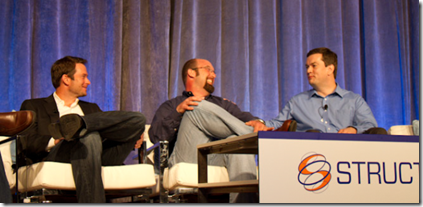
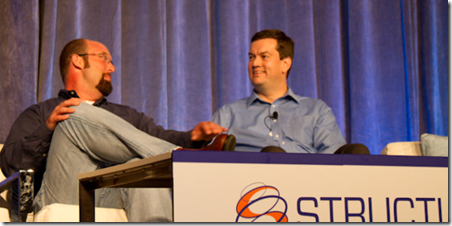
Facebook's Frank Frankovsky was on a panel at Structure 2011 and was as Dell's Forrest Norrod the baloney in the sandwich between the vendors VMware and Dell.  Frank looks like a pretty happy piece of Baloney here.

image

THE ECONOMICS OF OPEN EVERYTHING

The power of open-source software can’t be denied. At its best, it has democratized innovation and is a stub for other subsequent innovations. Think Apache and the web. But where is the money in it? Does there have to be a profit motive? We talk to two exponents of recent projects -- Open Stack and Cloud Foundry -- both of which are open and have the promise to shake up the cloud industry.

Moderated by:Lew Moorman - Chief Strategy Officer and President of the Rackspace Cloud, Rackspace
Speakers:Derek Collison - CTO, Chief Archictect, Cloud Division, VMware

Frank Frankovsky - Director, Hardware Design and Supply Chain, Facebook

Forrest Norrod - VP and GM, Server Platforms, Dell

The session was dynamic and Forrest Nod was able to crack a few smiles as well.

image

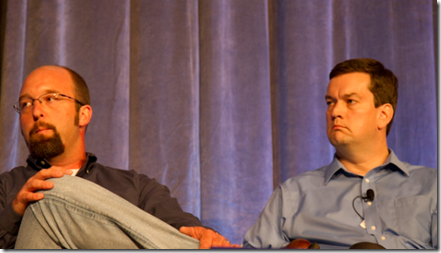
I didn't get a picture of Frank and Forrest smiling at the same time, but they are both looking quite serious here.

image

I caught Frank later at the conference and he said they shared their Open Compute summit information that they had on June 17, 2011.  I am going to break the information into a few posts - this one is server and storage hardware.

Facebook's Amir Michael announced v2.0 of the Open Computer Server that doubles the motherboard densities in the 1 1/2 U design.

Doubling the Compute Density

Amir Michael, Facebook’s hardware design manager, introduced our new initiatives in server hardware, presenting new AMD and Intel motherboard designs that double the compute density relative to our original designs.

Instead of placing a single motherboard in each chassis, we’re now building servers with two narrow motherboards sitting next to each other. These motherboards support the next generation of Intel processors and AMD’s Interlagos. To enable these new designs, we’ve also modified the server chassis, power supply (700W output from 450W), server cabinet, and battery backup cabinet.

What was not clear is what Facebook does for big storage for all the pictures on Facebook pages.  And.... the answer is Storage Server 1.0 which can support from one to four server connections with a variety of connection technologies to provide low cost and high performance.

Storage Server v1.0

One question that has been asked a number of times since releasing version 1.0 of the Open Compute designs is if Facebook plans to build a storage server. Amir announced a project designed for our storage intensive applications. It’s actually a platform approach in that you can vary the ratio of compute to storage using the same physical building blocks. If you fully load the server, each storage node can support 50 hard drives split across two controllers.