Usage-based Power Pricing, enables Green Behaviors in CRG West Colo DCs

Data Center Knowledge has a post on CRG's press announcement for Usage-Based Power Pricing.

CRG West is implementing usage-based power pricing at its new data centers in Boston, Chicago, Los Angeles, Miami, New York, Northern Virginia and the San Francisco Bay Area. The power pricing model, based on actual utilization, will benefit colocation customers by offering savings to those who reduce their IT electrical loads.

With the installation of Branch Circuit Monitoring (BCM) technology at seven of its 10 data centers, CRG West can provide usage-based pricing for AC power to even single-cabinet colocation customers. In addition, the BCM technology improves upon CRG West’s ability to manage and monitor power consumption at the data center, enabling customers to pay only for the power they consume and providing the visibility into load management that helps customers increase their uptime.

CRG West previously charged a flat monthly fee per circuit for breakered power capacity, which meant that customers would often pay for capacity they aren't using. Under the new model, customers can reduce their bills by turning off hardware that isn’t in use during off-hours or by purchasing hardware that is more efficient. Coming soon, CRG West will also offer customers the ability to monitor their power draws by circuit.

The CRG press announcement is here with a few points on energy efficiency.

With the installation of Branch Circuit Monitoring (BCM) technology at seven of its ten data centers, CRG West can provide usage-based pricing for AC power to even single cabinet colocation customers. In addition, the BCM technology improves upon CRG West’s ability to manage and monitor power consumption at the data center, enabling customers to pay only for the power they consume and providing the visibility into load management that helps customers increase their uptime.

Customers can reap the benefits of this technology by turning off hardware that isn’t in use during off-hours or by purchasing hardware that is more efficient; thereby significantly reducing their electricity expenses. Coming soon, CRG West will also offer customers the ability to monitor their power draws by circuit.

Already an industry leader in green data center design and construction, CRG West also focuses upon providing the information and tools our customers can use to enable them to manage energy consumption and costs more efficiently. Following the deployment of our award-winning, energy-efficient closed-loop cooling design, CRG West’s BCM technology is another example of innovative leadership in the industry. CRG West expects the colocation industry to adopt usage-based pricing and visibility as its standard within the coming years.

We should be a standard practice at many colo facilities. The enterprise data centers in general will move slower.  At an Uptime Institute presentation, there was actually a company which removed their metering system, because they didn't want to deal with the support issues when users challenged the power charges.
Read more

Greening the Data center with IBM Tivoli Software

IBM released a marketing document on how Tivoli software provides an integrated approach to managing software. It's pretty good for a marketing document on integrating the information for a green data center.

IBM assumes a PUE of 2.0 and don't discuss how they can use their tools to improve PUE.

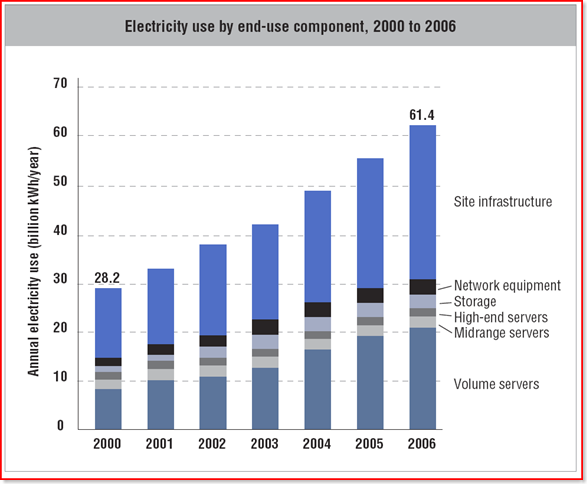
The one thing I did find useful is their electricity use by component, 2000 to 2006.image

For now a green data center tool I like is Mike Manos's Scry.

Read more

Who is going to Turn off The Virtual Worlds?

Gartner Group says ninety percent of businesses efforts in virtual Worlds like Second Life fail within 18 months.

Ninety percent of forays by businesses into virtual worlds–animated online communities where people can do things they do in the real world (and some things they wouldn’t)–fail within 18 months. That’s according to the tech researchers at the Gartner Group, although we could have told you the same thing, if not with a specific statistic.

secondlife_art_160_20080515121040.jpg

Not so much

Over the last few years, businesses have raced to set up storefronts in these virtual worlds, notably Second Life, in order to test new products, grab some publicity, and maybe even make a few bucks by selling digital versions of their products. But many of these shops are now vacant. Last summer we wrote that “Second Life storefronts for Best Buy’s Geek Squad, Sun Microsystems and Dell were all deserted, and American Apparel’s was virtually boarded up.” Time magazine labeled Second Life one of the worst sites on the Internet and called corporate efforts there “a case of some CEOs trying too hard to be hip.”

How much power is Second Life consuming?  Remember Nicholas Carr's infamous Avatar power consumption post.

Avatars consume as much electricity as Brazilians

December 05, 2006

Tony Walsh has, as others do, some doubts about whether Second Life is sustainable as a business. But he also poses another question that I hadn't come across before: "Is Second Life sustainable ecologically?"

He quotes Philip Rosedale, the head of Linden Lab, the company behind the virtual world: "We're running at full power all the time, so we consume an enormous amount of electrical power in co-location facilities [where they house their 4,000 server computers] ... We're running out of power for the square feet of rack space that we've got machines in. We can't for example use [blade] servers right now because they would simply require more electricity than you could get for the floor space they occupy."

I think the guys at Second Life (Linden Labs) need to look at solutions like Cassatt's software that automatically turns off servers as demand decreases.

Updated Cassatt Software Watches Changing Demand on Servers and Automatically Turns Off Idle Computers to Cut Data Center Energy Use

Cassatt Active Response Improves Data Center Efficiency Using New Demand-Based Policies, Increased Compatibility with Third-Party Management Solutions, and Broader Platform Coverage

SAN JOSE, Calif., May 20, 2008 – Cassatt® Corporation, a leader in providing software to make data centers more efficient, today announced a major new capability of its Cassatt Active Response products that enables the software to monitor the changing demand on servers and automatically turn them off when they become idle.  The updated software is the first to enable data center managers to actively control server power usage in both predictable and unpredictable computing environments, reducing the amount of energy needed to run and cool data centers, while maintaining application reliability and responsiveness.

This unique, demand-based management capability is part of a major new update to the Cassatt Active Response product line.  The new Cassatt Active Response 5.1 release offers:   

  • The ability to use demand-based policies to manage IT infrastructure in real time
  • Increased compatibility and integration with third-party management solutions, and
  • Management and control over a larger set of technology and data center equipment from multiple vendors.
Read more

Microsoft's Mike Manos comments on CADE metric from McKinsey and Uptime

Mike Manos posted his comments on the CADE metric presented by McKinsey and Uptime.

May 05

Struggling with CADE, McKinsey / Uptime Metric

I guess I should start out this post with the pre-emptive statement that as a key performance indicator I support the use of CADE or metrics that tie both facilities and IT into a single metric.  In fact we have used a similar metric internally at Microsoft.  But the fact is at the end of the day I believe that any such metrics must be useful and actionable.  Maybe its because I have to worry about Operations as well.  Maybe its because I don't think you roll the total complexity of running a facility with one metric.  In short, I don't think dictating yet another metric, especially one that doesn't lend itself to action, is helpful.

People were quoting Mike at Uptime to just start measuring something.  I want to add a correction that given Mike’s experience he would never randomly measure something which is what other presenters were suggesting to take action.  Mike knows what he wants is effective measurements, and knows whether he is picking a measurement that is useful.

The recommendation should be modified  to “pick something to measure that you think is useful in the long term, start anywhere you want, pick up a clipboard.”

Measurements need to be thought as part of a closed loop feedback system where the measurements are indicators of how you are meeting operation service goals and whether modifications you are performing are effective.

The presenter at Uptime for the McKinsey study joked that he had a process that had you running in circles, and CADE would probably do that.  As you keep on measuring CADE, it will have you running in circles, chasing what you need to do to make it better. The CADE numbers don’t have the expected result as Mike also points out some flaws.

  • As you cull out dead servers in your environment, your utilization will drop accordingly and as a result the metric will remain unchanged.  The components of CADE are not independent. Dead servers are removed so that Average server utilization goes up then Data Center Utilization goes down showing proportionally so there is no change and if anything PUE goes up which means the metric may actually go up. Keep in mind that all results are good when kept in context of one another.
  • Hosting Providers like Savvis, Equinix, Dupont Fabros, Digital Realty Trust, and the army of others will be exempt from participating.  They will need to report back of house numbers to the their  customers (effectively PUE).    They do not have access to their customers server information It seems to me that CADE reporting in hosted environments will be difficult if not impossible.  As the design of their facilities will need to play a large part of the calculation this makes effective tracking difficult.  Additionally, overall utilization will be measured at what level?
  • If hosters exempted, then it gives CADE a very limited application or shelf-life.  You have to own the whole problem for it to be effective.   
  • As I mentioned, I think CADE has strong possibilities for those firms who own their entire stack.   But most of the datacenters in the world would probably not fall into "all-in" scenario bucket.
  • This was my first Uptime Institute, and I have dozens of observations, I'll be making over the next couple of weeks.

    As McKinsey and Uptime also promoted the idea of the energy czar. I disagree with the idea, and bounced a better idea off of multiple people at the conference that energy metrics should be integrated as part of capacity planning  and reporting. Data Center staff and executives need to get used to seeing power numbers along with other key performance indicators for their data centers.

    The last thing you want in the data center is to have an energy czar/nazi who measures their performance on energy savings who does not appreciate the relationships of efficiency projects to overall operations.

    So, even though it was a nice effort to introduce the idea of a data center efficiency metric, it will not work as I first thought. The data center efficiency metric makes more sense to be developed by a group like the The Green Grid where the consensus driven model for publishing content will make sure a metric has industry support before publishing.

    Read more

    Digital Realty Trust Adopts PUE as Standard Metric for Green Data Center

    Digital Realty Trusts has taken a leadership position to publish PUE for its datacenter facilities. PUE enables customers to evaluate how efficient a facility is versus theirs.

    Digital Realty Trust Publishes Industry's First Data on Datacenter Energy Efficiency

    Company Adopts PUE Metric as Standard for Measuring Datacenter Efficiency

    SAN FRANCISCO, May 1 /PRNewswire-FirstCall/ - Digital Realty Trust, Inc. (NYSE: DLR), a leading owner and manager of corporate and Internet gateway datacenters, announced today that it has published the industry's first energy efficiency data about its datacenter facilities. Digital Realty Trust will use the Power Usage Effectiveness (PUE) metric as the methodology for measuring and reporting energy efficiency in its portfolio of facilities in North America and Europe. Digital Realty Trust is the first company to provide customers with detailed and actionable information about how datacenter operations are meeting their corporate green IT objectives. The Company will also publish benchmarks that will support industry-wide initiatives to make datacenters greener and reduce expenditures on energy.

    PUE is an emerging standard promoted by The Green Grid and others in the datacenter industry to provide a simple and consistent method of measuring the ratio of power delivered to IT equipment to the total amount of power used by the datacenter facility. PUE provides reliable information about the energy efficiency of datacenter facilities by calculating how much power is devoted to driving the actual computing/IT components (servers, for example) versus the ancillary support elements such as cooling and lighting.

    This follows through with their Green Datacenter Vision.

    Our Green Datacenter Vision

    Digital Realty Trust is committed to developing practical standards that reduce datacenter power requirements and negative by-products while increasing their operational effectiveness. Our datacenter facilities are designed to LEEDs (U.S.A.) and BREEAM (Europe) certification standards. Digital Realty Trust is a voting member of the Green Grid consortium.

    The interesting effect is how customers can now compare their own data centers vs other hosting companies as Jim Smith, VP of engineering states. Imagine a customer asking for the PUE for a hosting facility and the sales rep, says "PUE? What is that?"

    "Digital Realty Trust has been a leading voice on this issue since well before it gained the prominence it has today, and has achieved a number of important industry milestones related to green datacenters. However, I believe that reporting the PUE metric for our datacenter facilities is the most significant milestone yet because it will provide a model and benchmarks that can be used industry-wide to achieve dramatic increases in energy efficiency and can be used by customers to compare the energy efficiency of different datacenter facilities."

    It will be interesting to see what kind of numbers Digital Realty Trust publishes and whether they publish the range of PUE vs different times of the day and year as well as how load can effect PUE in their facility.

    Remember PUE is a dynamic number, not static, and is expected to fluctuate in a range.

    Read more