Ken Brill Promotes CADE Metric in Forbes.com

Ken Brill has a commentary written in Forbes.com promoting the use of the CADE Metric.

I define a green data center as delivering the most productivity for the least amount of energy consumed. Will Forrest of McKinsey & Co. and I have defined a measure we call the Corporate Average Datacenter Efficiency (CADE) as being a useful--and, currently, the only--metric for measuring the combination of data center productivity and energy consumption.

CADE, while not perfect, divides overall data center efficiency into four individual measures, each of which can be separately measured and benchmarked. These elements include measures of IT asset efficiency and utilization as well as the asset efficiency and utilization of the physical facility that houses these assets. (You can read the report here.)

Nothing really new in this article. 

There are some experts who have opinions on CADE, but no one has stepped up with an alternative view.
Read more

A Look Inside Microsoft’s Green Data Center Efforts, Educating Enterprise Developers and Sys Admins

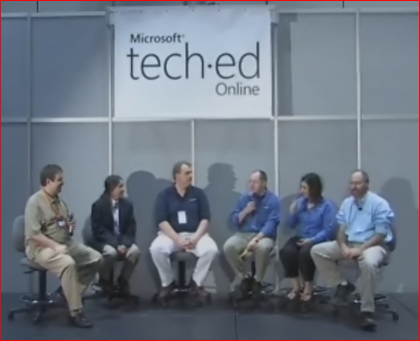
Microsoft hosted a panel discussion at TechEd 2008 in Orlando.  The panel was moderated by George Cerbone with Mike Manos, Lewis Curtis, Beth Humphreys from Microsoft. Additional panel members are Kathy Malone and David Platt.

The video is here. Don’t hesitate to just hit play, and listen to the audio while you are surfing the web.  It has some good perspectives.

image

Lewis Curtis presented first his past experiences over the last year working on Green IT at Microsoft.

Mike Manos presented why going Green is a business responsibility to save energy and has monetary savings.

Beth Humphreys shares her experiences in customer engagements discussing Green IT.

Kathy Malone talks about her efforts to build compliance systems and a green IT developer community.

David Platt, a recognized .NET developer expert, explains why developers are not creating green applications. His view is green should be an OS function, and developers don’t have enough time for this.

Mike Manos brings up a good rebuttal that once Microsoft changed to an energy based chargeback system, the business units started to understand the impact of their SW on their energy bill, and have chosen energy efficiency vs. a focus on only performance.

David Platt continues to make the point developer costs and power is negligible, repeating his point that the energy efficiency is the responsibility of the OS, and none of the effort should be taken on by the developer.

The good thing is the rest of the panel think David Platt is wrong.

Kathy Malone makes excellent points on compliance systems.

This video gives you an idea of some of the people in Microsoft who are driving the Green Data Center efforts to the software developer community. 

I am glad I caught Lewis’s post.

Read more

Changing Behavior, follow up to Christian Belady's point at Energy Efficiency Workshop, NY starts posting calories on restaurant food

Microsoft's Christian Belady made the point at last week's Energy Efficiency Strategy Workshop that Changing Behaviors are best done by a change in charge back methods.

Another proof of Christian's point is what is happening in NY as the state requires calorie disclosures on restaurant food.

New Yorkers try to swallow calorie sticker shock

600 calorie muffins? The first city to adopt law faces unappetizing surprises

Although touted as "fat free," a slice of banana chocolate chip cake at Starbucks packs 390 calories, as New Yorkers discovered when the coffee chain began displaying calorie counts to comply with a new New York City law.

Nora Cara was flabbergasted.

She was about to order her usual morning coffee and muffin at Dunkin’ Donuts when she saw the new calorie labels. The chocolate chip muffin she had her eye on was 630 calories.

“I was blown away,” said Cara, a 27-year-old homemaker from Forest Hills in New York City. “I’m not a no-carb type of person, and I usually don’t even think about it. But you pick up a little muffin with your coffee, and it has 630 calories in it? That’s a bit extreme!”

New Yorkers have been in the throes of sticker shock since this spring when the Big Apple became the first city in the country to implement a law forcing chain restaurants to post the calorie count of each food in the same size and font as the price.

People will change their IT behaviors if they saw the Power and Carbon impact of their actions.  I am sure a lot of people will be surprised with the #'s, just like this.

1,360 calorie salad
Many New Yorkers are finding that even the foods they thought were lower calorie really aren’t. Vicki Freedman, who lives in Manhattan, watches her weight and always tries to choose a light option when eating out. But the 26 year old just discovered that the Friday’s pecan-crusted chicken salad, served with mandarin oranges, dried cranberries and celery, has 1,360 calories.

“That surprised me the most because they market it as a healthy option,” she said. “It’s like false advertising. You think it’s better than the burger and the fries. It’s misleading.” (The cheeseburger served with fries is, indeed, 1,290 calories.)

Read more

Microsoft's James Hamilton Presents "Where Does Power go in Data Centers and How to get it Back?"

James Hamilton has a blog post about his attending O'Reilly's Foo Camp and his presentation on "Where does Power go in Data Centers and How to get it Back?"

The title for my session was Where Does the Power go in Data Centers and How to get it Back?  I didn’t show slides but much of what we covered is posted at: http://mvdirona.com/jrh/TalksAndPapers/JamesRH_DCPowerSavingsFooCamp08.ppt.  In the session, we talked through how contemporary large data centers work first looking at power distribution. We tracked the power from the feed to the substation at 115,000 volts through numerous conversions before arriving at the CPU at 1.2 volts. We then talked about power saving server design techniques.  And then the mechanical systems used to get the heat back out.  In each section we discussed what could be done to improve the design and how much could be saved.

Our conclusion from the session was that power savings of nearly 4x where both possible and affordable using only current technology.  For those participated in the session, thanks for your contribution and  for your help. It was fun.

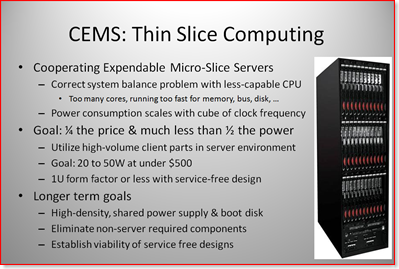
James comes to the conclusion there is a power savings of 4x. If  you are curious as to how he comes to this look at his slides.  One of his ideas that flies in the face of high density computing is Thin Slice Computing.

image

Read more

Intel IT: Relevance of Architecture – Closed Loop Feedback System

I found this following blog post on Intel’s Expert Center for IT best practices. It’s kind of a long post, but makes good points on the importance of architecture for Manageability and Automation which are key methods for a Green Data Center

Intel Open Port: Intel vPro Expert Center Blog: Relevance of Architecture: Part 3 - How Architecture Can Help

The primary role of architecture is to provide an orchestrated plan to meet short term and long term Manageability & Automation (M&A) objectives. Architecture is all about technical planning and can enable reduced operational costs and agility if done correctly. I strongly believe that architecture can help accelerate the rate of change and provide real value for "M" and for "A".

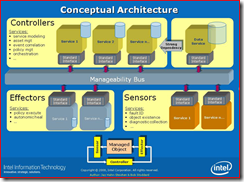
The below graphic is one which does a good job of articulating the need for a manageability bus.


image

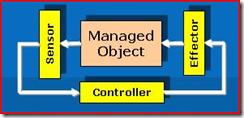
Unfortunately, he misses the simplicity of explaining what you need is a closed loop feedback system as he has this diagram which is drawn backwards.

image

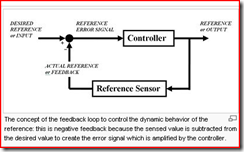
This is the diagram he should have used. http://en.wikipedia.org/wiki/Control_theory

image

I am amazed at how often the IT community misses the opportunity to use control theory to explain management systems.  Most IT systems actually run open loop.

On a related topic I had a chance to meet with a fellow consultant, Michael Emanuel who has worked on IT management tools, and knows of a company developing some innovative solutions to the challenge of building a closed loop management tool for a Green Data Center.  After I  have had a chance to review the product features, it will be in a future blog post.

Read more