ROI of Smart Meters, A Dumb Idea?

WSJ asked a good question on whether Smart meters are a dumb idea.  Why is this potentially dumb?  Because a utilities and politicians are making an ROI decision without any data to support their decision for smart meters, and almost no one is transparent as to the cost and energy savings.

Smart Meter, Dumb Idea?

New devices promise to cut energy use by giving consumers more information. Critics say they aren't worth the cost.

By REBECCA SMITH

Not everyone thinks smart meters are such a smart use of money.

Utilities are spending billions of dollars outfitting homes and businesses with the devices, which wirelessly send information about electricity use to utility billing departments and could help consumers control energy use.

Proponents of smart meters say that when these meters are teamed up with an in-home display that shows current energy usage, as well as a communicating thermostat and software that harvest and analyze that information, consumers can see how much consumption drives cost -- and will consume less as a result.

There are a few asking the right questions, but they are in the minority.

"What we're most concerned about is that consumers realize real benefits from the meters" from the start, says Michelle Furmanski, general counsel for the Texas House Committee on State Affairs, which is considering legislation that could establish more protections against disconnections.

I run into this situation many times in data centers, and here is a course of action.

Two years ago, Connecticut Light & Power Co. proposed to provide smart meters for all of its 1.2 million customers. "But then we heard from the Connecticut attorney general asking us, why don't you walk before you run?" says Mitch Gross, a spokesman for the utility. "He was concerned about the cost."

As a result, the utility will do a pilot program this summer to test customer acceptance of smart meters and variable pricing. Some 3,000 customers have volunteered, and the utility intends to see whether people cut energy use during times that prices rise. Some consumers will have "energy orbs" in their homes that change color, a visible indication of how prices are changing, as a way to stimulate behavior changes.

Instead of the estimated $255 million cost of a full meter deployment, the test will run $13 million.

The simplest thing to do is think of an ROI for your metering/monitoring system.  Thinking of what you will do with the data when you collect it.  Will you use it in a closed loop feedback?  Or for user awareness on power use?  Can you estimate power consumption based on server activity?

All of these things can be done if you create a lab to evaluate possible metering systems and the ROI.

Read more

US Electricity Grid Penetrated by Spies

I met a couple of people from the DOE 2 years ago at an OSIsoft User Conference who studied the security of the energy grid.  The WSJ article has an article on the problem.

Electricity Grid in U.S. Penetrated by Spies

By SIOBHAN GORMAN

[Robert Moran monitors an electric grid in Dallas. Such infrastructure grids across the country are vulnerable to cyberattacks.] Associated Press

Robert Moran monitors an electric grid in Dallas. Such infrastructure grids across the country are vulnerable to cyberattacks.

WASHINGTON -- Cyberspies have penetrated the U.S. electrical grid and left behind software programs that could be used to disrupt the system, according to current and former national-security officials.

The spies came from China, Russia and other countries, these officials said, and were believed to be on a mission to navigate the U.S. electrical system and its controls. The intruders haven't sought to damage the power grid or other key infrastructure, but officials warned they could try during a crisis or war.

"The Chinese have attempted to map our infrastructure, such as the electrical grid," said a senior intelligence official. "So have the Russians."

The espionage appeared pervasive across the U.S. and doesn't target a particular company or region, said a former Department of Homeland Security official. "There are intrusions, and they are growing," the former official said, referring to electrical systems. "There were a lot last year."

Discuss

Many of the intrusions were detected not by the companies in charge of the infrastructure but by U.S. intelligence agencies, officials said. Intelligence officials worry about cyber attackers taking control of electrical facilities, a nuclear power plant or financial networks via the Internet.

Authorities investigating the intrusions have found software tools left behind that could be used to destroy infrastructure components, the senior intelligence official said. He added, "If we go to war with them, they will try to turn them on."

What is the uptime of a data center when the electrical grid can be brought down by a cyber criminal?

Don’t forget about other infrastructure.

Officials said water, sewage and other infrastructure systems also were at risk.

Read more

Speculating Cap and Trade’s Impact to Data Centers

ComputeWorld has an article on data centers and cap and trade.

Data centers brace for Obama's 'cap and trade' energy pricing plan

The president's proposed 'cap and trade' program on carbon emissions may have big implications for power-hungry IT facilities.

By Patrick Thibodeau

April 6, 2009 (Computerworld) Data centers are part of the greenhouse gas problem, and their operators may soon start paying to help fix it under President Barack Obama's proposed cap-and-trade energy plan.

The cap-and-trade scheme is designed to impose higher costs on power generators that don't use so-called clean energy sources. The government would cap overall carbon dioxide emissions and then auction off permits enabling companies to exceed the limits -- essentially adding an indirect tax on some forms of energy, such as coal-fired electricity.

Power bills likely would increase as utilities forced to buy the permits passed the added costs on to their customers. And over time, the pool of permits would decrease, sending electricity costs further upward unless generators switched to cleaner energy sources.

How’s this affect you?  Who knows?

But there's no way to accurately gauge the potential impact of a cap-and-trade initiative. "Everything is depending on how they arrange these regulations," Deaderick said. "It could go a lot of different ways."

There is a sense of inevitability among analysts, though, that the White House and Congress eventually will agree on a new energy-pricing plan.

"Anticipating zero-carbon pricing... those days are gone," said Pat Concessi, an energy consultant at Deloitte Touche Tohmatsu.

The one thing you can count on is energy prices are not going to decrease.

And, people are going to learn to look at their data center power bills.

Read more

Monitoring Water Use at a Power Station

I just blogged about water use at a electric power plant.  I mentioned the article to OSIsoft’s Martin Otterson, and he pointed me to a solution for measuring water use at power plant.

Pin-pointing water usage

April 2009

Emerson’s Smart Wireless technology is helping E.ON UK to accurately monitor and measure treated water usage, thus allowing trending and analysis to formulate target values at its Kingsnorth dual-fired power station. Using Emerson’s Rosemount wireless transmitters, E.ON is now able to collect flow measurement data from new flowmeters installed throughout the turbine hall. The self-organising wireless network delivers the data for trending in an OSIsoft PI historian which helps personnel monitor water usage within the system.

Solution evaluation
E.ON Kingsnorth, a 1940 MW generating facility located on the Medway Estuary in Kent needed a solution to monitor and measure water usage within its main plant. They decided to install new non-intrusive ultrasonic flowmeters to carry out this task. The high cost of wiring associated with a conventional cabled solution and a desire to embrace the very latest networking technology led E.ON to evaluate wireless technologies that could meet their needs.
“E.ON is keen to adopt the very latest technology to help improve productivity, efficiency and availability, and wireless technology provides the ideal networking solution to access the flow measurement data from the turbine building without having to install new cabling," said Chet Mistry, team leader, E.ON UK.

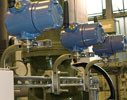
Emerson’s wireless transmitters provide access to flow readings from non-intrusive ultrasonic flowmeters

Emerson’s wireless transmitters provide access to flow readings from non-intrusive ultrasonic flowmeters

Having initially undertaken extensive trials of Emerson’s Smart Wireless technology, E.ON selected the Emerson solution because it offered high levels of reliability and long transmitting distance, as well as the ability to add additional devices to the network without the need for additional infrastructure.

The water data is integrated into OSIsoft’s PI system.

System architecture and operation
Fourteen Rosemount wireless transmitters have been installed to provide access to flow percentage readings from the new non-intrusive ultrasonic flowmeters monitoring different sections of the turbine hall. The Rosemount wireless transmitters are transmitting flow measurement data every 15 seconds to an Emerson Smart Wireless gateway, situated in the main administration building on the other side of the road from the turbine hall.

Using Ethernet, the data is sent from the gateway to Emerson’s AMS Suite predictive maintenance software, which manages the wireless transmitters and uses its OPC server to import the flow data into the PI data historian. From here operators view trends and pinpoint where any loss of flow takes place.

Think about a system like this for your data center.  If you think it is difficult to get a wireless monitoring system running in a data center, imagine the issues in a power plant.

Difficult RF environment
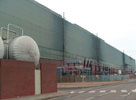
The turbine hall at Kingsnorth is around 500 m long and presents a difficult working environment for wireless as it houses large turbines, vast amounts of metal piping and a number of metal walkways that could interfere with the wireless signal. Such an environment would not be suitable for a line-of-sight wireless solution, but Emerson’s Smart Wireless self-organising technology encountered no problems in terms of routing data back to the gateway or reliability of connection.

Read more

4 Green Data Center Tools

GigaOm has a post on 4 data center tools for energy efficient data centers, focusing on server power management.

Appistry EnergySaver: An add-on to Appistry’s Enterprise Application Fabric, EnergySaver lets customers define performance-based policies for power management. When resources are no longer necessary, EnergySaver puts them to sleep, only bringing them back up as needed. If target resource utilization for a system is set at 50 percent, EnergySaver can power on or power off machines to keep aggregate usage at the predefined level.

Cassatt Active Power Management: Available across Cassatt’s line of Active Response solutions or as a standalone product, Active Power Management takes into account a variety of factors — from system performance to your electric utility’s peak and off-peak pricing schedules  — to determine when to turn servers on and off. If machines are needed for failover or to maintain application service levels, Active Power Management can bring them back up automatically.

Virtual Iron LivePower: A standard but still “experimental” feature of Virtual Iron v4.4, LivePower lets users set pre-determined utilization levels for physical machines. (Virtual Iron calls the feature experimental because “it has not yet been widely tested in production environments.”) When utilization falls below that level, LivePower leverages Virtual Iron LiveCapacity to move VMs running on that machine elsewhere. The physical server is shut down, rebooting and reentering the pool as demand picks up.

VMware Distributed Power Management: Another “experimental” feature, Distributed Power Management (DPM) is part of VMware Distributed Resource Scheduler (DRS). DPM monitors power consumption in DRS pools and uses vMotion to consolidate workloads onto fewer physical servers automatically. Unneeded physical machines go into standby mode and come back online as predefined utilization policies dictate.

Read more