Pictures of Microsoft's Wind Powered Container in Boulder, CO

On Dailycamera.com there are pictures from Microsoft's Wind Powered Container event in Boulder, CO. The picture at the bottom has a shot of a Verari Systems Rack.

The article is here.

The new additions near the parking lot of Microsoft Corp.'s Boulder office may have the look of three white semi-trailers, but what's inside is powering the world.

Or, rather, the virtual world.

Redmond, Wash.-based Microsoft on Thursday unveiled its new wind-powered, container-based data lab, which houses processing servers for the photorealistic 3-D city models used in the company's Virtual Earth online mapping program.

The data center also is wind-powered, officials announced, noting the purchase of wind-generated power from Boulder-based Renewable Choice Energy.

The cores of the servers can support more than 10 petabytes of data, said Jim Curlander, principal development manager of Virtual Earth. Combined with the servers located in the Boulder facility, that storage capacity is 15 petabytes, he added.

The pictures here and here.

Photo by Cliff Grassmick

Debra Chrapaty, left, and Stephen Lawler christen one of Microsoft Corp.'s new wind-powered, container-based data labs.

Photo by Cliff Grassmick

Lab Manager Brian Cunningham talks about the data center containers during the grand opening. Microsoft introduced its new wind-powered container-based data lab Thursday in Boulder.
Read more

Microsoft Unveils Wind-Powered Containers

DataCenterKnowledge posts on Microsoft's latest demonstration that leverages an advantage of containers.

Microsoft is thinking a lot of about green power these days, as Michael Manos explained at Data Center World. Manos, Microsoft's director of data center services, believes the federal government will become more active on power issues. "Sustainability regulation is coming," he said. "The conversation is not if, but when. It's more about what we're going to require companies to report against."

With some data centers now provisioning more than 100 megawatts of power, utility capacity is a primary issue in data center site location. But it's likely that green power profiles are beginning to gain more weight as companies decide between specific cities and utilities. For now, the percentage of renewable energy vs. coal in a utility's generating base is probably serving as a tiebreaker between competing locations.

But that may change as more companies offer carbon neutrality pledges and federal agencies weigh sustainable IT as a regulatory issue. This is an area where container solutions have the potential to be disruptive, allowing companies to move computing infrastructure to places where they can run on wind, hydro or solar power. Will we see cities of container data centers springing up next to utility-scale thermal solar power plants in the Mojave Desert? 

There are lots of potential scenarios, and it's hard to say how often green power plays using containers will work from an operational standpoint. But given data centers' energy use as a percentage of a company's total power bill, the math suggests these approaches will be seriously studied.

Read more

Microsoft Publishes Article - Sustainable Computing: Putting IT on a Diet

Microsoft's TechNet Magazine has started a series of columns on Sustainable Computing that will be a regular topic. To introduce the Green/environment sustainable topic to IT pros, there is an article Sustainable Computing: Putting IT on a Diet.

As the environment and energy consumption become topics of increasing attention, IT has been called out by many as a large energy consumer. And rightfully so. There are many problems throughout the IT environment—over provisioning, underutilized equipment, poor user practices and policies, inefficient hardware, and lack of hardware retirement policies, to name just a few.

Yet there are countless strategies for making IT more environmentally sensitive. This creates an excellent opportunity for you, as an IT professional, to drive change. Every organization needs a solid sustainable computing strategy and this, in turn, requires IT professionals with knowledge who are ready to lead and evangelize changes throughout the organization.

The topic is vast and constantly changing. And your strategy is something you should be thinking about every day. So we are kicking off this new online column to explore the issues, solutions, and strategies that make up environmental and sustainable computing. In fact, there's so much to discuss, we'll be publishing, for the time being, new columns every two weeks.

The Energy Diet

Data centers used 61 billion kWh of electricity in 2006. That represents 1.5 percent of all U.S. electricity consumption that year. More alarmingly, it is double the amount consumed by data centers just a few years earlier, in 2000. (See the March 2008 Fact Sheet on National Data Center Energy Efficiency Information Program available at energystar.gov/ia/partners/prod_development/downloads/NDCFactSheet.pdf for more information.)

If current trend continue, energy consumed by data centers can be expected to grow by 12 percent per year. And the problem reaches beyond the data center. Desktops, laptops, and mobile devices are all large energy consumers, but their exact numbers are hard to grasp as devices are scattered around offices.

With Web services becoming increasingly common and the proliferation of mobile devices growing at exponential rates, companies, organizations, and governments around the globe are looking at how we can reduce consumption and put IT on an energy diet, such as expanding initiatives like the Energy Star program from desktops to severs as well.

Government agencies, for example, are looking into how to regulate energy use. As one of the largest energy consumers, IT is the least regulated. So don't be surprised when the government implements future requirements for sustainability and efficiency reporting.

...

The "Diet" analogy is a fun one and I've received good feedback on this as a method to discuss Green IT ideas. I'll be using this method more, as I was the writer for this article.

Read more

The Manos Tree at Microsoft's San Antonio Data Center

San Antonio Express has an article about Microsoft's Data Center in San Antonio, Model of Efficiency, and tells the story of the Manos Tree.

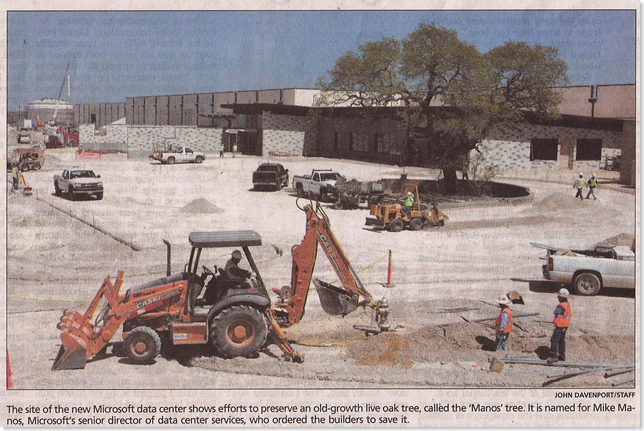
A lone oak in front of Microsoft's massive new data center in Westover Hills symbolizes the technology company's efforts at green business practices.

It's called the "Manos" tree, named for Mike Manos, Microsoft's senior director of data center services. He ordered Turner Construction, the facility's builders, to save it.

"Microsoft made a commitment to save and preserve the old-growth live oak trees," Manos said. "For the most part, in the area where we constructed the data center, there wasn't any old-growth oaks except for one — dead center in the middle of the construction project."

So Turner's workers built the building around the tree, which covers about as much ground as a sandbox, even putting up concrete barriers at times to save it. They also successfully saved dozens of old oak trees on the perimeter of the 44-acre site. Those trees will help shade the 470,000-square-foot building and reduce cooling costs.

image 

Other Green features mentioned in the article are:

Microsoft's mammoth building looks like a mirror image of its first built-to-suit data center in Quincy, Wash., but it has a lot of incremental improvements over that facility simply because Microsoft has learned through the process how to design the center more efficiently, Manos said. Those improvements include the ways the servers are laid out in the rooms, the lighting in the building and other materials used for construction.

In addition to the conservation of trees, Microsoft has other green initiatives under way, such as plans to use an estimated 6 million to 8 million gallons a month of gray water or recycled water from the San Antonio Water System.

. To create a green data center, Microsoft must run its business efficiently, Manos said.

"When you think about the data center, the big white elephant in the room is the use of power in the data center itself," Manos said. Microsoft says its San Antonio center is the most energy-efficient data center yet. It plans to improve on energy efficiency through the use of high-efficiency servers and power systems. The company also has worked to maximize the efficiency of its cooling systems.

"Every drop of electricity is being utilized in the most significant way," Manos said.

And other data centers are following Microsoft to San Antonio. As Microsoft adds Green data center features like gray water/recycled water cooling systems, others are asked to follow.

Other San Antonio companies with major data centers also have focused on green business practices.

CityNap bills itself as a 100 percent green data center because it buys all of its electricity from CPS Energy's Windtricity program. Rackspace, a Web-hosting company, is moving into new headquarters at the Windsor Park Mall and has undertaken a number of green initiatives as part of that relocation.

Since Microsoft announced its project in January 2007, four other data center projects have announced projects, and Hernandez expects more announcements shortly. He is working with eight more data center prospects.

San Antonio's inexpensive power, excellent telecommunications infrastructure, recycled water program and a stable environment appeals to Microsoft and other technology companies, said Mario Hernandez, president of the San Antonio Economic Development Foundation.

"When you're touted as one of the premier sites for data centers, it sends a message to other companies," Hernandez said. He just got back from meeting with high-tech companies in Los Angeles and San Francisco that wanted to know more about San Antonio's data center industry.

front page picture

Read more

Microsoft Employee comments on Microsoft's data center group

Watching the news spread on Microsoft's data center container strategy, found this post by Steve Clayton a Microsoft employee.

The whole datacenter topic is one I expect to find myself talking about more and more over the next year. A whole new game is emerging that some call Cloud Computing. One way of building these datacenters is through the use of containers and Michael Manos from our Data Center Services group talked about this yesterday at the AFCOM Data Center World conference. (Wow, there is a world conference for datacenters).

Christian Belady in the same group as Michael has a rather interesting job title - Principal Power and Cooling Architect.

You may chuckle but this stuff is important. Both the datacenters and and the power and cooling stuff. Datacenters that are so large you can see them from the moon will require a lot of power….and a lot of cooling. In an increasingly eco friendly world, this needs to be done in an environmentally friendly way.

And, gives a small peak inside how Microsoft employee's view the Microsoft datacenter group.

I can’t say a great deal about our datacenter group but I will say this – they’re incredibly thorough about their work. In a way I wish some other groups were to be honest. When you build something that costs many many millions you need to be damn sure you chose the right place and approach. These guys impress me a lot and I’m not alone

Steve Clayton's latest job at Microsoft is here, and posted below which gives a level of credibility in what this guy says about Microsoft's datacenter group.

clip_image001
"This transformation from software to software-plus-services is a very, very big deal for our company," - Ray Ozzie

Today I started a new gig at Microsoft that has a lot to do with the image above. Hugh kindly drew this a few months back and I was quick to snag it as I knew it would become my new card. Basically I'm working in a part of the organisation known as Microsoft International and helping to shape how we talk about Software + Services internally and externally. It's a big new adventure and I'm really looking forward to it. It means I'm no longer managing the PTS team which I'll miss as they're just a great bunch of guys doing outstanding work, but the opportunity to be involved this deeply with S+S was something I couldn't pass up. I'll have involvement in a few other projects I can't talk about but S+S will be my main schtick.

Given that, it's probably a good time to clear up some confusion on what Software + Services is (and isn't), so here goes...

  • Software + Services is not Microsoft's answers to SaaS
    Or Web 2.0 or SOA. In fact, S+S encompasses all of those things. The best explanation of this comes from Sanjay Parthasarathy at our Worldwide Partner Conference this year when he discussed the notion of S+S. He thinks about Web 2.0 as the experience, SaaS as the delivery and SOA as the composition and federation. So if we think about something like Exchange it uses SaaS as a delivery model (for OWA) and is a Web 2.0 experience in it's use of data presented with AJAX.
  • Software + Services is not a Microsoft only thing
    It's an industry thing and when you step back and look this becomes increasingly obvious. Lets take a few examples to explain this point.
    • Salesforce.com is probably the most oft quoted example of SaaS and initially they were a pure play SaaS vendor with a no touch (assuming a browser) client impact and service which is hosted in the "cloud". Salesforce now offer a client for their service. There are scenarios which demand it, not least offline.
    • Google Gears is a good example of the darling of Web 2.0 providing Software + Services. I can now take Google Reader offline and read it when I don't have connectivity - on a plane for example.
    • XBOX Live is a good Microsoft example of the combination of local software connected to a cloud service to provide mutliplayer gaming and a marketplace.
    • Exchange is possibly the best Microsoft example where you can have an email server that his "on premise" (in your office), hosted (by a partner) or even provided by Microsoft. You can then access that service from a rich client on a PC (Outlook), a pure web client (Outlook Web Access) from a mobile device using a rich client (ActiveSync) and now even a voice interface with no client (Outlook Voice Access).
    • Apple is also a great proponent of S+S, though you'd never hear them call it that. iTunes + iPod = Software + Services. Perhaps even more so with the iPhone which makes much of the fact it connects to YouTube and the iTunes music store from a rich client on a device.
    • eBay TurboLister and eBay Desktop are two rich clients that connect to one of the worlds most popular Internet services.
  • Software + Services is a pretty big thing for Microsoft
    Ray Ozzie isn't known for hyperbole so the statement at the top of this post should be taken at face value. The breadth of Software + Services is vast. It encompasses everything from Zune (note iPod above), XBOX Live, Live services (such as Virtual Earth), Biztalk Services, Microsoft Online and more.
    Ray's talk at the Financial Analyst Meeting earlier this year gives you an indication of the breadth, and the depth of investment. Basically it touches almost all of Microsoft and I'm struggling to think of one area it doesn't affect. However, much as I'd like to think I'm going to work on all of these products and services that simply isn't true or indeed feasible. What I will be doing is helping make this understandable both inside and outside of Microsoft. That's what I think I'm okay at - synthesizing lots of inputs on technology and turning them in to something an audience can understand.That's where the Geek In Disguise thing came from after all (thanks Sarah) and to quote Charles Mingus:
    Making the simple complicated is commonplace; making the complicated simple, awesomely simple, that's creativity.

I'm not saying I'm creative (more simple) but the quote does capture why I try to do.

Anyhoo, that's probably enough for now but this is what you'll hear a little more about from me over the coming months. Rest assured though, this blog will continue to be home to an eclectic mix of technology, design, gadgets, Microsoft, industry and other random stuff I find. I hope you keep coming back and if you have question on S+S, fire away!

Your loyal blogging servant, Steve...

Read more