Microsoft Presents Container Data Center Details at Intel Developer Forum

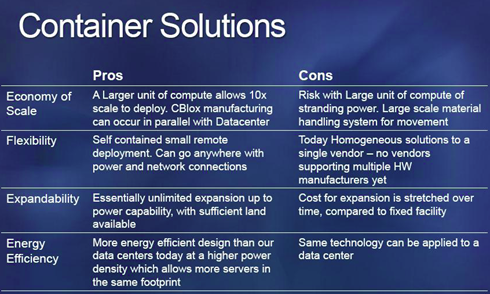
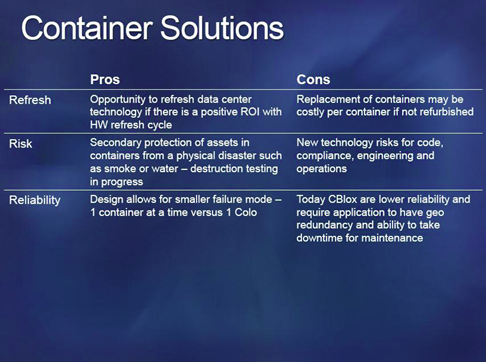
Microsoft Data Center Research Mgr Daniel Costello presented Microsoft’s Cblox (container) solution at Intel Developers Forum. The slides provide a good set of issues to look at when evaluating containers.

There are a total of 6 sildes, Here are three slides that provide the most information.

image

image

image

The full slide deck can be accessed here under Container Slides.

Unfortunately, I couldn’t find the presentation posted as this was a Day 0 presentation.

Read more

Uptime Warns Data Center Pros on Using PUE, a Simple fix

Matt Stansberry writes on Uptime’s seminar giving warning on the use of PUE.

Uptime warns data center pros against being benchmarked on PUE


Posted by: Matt Stansberry
Data Center Metrics, DataCenter, Green data center

Uptime Institute executive director Ken Brill warned panelists at an online seminar today to be wary of very low Power Usage Effectiveness (PUE) ratios touted by some data center operators. “If your management begins to benchmark you against someone else’s data center PUE, you need to be sure what you’re benchmarking against,” Brill said.

Brill said he’s seen companies talking about a PUE of 0.8 — which is physically impossible. “There is a lot of competitive manipulation and gaming going on,” Brill said. “Our network members are tired of being called in by management to explain why someone has a better PUE than they do.”

If you’re going to compare your PUE against another company, you need to know what the measurement means. “You need to know what they’re saying and what they’re not saying,” Brill said. “Are you going to include the lights and humidification system? If you’re using free cooling six months of the year, do you report your best PUE?”

Matt was nice enough to send me this link and ask what I thought.

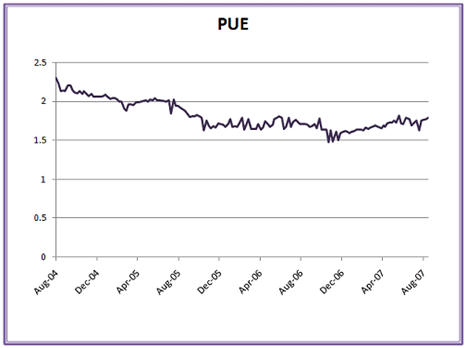
Here is a simple fix to the problem. PUE should be reported as a range of #’s low to high, and the average calculated over a period of time. This could be a graph.  For example, Microsoft shows their PUE for one facility with this graph.

image

This graph shows 3 years of history and how the #’s have fluctuated. This graph is credible. A static PUE # has little meaning as it is just one data point with no background.

I’ve written about this issue before that PUE is dynamic.

I've been meaning to write about PUE, and have been stumped in that It is defined as a metric, and in the Green Grid document referenced it makes no reference that is dynamic. In reality PUE will be a dynamic # that changes as the load changes in a room. How ironic would it be that your best PUE # is when all the servers are running at near capacity, and shutting down servers to save power will increase your PUE? Or your energy efficient cooling system uses large amounts of water in Southern California where it is just a matter of time before water shortages will cause more environmental issues?

What helped me to think of PUE as a dynamic # is to think of it as quality control metric. The quality of the electrical and mechanical systems and their operations over time are inputs into PUE.  As load changes and servers will be turned off the variability of the power and cooling systems influence you PUE.  So, PUE can now have a statistical range of operation given the conditions.  This sounds familiar.  It's statistical process control.

Statistical Process Control (SPC) is an effective method of monitoring a process through the use of control charts. Much of its power lies in the ability to monitor both process centre and its variation about that centre. By collecting data from samples at various points within the process, variations in the process that may affect the quality of the end product or service can be detected and corrected, thus reducing waste and as well as the likelihood that problems will be passed on to the customer. With its emphasis on early detection and prevention of problems, SPC has a distinct advantage over quality methods, such as inspection, that apply resources to detecting and correcting problems in the end product or service.

At Data Center Dynamics Seattle, Microsoft’s Mike Manos said the average PUE for Microsoft data centers is 1.6, and his team is driving for 1.3 in 2 years.  When Mike hits a PUE of  1.3 I am sure he’ll show us a graph to prove Microsoft has hit it.

Read more

Uptime Warns Data Center Pros on Using PUE, a Simple fix

Matt Stansberry writes on Uptime’s seminar giving warning on the use of PUE.

Uptime warns data center pros against being benchmarked on PUE


Posted by: Matt Stansberry
Data Center Metrics, DataCenter, Green data center

Uptime Institute executive director Ken Brill warned panelists at an online seminar today to be wary of very low Power Usage Effectiveness (PUE) ratios touted by some data center operators. “If your management begins to benchmark you against someone else’s data center PUE, you need to be sure what you’re benchmarking against,” Brill said.

Brill said he’s seen companies talking about a PUE of 0.8 — which is physically impossible. “There is a lot of competitive manipulation and gaming going on,” Brill said. “Our network members are tired of being called in by management to explain why someone has a better PUE than they do.”

If you’re going to compare your PUE against another company, you need to know what the measurement means. “You need to know what they’re saying and what they’re not saying,” Brill said. “Are you going to include the lights and humidification system? If you’re using free cooling six months of the year, do you report your best PUE?”

Matt was nice enough to send me this link and ask what I thought.

Here is a simple fix to the problem. PUE should be reported as a range of #’s low to high, and the average calculated over a period of time. This could be a graph.  For example, Microsoft shows their PUE with this graph.

image

This graph shows 3 years of history and how the #’s have fluctuated. This graph is credible. A static PUE # has little meaning as it is just one data point with no background.

I’ve written about this issue before that PUE is dynamic.

I've been meaning to write about PUE, and have been stumped in that It is defined as a metric, and in the Green Grid document referenced it makes no reference that is dynamic. In reality PUE will be a dynamic # that changes as the load changes in a room. How ironic would it be that your best PUE # is when all the servers are running at near capacity, and shutting down servers to save power will increase your PUE? Or your energy efficient cooling system uses large amounts of water in Southern California where it is just a matter of time before water shortages will cause more environmental issues?

What helped me to think of PUE as a dynamic # is to think of it as quality control metric. The quality of the electrical and mechanical systems and their operations over time are inputs into PUE.  As load changes and servers will be turned off the variability of the power and cooling systems influence you PUE.  So, PUE can now have a statistical range of operation given the conditions.  This sounds familiar.  It's statistical process control.

Statistical Process Control (SPC) is an effective method of monitoring a process through the use of control charts. Much of its power lies in the ability to monitor both process centre and its variation about that centre. By collecting data from samples at various points within the process, variations in the process that may affect the quality of the end product or service can be detected and corrected, thus reducing waste and as well as the likelihood that problems will be passed on to the customer. With its emphasis on early detection and prevention of problems, SPC has a distinct advantage over quality methods, such as inspection, that apply resources to detecting and correcting problems in the end product or service.

At Data Center Dynamics Seattle, Microsoft’s Mike Manos said the average PUE for Microsoft data centers is 1.6, and his team is driving for 1.3 in 2 years.  When Mike hits a PUE of  1.3 I am sure he’ll show us a graph to prove Microsoft has hit it.

Read more

Microsoft's Christian Belady, "Energy Efficiency is More a Behavior Problem, not a Technical one"

Christian Belady has his posted on Changing Data Center Behavior Based on Chargeback Metrics. Here is the main point and results from the post.

Changing the Charging Model

In my presentation, I described how Microsoft now charges for data center services based on a function of kW used. If someone upgrades to a high-density blade server, they do not reduce their costs unless they also save power. This change created a significant shift in thinking among our customers, together with quite a bit of initial confusion, requiring us to answer the stock question “You’re charging for WHAT?” with “No, we’re charging for WATTS!”

Recording the Changes

From our perspective, our charging model is now more closely aligned with our costs. By getting our customers to consider the power that they use rather than space, then power efficiency becomes their guiding light. This new charging model has already resulted in the following changes:

  • Optimizing the data center design
    • Implement best practices to increase power efficiency.
    • Adopt newer, more power efficient technologies.
    • Optimize code for reduced load on hard disks and processors.
    • Engineer the data center to reduce power consumption.
  • Sizing equipment correctly
    • Drive to eliminate Stranded Compute by:
      • Increase utilization by using virtualization and power management technologies.
      • Selecting servers based on application throughput per watt.
      • Right sizing the number of processor cores and memory chips for the application needs.
    • Drive to eliminate stranded power and cooling—ensure that the total capacity of the data center is used. Another name for this is data center utilization and it means that you better be using all of your power capacity before you build your next data center. Otherwise, why did you have the extra power or cooling capacity in the first place...these are all costs you didn’t need.

I will be discussing the concepts of stranded compute, power, and cooling in greater detail in later posts.

Christian predicts electricity based chargebacks will change the behavior of the industry to think in terms of processing capability per kilowatt used.

Moving the Goalposts

I think it will take quite a bit of time for manufacturers to realize that the goalposts have moved. At present, it is quite difficult to get the answer to questions such as “What is the processing capacity of your servers per kilowatt of electricity used?” However, I do believe this change will come, which will drive rapid innovation along an entirely different vector, where system builders compete to create the most energy efficient designs. The benchmarking body, SPEC, has already started down this path with their SPECpower benchmark, but this needs to be done with applications.

Read more

Oct '08, Same Month for Microsoft's Container Data Center and PDC, Convenient Timing?

Franklin Park Herald of Northlake has an article about Microsoft's Container Data Center being completed in first half of October.

Microsoft building slated for fall completion

July 23, 2008

Recommend

By MARK LAWTON mlawton@pioneerlocal.com

Construction on Microsoft's data center in Northlake is on schedule to tentatively be finished in the first half of October.

The 550,000-square-foot building at 601 Northwest Avenue will house thousands of servers used to control Microsoft's online services.

» Click to enlarge image

The Microsoft data center in Northlake will contain equipment that supplies power, water and networking capabilities.

The outer shell of the building is complete. A "significant portion" of the building electrical and mechanical work has also been completed, said Mike Manos, general manager of data center services.

The building will be a "container data center" and constructed in a manner that resembles an erector set or Lego toys.

"Literally, a truck will put up with a container on its back," Manos said. "The container has the computer equipment and cooling and electrical systems. It plugs into what we refer to as the spine, which gives it power and water (for cooling the equipment) and networking capabilities. Then the truck pulls away."

When the electrical and mechanical work is done, Microsoft will start the commissioning process. That's when they start testing out all the computer network servers -- "tens to hundreds of thousands," Manos said.

That process will take one to two months. Then the center will start being used.

Microsoft's PDC (professional developer conference) is scheduled for Oct 28 -30 where we will see if rumors of Microsoft's cloud services are true.

Microsoft Mum On 'Red Dog' Cloud Computing

The Windows-compatible platform can be seen as Microsoft's counterpart Amazon's Elastic Cloud Computing service, known as EC2, and to the Google App Engine.

By Richard Martin
InformationWeek
July 23, 2008 12:00 PM

Attempting to respond to cloud computing initiatives from Google and Amazon (NSDQ: AMZN), Microsoft (NSDQ: MSFT) is apparently in the process of preparing a cloud-based platform for Windows that is codenamed "Red Dog."

Though reports of the project have been circulating in the blogosphere for months, Microsoft has not publicly described the service. Microsoft did not respond to repeated requests for comments for this story.

Providing developers with flexible, pay-as-you-go storage and hosting resources on Microsoft infrastructure, Red Dog can be seen as Microsoft's counterpart Amazon's Elastic Cloud Computing service, known as EC2, and to the Google App Engine, according to Reuven Cohen, founder and chief technologist for Toronto-based Enomaly, which offers its own open-source cloud platform.

"It seems that Microsoft is working on a project codenamed 'Red Dog' which is said to be an 'EC2 for Windows' cloud offering," Cohen wrote on his blog, Elastic Vapor, last week. "The details are sketchy, but the word on the street is that it will launch in October during Microsoft's PDC2008 developers conference in Los Angeles."

Convenient Timing?  Or planned execution?

Read more