Microsoft's Bob Muglia says Cloud Computing provides early feedback

Cloud Computing has many benefits, but here is one you don't hear often.  We run the Cloud for early validation.  CNET has an interview with Microsoft's Bob Muglia.

You mentioned that Microsoft is pretty much doing everything for the cloud first. Does that mean that over time on-premises customers are actually going to be getting technology that's somewhat older, for better and for worse?
Muglia: Well, I think the way to look at it is that we're able to use the cloud to do a lot more of our early validation than we've ever been able to do before. You know, you see us with labs, you know, Live Labs and things like that, being able to take ideas and put them up in the cloud. More and more what you'll see is the beginning of our beta processes will be run for new things up in the cloud, because our ability to get feedback from customers is so much more rapid if customers don't have to deploy the infrastructure themselves. So, there's a set of things that we can do, which will help to reduce our cycle time, and bringing new features to market.

Could Microsoft provide a cloud environment as part of enterprise sales agreements?

I mean, in general our products run on two- to three-year cycles, and it very often takes customers at least that long to deploy them. I actually think the cloud will expedite customers' ability to get our software and our innovations, even if they run it themselves, because it will shorten our cycle for delivery, and also I think customers as they see these things available in the cloud will have a better understanding of the advantages they can get if they deploy it themselves. So, I actually don't think it slows down things at all for our customers that choose on-premises.

Or help customers run their own private clouds.

We hear a lot about this term, private cloud, meaning taking a cloud-like infrastructure and deploying it in one's own data center, taking the idea of a public cloud and having a completely private version of that replicated in someone else's data center. I guess I'm kind of curious what are you hearing the most demand from customers for when they say private cloud.
Muglia: Well, you know, one of the things we've learned is that customers have different views of the term private cloud. And so what we've been talking about is customers' ability to build their own clouds in their own data centers or for partners to be able to build clouds.

But fundamentally we do see a great deal of demand for that, because customers have some very reasonable concerns about their ability to control the environment, and they often have security concerns. So, for many circumstances having a customer build their own cloud is what absolutely makes sense for them, and we're supplying them with the tools and products they need in the form of Windows Server, System Center, and SQL Server to build their own clouds.

The business models for cloud computing is where there new opportunities.  Most focus on an AWS type of model.  But, it is interesting to think down the path of what Bob Muglia suggests as a cloud computing run as part of product development.

BTW, one of the problems Microsoft has is Microsoft Update which was started in the Office team then Windows, is almost always turned off in the Server product.  So, Microsoft gets very little product crash data from Server.  In Azure though they can get all the for known environments.  That in itself is a big help for Microsoft's Server business.
Read more

Saw Eric Schmidt walking with his Android Phone, made me think who would have thought a Phone made Apple more valuable than Microsoft

I was sitting down at lunch today and Eric Schmidt walked by typing on his Android Phone.  I wonder if I had got my iPhone  out quick enough to take a picture if he would react the way Steve Ballmer does.

Steve Ballmer Will Smash Your iPhone, Mock You

Don't upset Steve Ballmer. You wouldn't like him angry. One Microsoft employee discovered that the hard way at a recent event for the company. As the CEO was making his rounds amongst the employees, the worker pulled out an iPhone to snap a shot of Ballmer. Ballmer grabbed the phone, put it on the ground, and pretended to stomp it. All in good fun, apparently.

What is hilarious is watching Ballmer discussing Google Android in Nov 2007 welcoming the competition.

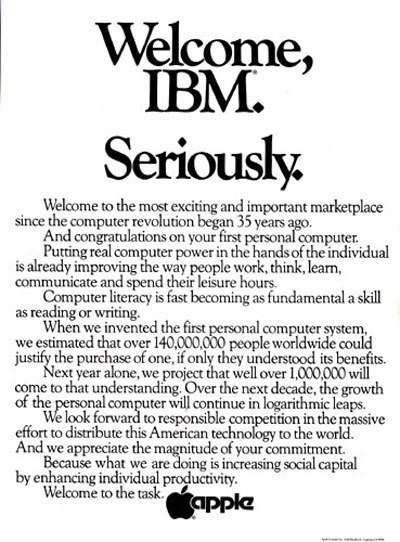
Which reminded me of Apple's welcoming IBM.


And Steve's comment about the iPhone.

But Apple gets the laugh today as they achieved a higher market cap than Microsoft.

May 26 (Bloomberg) -- Apple Inc., the computer maker turned mobile gadgeteer, overtook Microsoft Corp. to become the most valuable technology company on optimism it can keep adding customers for its iPhone, Macintosh computer and iPad.

By 4 p.m. New York time in Nasdaq Stock Market trading, Apple’s market value was at $222.1 billion, higher than Microsoft’s $219.2 billion. That made Apple the most valuable technology firm in the world. It’s also the second-largest U.S. stock by market value, behind oil company Exxon Mobil Corp., valued at $278.6 billion on the New York Stock Exchange.

And IBM has a market cap of $152 billion.  How times change.

Read more

Gaming Priorities shifting to overall experience vs. performance, Mac more stable than Windows

I found this article about Mac vs. Windows gaming performance, quoting Gabe Newell, making some points that my Apple friends and Mac users will take pleasure in vs. Windows.  The full podcast interview is here.

image

Also, said Newelll,"what's sort of surprising is how much more stable our games are on the Mac." Looking at the early data available from the Steam client, "the Mac is five times more stable than Windows" when using the metric of minutes played versus number of crashes.

Gaming is a segment normally focused on the graphics and processer performance.  System stability is not as high a priority as systems are over-clocked and liquid cooled to dissipate the heat.  Kind of sounds like some data centers with higher density computing and cooling problems.

Gabe Newell is the Founder of Valve Software.

Valve is the creator of Steam, the world’s largest online gaming platform. Steam turns any PC (and soon any Mac) into a gaming powerhouse by providing instant access to a huge library of titles, and by automatically keeping a user’s games completely up to date. With an active user-base of over 25 million, Steam also connects gamers with each other, making it easy to find friends, keep track of each other’s gaming activity, and easily play games together. Since its inception as a service for updating Valve’s own game Counter-Strike, Steam has grown to become a service used world-wide, translated into 21 languages, and with content servers on every continent (save Antarctica, but we’re sure that’s just a matter of time).

Who is Gabe Newell?

After dropping out of Harvard University[1] Newell spent thirteen years working for Microsoft Corporation, ultimately becoming a "Microsoft Millionaire." Newell has described himself as "producer on the first three releases of Windows".

Gabe makes the point that it is less about graphics performance and shifting to a focus on services, less about pixels and more about micro transactions and identity.

Newell remarked during the podcast that graphics performance is much less of a concern overall compared to finding ways to offer a better user experience, such as the greater stability on the Mac. "I think we're starting to enter a period where graphics performance is sort of a solved problem," Newell said. "We're moving away from loss-leading graphics approaches [of consoles] toward more of a service platform. It's less about pixels per second and more about micro-transactions and identity."

If gaming is making this shift to stop being obsessed about graphics and processor performance, does it make sense for data centers to take this same approach as well?

This article particular interesting personally because Gabe Newell was my first interview at Microsoft in 1992 and I was interviewing in Microsoft Mail group. Gabe took one look at my Apple and HP experience on my resume and said "you need to be talking to the Microsoft TrueType group."  I told him, I had enough of TrueType and fonts and was looking to do something different.  Gabe said, "no you are going to interview with TrueType group we are changing your interview schedule now."  My next interview was with Peter Pathe who was my Microsoft hiring manager and coincidentally I am having lunch with next week.

His may not be a household name as Microsoft (NSDQ:MSFT) names go. But Peter Pathe is a big mover and shaker.

After 215 years with the company, he's getting ready to retire and this Microsoft Press Pass Q&A shows off what he's done for the Big M. For one thing, ubiquitous Microsoft Word was Pathe's baby for 15 years.

Gabe Newell was a hard-core Microsoft Windows guy at one time and is now saying the Mac OS X is five times more reliable than Windows.  Who knows maybe after 18 years, I can get a chance to talk to Gabe about his servers in data centers for Steam gaming.

Read more

Microsoft, HP, and Digital Realty Trust win Green Data Center awards at Uptime Symposium, recognizing top achievement

Here is a summary of Three winners of Green IT awards at Uptime Symposium.  Being Green in the Data Center is now becoming an accepted behavior and leadership like below helps others with their own plans.

HP has their press release for the Wynyard facility.

Green Enterprise IT Awards showcase organizations pioneering energy-efficiency improvements in their IT and data center operations or providing technology that can significantly reduce energy consumption.

HP was recognized as the winner in the Data Center Design category for its Wynyard facility in the United Kingdom. Commissioned in September 2009, the data center uses a large quantity of fresh air supplied by fans through high-efficiency filters to reduce the energy required for cooling. The building features an energy-efficient and sustainable design that incorporates recycled materials as well as harvested rainwater.

here is a video of the air side economizer system.

Microsoft received a Green IT Award for its Chicago data center.

Chicago Datacenter Wins Green Enterprise IT Award from Uptime Institute

Today, Microsoft won a prestigious Green Enterprise IT Award from the Uptime Institute for the bold IT initiatives we utilized in our recently opened datacenter in Chicago. The facility integrates new design solutions which have led to greater efficiencies and carbon waste reductions.  This includes a significant reduction in water and material usage enabled by the deployment of containers and other IT innovations. The Uptime Institute is an organization that is focused on providing education and thought leadership for the enterprise datacenter industry and for datacenter professionals. The Green Enterprise IT Awards are the Uptime Institute's highest honor.Green Enterprise IT Award

By incorporating containers we have reduced carbon waste from extra packaging of servers and equipment and individual transport shipping consumables such as cardboard, styrofoam, plastic, and other packaging materials.  The highly innovative approach to design, construction and operations has also allowed us to fully deploy thousands of servers within a few hours, with a drastically reduced carbon footprint and great cooling efficiencies, with a reduced PUE of 1.15 - 1.22 across the facility.

Digital Realty Trust also won an award for its leadership in LEED Data Centers.

Digital Realty Trust received the award for its commitment to sustainability and innovation in the construction of a LEED certified data center utilizing full airside economization for more than 65 percent of each year. The LEED Platinum-certified datacenter project in Santa Clara, California is expected to save 3.5 million kilowatt hours of energy annually saving more than $250,000 per year at today’s energy prices.


“The construction of the green datacenter in Santa Clara demonstrates Digital Realty Trust’s strong commitment to energy efficiency and sustainability,” said Thomas Freeman, Managing Director and head of the Data Center practice at Jones Lang LaSalle. “Their adoption of industry best practices ensures a reduction in energy use, cost and associated greenhouse gas emissions.”

Here are photos from the presentation on DataCenterKnowledge.

DATA CENTER DESIGN: HP was honored for its design of the Wynyard data center in northern England, which makes extensive use of free cooling. Accepting for HP is Ed Kettler (with plaque), a fellow in the Chief Technologist Office at HP Enterprise Services.

AUDACIOUS IDEA: The data center team from Microsoft was recognized for its IT PAC container technology. Accepting for Microsoft are Dan Costello (center) and Sean Farney (second from right). Representing Uptime are Ken Brill (left), Lex Coors of Interxion (second from left) and Tom Freeman of Jones Lang LaSalle (far right).

Read more

Building your First Data Center, learn some lessons from Microsoft who say they can build for 50% less

Building your first data center can be a challenge.  Many have tackled this task over the past few years - Microsoft, Yahoo, Intuit, ask.com, eBay, Apple, and Facebook.  Building your first is an opportunity to consolidate your IT loads and reduce costs.  Given the difficulty of getting all the ducks lined up to get the project going, the budget for the first data center can be over $250 million.

DataCenterKnowledge reports on Microsoft's latest Quincy data center.

The new data center is being built next to Microsoft’s existing 470,000 square foot data center in Quincy, which was built in 2007 and is now one of the largest data centers in the world. But the new facility will be dramatically different in both its cost and design. After years of investing up to $500 million in each data center project, Microsoft plans to spend about $250 million or less on each data center going forward.

One trap I have seen many fall into is to build a big data center as the first.  Why?  Well, part of what drives this is data centers are the highest profit margin business for the construction industry and there are plenty of people who will tell you bigger is better.  The analysts will help you justify a $250 million dollar data center is the sweet spot of getting an ROI.

But, a different way of thinking about this problem is to build Ten $25 million data centers instead of one.  The first one may be a bit more than $25 million, but you can cut costs on the next, and the next, then after your third, you realize "hey there is a different way we can be doing this.  Let's change the design.  Build three more, then you go "wow we learned a lot, let's really push for something innovative."  The last three now cost $12.5 million instead of $25 million.

This is what Microsoft has done, but spending $500 million a data center.  They built Quincy 1, San Antonio, Dublin (air side economizer), and Chicago (container).  And the 4th generation data center is next.

Get Microsoft Silverlight

One additional benefit of building a $25 million data center is you don't end up with consultants, designers, and construction companies swarming to get your business.  If you choose an incremental data center design you'll learn a lot on what is real and what is hype.  Google, Microsoft, and Amazon can do this why can't you too?

BTW, another thing Microsoft has done is figured out how to build the 4th generation data center faster than the 1st generation. Part of the reason the first data center is so big is because it was so hard to get the project going.  Speed is important in addition to capabilities.

I've discussed these ideas with a few data center designers, and we have used the metaphor that data centers are designed like Battle tanks.  But not all businesses, so not all data centers should be same and if you have geo redundant SW like Google, Amazon, and Microsoft, it can be more cost effective to build different data center types for the same reason why there are light and heavy tanks.

Which brings up another benefit of the Microsoft 4th generation data center, the design is not in a concrete bunker which means it could be moved much easier if need be.

This next-generation design allows Microsoft to forego the concrete bunker exterior seen in the original Quincy facility in favor of a steel and aluminum structure built around a central power spine. The data centers will have no side walls, a decision guided by a research project in which the company housed servers in a tent for eight months.

What happens if you focused on building iterative data centers with a range of capabilities to adapt to business needs and could be moved if business or power conditions change in a location.  Doesn't this sound like a better way to spend $250 million.  But, the data center ecosystem is not going to promote this idea as it changes their profits and business models.

Microsoft, Google, and Amazon's battle for cloud computing is going to continue to drive some of the most innovative thinking.  And you don't have to wait to start thinking like they do.

Read more