Why Model? Increase Trust in The System

I”ve just had a day of intense modeling conversation followed up the next day a lunch meeting with an old friend who just left Microsoft.  We worked together at Apple, and ran into other during years at Microsoft.  Coincidentally, we saw each other a week after he left while he was on a charity holiday run.  He left Microsoft after 14 years and I did too. 

Given his recent departure and process of decompressing from 14 years at Microsoft I asked if he had reached an epiphany.  He hadn’t yet, but I did.

There are many reasons why you want to create abstract models of complex systems.

Scientific modelling

From Wikipedia, the free encyclopedia

  (Redirected from Model (abstract))

Jump to: navigation, search

Example of scientific modelling. A schematic of chemical and transport processes related to atmospheric composition

Scientific modelling is the process of generating abstract, conceptual, graphical and or mathematical models. Science offers a growing collection of methods, techniques and theory about all kinds of specialized scientific modelling.

Modeling is an essential and inseparable part of all scientific activity, and many scientific disciplines have their own ideas about specific types of modeling. There is little general theory about scientific modeling, offered by the philosophy of science, systems theory, and new fields like knowledge visualization.

And, I have had fun discussing models with executives like Thetus’s Danielle Forsyth and Skanska’s Jakob Carnemark.  We all see the benefit, but how do you get others to understand why modeling.

Modeling enables Trust of a technical solution.

For a trustful and friendly use of technology, the user must be able to have a clear mental model of its use and functioning (way of working), being it partial, superficial and even wrong, but at the same time sufficient for having precise expectations and for knowing how and what to do, i.e. sufficient for reducing uncertainty and perceiving safety and reliability.

So, why model the data center? It increases trust in the data center system including its users. Higher trusts promotes knowledge sharing.

It is clear how trust is a precondition for knowledge sharing and a result of it or, more precisely, that trust is a mediator, a catalyst of the process: it is a mental and interpersonal (cognitive, dispositional, and relational) precise condition for the two crucial steps in the organisational flow of knowledge.

The relationship between trust and knowledge sharing is circular: in order to trust Y, X must either have information about Y, helping him to evaluate Y's trustworthiness, or having knowledge in common with him that encourages the establishment of a trust relationship so as values sharing; on the other hand, in order to share knowledge, it is necessary to have a trust relation or atmosphere.

While caring of making knowledge capital explicit and circulating, an organisation should care of what are the beliefs of the actors about the knowledge itself, about the organisation values, authority, infrastructure, and about each-others, and what they expect and feel on the basis of such beliefs. In knowledge management organisations should monitor and build the right expectations in their members. Knowledge management entails a cognitive, affective, and structural "trust management" in organisations.

I’ve always done business assuming trust of the other party to create partnerships. I hadn’t thought about it as a separate property that indicates the health of the a system.  Modeling if used right can increase trust of the modeling systems.

Read more

How You Operate Affects Your Mileage – BMW M3 beats Prius

Top Gear has a post on their fuel economy test comparing a BMW M3 vs. a Toyota Prius.

Jeremy's miles per gallon test between the BMW M3 and Toyota Prius might have been a little, er, biased. But should your commute be, er, speedy, and you're looking for an excuse to buy the RWD, V8-powered M3 instead of a FWD 4-cyl hybrid...

Simple rules drive the Prius as fast as possible, and have the BMW keep up.

The Prius did 17.2 MPG, M3 did 19.4 MPG.

The full M3 vs Prius Video is here.

The message in the story.  It’s how you drive it that matters.  And, you can get better mileage by simply driving your existing car more efficiently.

Don’t change the car, change your driving style.

What’s this got to do with data centers.  Shouldn’t I relocate my IT resources to green data center space. Someone may think I just built a green data center that is LEED certified with all the latest energy efficiency power and cooling systems.  But, I bet you many don’t know how to operate this unique configuration of data center equipment in the most energy efficient manner?  Have you thought about how you will drive your data center?

If you don’t know how to operate your data center in the most energy efficient manner one company you should look at to run your data center operations is Lee Technologies managed maintenance and facilities operations.

Lee Technologies :: Solutions :: Managed Maintenance
Data Center & Mission-Critical Managed Maintenance
Over 86% of all Data Center Outages are Preventable
Lee Technologies :: Solutions :: Full Lifecycle Support :: Operations & Maintenance PDFInfrastructure failure and human error are the two leading causes of downtime in mission-critical facilities. The leading cause of infrastructure failure is poor maintenance. Our experienced staff has been providing infrastructure solutions for mission-critical facilities since 1983. Lee Technologies provides operations, managed maintenance and facility operations services supporting over 3 Million square feet of data center and mission-critical facility space across the United States.
Maintenance-Crucial
In mission-critical facilities, failure is not an option. That's why, night or day you can depend on Lee Technologies' Managed Maintenance Programs for comprehensive service and support. Our Managed Maintenance services are customized to the specific needs of each client and facility. Whether it's 24/7/365 monitoring, preventative maintenance, or comprehensive facility operations, Lee Technologies has the technology, capability and experience to meet your needs… and exceed your expectations.


Lee Technologies :: Solutions :: Facility Operations
Data Center & Mission-Critical Infrastructure Facility Operations
Lee Technologies :: Solutions :: Full Lifecycle Support :: On-Site Technical Staffing PDFMission-critical facilities utilize the latest technologies to keep the world's information flowing. However, even the most advanced technology is only as good as the people that maintain and operate it. With so much at stake, you don’t want to trust your mission-critical operation to just anyone. You want the right people, in the right place, at the right time... with the right tools, talent and training.
Many studies show that the #1 cause of data center downtime is human error. In an expanding market for high-availability services, finding, keeping and training qualified personnel has become more challenging than ever. That's why a growing number of organizations count on Lee Technologies data center infrastructure facility operations specialists at their mission-critical facilities.

Thanks to a fortunate introduction at Data Center Dynamics London I met Lee Technologies, Lee Kirby who set up a meeting at my beach house last week to discuss data center modeling and maintenance with Bob Woolley, VP of Facilities Operations and Quality Systems & David Gentry, Sr VP of Service while they were in town for their employee holiday party.

I’ve been spending a lot of time investigating modeling ideas and I wanted to see what Lee Technologies executives see as current and future issues to run a Greener Data Center.  We were in agreement on many points, and we discussed ideas on what I could blog in future posts on this site or other areas a boring topic “how to operate and maintain your data center.”

The M3 vs. the Prius is an interesting point for data centers, in that many have built for performance (M3), and the new way is for efficiency (Prius).  But, how you drive has the biggest influence on your energy use.

Also, another company who has embraced this idea is Skanska’s Robert Bellantoni.  Here is his article in DatacenterDynamics Focus. 

The “Fix First” concept is based on the needs of current legacy data centers to make immediate and necessary improvements in their operational efficiency without costly retrofit, redesign or timely rebuilding options.


“The fastest way to needed improvement is often apparent and can usually be fixed with minimum cost,” says Bellantoni. “We conduct a physical audit of the as built state of their current cabinets and rack installation. Most legacy data centers are in a ‘mid-life crisis’ mode as a result of an aging design that may have been the bestof- breed at the time, but did not take critical efficiency and rising operating costs into consideration when creating the original design model.”

Read more

Resource Modeling Tool for Green Data Center

I’ve been looking for a Resource Modeling Tool to build models for a Green Data Center.  Data Center Models were another reoccurring theme in a few Data Center Dynamics London sessions, but I didn’t hear anybody discuss their tools.

Luckily, I was able to go to a local presentation by Thetus’s CEO Danielle Forsyth where she presented their Tupolo Resource Modeling.

Understanding the impact of actions and the degree of progress towards goals requires a holistic understanding of all facets of a problem. Tupolo resource modeling is for those who need to understand overall system dynamics; simulate outcomes for different incentive, campaign and policy options; optimize campaigns and incentives to meet goals set for policy makers, environmental groups, engineering and community outreach; and ultimately assess results against defined objectives.

Thetus Tupolo Resource Modeling Solutions

Thetus Tupolo™ Resource Modeling Solutions

The Tupolo solution provides the ability to model interconnected systems of systems to achieve a unified view of complex problems. The functions and relationships of different organizations and interest groups can be modeled to help maximize a particular program's benefits and effectiveness. The application of Tupolo modeling to the management of resources such as energy, infrastructure and human capital can assist not only policy makers, but can encourage community involvement and participation—with a high degree of personalization—in meeting goals.

Interconnected System of Systems

This looks like the ideal tool, and I am looking forward to have discussions with Danielle.  We briefly discussed data center design workflow and how Autocad drawings with a BIM (Business Information Model) can be used to build a Green Data Center Model taking into account a full life cycle and its impact to the environment.

The Tupolo modeling solution should fit well with Skanska’s vision for a Living Data Center I”ve mentioned in previous post. Designing in real-time data center monitoring with modeling is the next big step in data center design.

A model like this enables what if analysis and make ROI calculations for monitoring solutions like OSIsoft’s PI system.

The awesome part is Danielle has already done work on modeling environmental impact of systems like storm water runoff, and in many ways a data center are easier to model than a water system.  Although I am curious to get into a water monitoring discussion as you can take OSIsoft’s Water and Waste Management solution and combine it with the Tupolo water model.

Keeping pace with the improvements necessary to manage stormwater through large infrastructure additions can be a significant economic hardship for cities, not to mention invasive and inconvenient. Big pipe projects are increasingly at odds with mounting public awareness of environmental issues and pressure on public officials to constrain the skyrocketing costs of grey building projects and embrace green management strategies.

Cities are therefore exploring solutions that depend less on resource-intensive, large-scale projects and more on green, cost-efficient and community-based improvements aimed at addressing stormwater at its source. To this end, Portland, OR, recently launched a $50 million, five-year "grey to green" initiative to fund the protection and restoration of the city's watersheds through green infrastructure. This approach, which includes planting trees, removing culverts, implementing ecoroofs and removing invasive plant species, requires community action and participation in stormwater programs.

Read more

Microsoft Embraces Modeling for Higher Efficiency

Microsoft has a press release on their joining the OMG Unified Modeling Language (UML) and Business Process Modeling Notification (BPMN) efforts.

Microsoft Focuses on Bringing Modeling Mainstream, Improves IT Delivery of Business Strategies

Senior Vice President Bob Muglia shares perspective on future of model-driven development and announces Microsoft’s participation in OMG.

REDMOND, Wash. — Sept. 10, 2008 — Microsoft Corp. today outlined its approach for taking modeling into mainstream industry use and announced its membership in the standards body Object Management Group™ (OMG™). Modeling is a core focus of Microsoft’s Dynamic IT strategy, the company’s long-term approach to provide customers with technology, services and best practices to enable IT and development organizations to be more strategic to the business.

Modeling often has been heralded as a means to break down technology and role silos in application development to assist IT departments in delivering more effective business strategies. However, although the promise of modeling has existed for decades, it has failed to have a mainstream impact on the way organizations develop and manage their core applications. Microsoft believes that models must evolve to be more than static diagrams defining a software system; they are a core part of daily business discussions, from organizational charts to cash flow diagrams. Implementing models as part of the design, deployment and management process would give organizations a deeper way to define and communicate across all participants and aspects involved in the application life cycle.

Modeling is a great method to develop Green Data Centers, optimizing components in an abstracted representation, making it easier to simulate interactions of components. There are a handful of companies doing this now.  One example is Skanska in data center construction. Here is a press release on Skanska’s use of Business Information Modeling.

Tekla and Vela Systems Create First Combination of Field and BIM Software for Construction Supply Chain Management

1 April 2008

Uniting 4D Building Information Modeling with RFID-Enabled Field Solution
Yields $1 Million Cost Savings at New Meadowlands Stadium 

Vela Systems, a developer of mobile field software  for the AECO (architecture, engineering, contractor and owner) industry, and Tekla Corporation, a leading building information modeling (BIM) solutions provider for the building and construction industry, today announced a joint software solution that brings dramatic new management capabilities to construction projects. The solution marries Vela’s patent-pending field administration software with Tekla’s construction management solutions. When enabled with field software and radio frequency identification (RFID), stakeholders in a construction project can manage critical-path building components and visualize the supply chain through a real-time, 4D simulation in which the fourth dimension is time. The joint Field BIM solution enables the AECO industry to feed into BIM the constantly changing status of the supply chain in the field.

Back to Microsoft, here is an explanation of why they are embracing models.

To make model-driven development a reality, Microsoft is focused on providing a model-driven platform and visual modeling tools that make it easy for all “mainstream” users, including information workers, developers, database architects, software architects, business analysts and IT professionals, to collaborate throughout the application development life cycle. By putting model-driven innovation directly into the Microsoft .NET platform, organizations will gain visibility and control over applications from end to end, ensuring that they are building systems based on the right requirements, simplifying iterative development and re-use, and resolving potential issues at a high level before they start committing resources.

“We’re building modeling in as a core part of the platform,” said Bob Muglia, senior vice president, Server and Tools Business at Microsoft. “This enables IT pros to specify their business needs and build applications that work directly from those specifications. It also brings together the different stages of the IT life cycle — connecting business analysts, who specify requirements, with system architects, who design the solution, with developers, who build the applications, and with operations experts, who deploy and maintain the applications. Ultimately, this means IT pros can innovate and respond faster to the needs of their business.”

Here is a video with Bob Muglia.

image

The good news is Microsoft is embracing an open standard modeling method.

OMG has been an international, open-membership, not-for-profit computer industry consortium since 1989. OMG’s modeling standards include the Unified Modeling Language™ (UML®) and Business Process Management Notation (BPMN™). In addition to joining the organization, Microsoft will take an active role in numerous OMG working groups to help contribute to the open industry dialogue and assist with evolution of the standards to meet mainstream customer needs. For example, Microsoft is already working with the finance working group on information models for insurance business functions related to the property and casualty industry, and will eventually look to expand those models so that they can be applied to P&C, life and reinsurance. Another early focus will be on developing specifications for converting messages across the various payments messaging standards.

“Microsoft has always been one of the driving forces in the development industry, helping to make innovation possible but also simplifying many of the most challenging aspects of the application development process,” said Dr. Richard Mark Soley, CEO at OMG. “In less than 10 years, OMG’s UML, a cornerstone of the Model Driven Architecture initiative, has been adopted by the majority of development organizations, making OMG the seminal modeling organization and supporting a broad array of vertical market standards efforts in healthcare, finance, manufacturing, government and other areas. Microsoft’s broad expertise and impact will make its membership in OMG beneficial to everyone involved.”

Imagine in the future there are models for the whole data center including the software running on the hardware.  You’ll be able to monitor the efficiency of the system, and resolve waste with automation.

BTW, one of the changes I made recently to the M3 of GreenM3 is I have added Modeling and removed Metering.  My old tag line was Monitoring, Metering, and Managing. Metering is reaching critical mass in the industry and I moved on to look at Modeling as a method to go Green.  My new tag line is Monitoring, Modeling, and Managing.

Read more

Modeling for Green Data Centers

A stimulating conversation with a data center executive got me thinking about modeling for a Green Data Center, and what method would make sense for modeling method. Given my software background, my first look was at Universal Model Language (UML).

Unified Modeling Language (UML) is a standardized general-purpose modeling language in the field of software engineering. UML includes a set of graphical notation techniques to create abstract models of specific systems, referred to as UML model.

After looking at how UML could be used in IT for data center design, I hit upon Systems Modeling Language (SysML).

The Systems Modeling Language (SysML), is a Domain-Specific Modeling language for systems engineering. It supports the specification, analysis, design, verification and validation of a broad range of systems and systems-of-systems.

The dominant group influencing the creation of SysML were aerospace and defense contractors who build complex systems integrating hardware, software, and people. A SysML FAQ points out strengths of SysML vs. UML.

SysML offers systems engineers the following advantages over UML for specifying systems and systems-of-systems:

  • SysML expresses systems engineering semantics (interpretations of notations) better than than UML. It reduces UML's software bias and adds two new diagram types for requirements management and performance analysis: Requirement diagrams and Parametric diagrams, respectively.
  • SysML is smaller and easier to learn than UML. Since SysML removes many software-centric and gratuitous constructs, the overall language is smaller as measured in diagram types (9 vs. 13) and total constructs.
  • SysML allocation tables support various kinds of allocations (e.g., requirement allocation, functional allocation, structural allocation) thereby facilitating automated verification and validation (V&V) and gap analysis.
  • SysML model management constructs support the specification of models, views, and viewpoints and are architecturally aligned with IEEE-Std-1471-2000 (IEEE Recommended Practice for Architectural Description of Software-Intensive Systems).

Looking for whether anyone who has used SysML in data center construction I hit upon a google forum thread.

Do any of you know or have heard of SysML being used to model building systems in the construction-industry (parametric building design, logistics/processes, etc)?

Here is the response from a SysML architect.

Here's a short analysis.  First, let me say that I am an Aerospace kinda
guy.  I have worked just about every aspect of it spending about 20 years in
the Skunkworks and beyond.  I am also a Enterprise Architect and specialize
in interoperability and NetCentric Operations.  Most recently I have been
helping out in Disaster Relief and Recovery as well.  The answer to your
question is that no, I haven't heard of it being used yet and it's probably
because SysML spec has only been out about a year.  Second part is most
definitely it can apply.  Especially when the construction looks at the
larger "Enterprise" context which would apply to more than the construction
of the building itself but the infrastructure of the environment such as
urban planning, green enterprise application and those things that are
beyond cement and wires.

My first recommendation is to read Tim's book (System Engineering with
SysML/UML).  If I was given the task of "parametric building design, etc.,",
I would view the task using Tim's SysMOD process.  It's not an end all, but
it's a start.  Secondly, I would look at some the advances in "Green
Enterprise Architecture".  These are those initiatives that could be applied
to help the construction domain with the rapid advances of the green
enterprise.  I think that it's very useful to view these things from the
domain of the customer that "wants to do the right thing" for the
environment.  This is where the SysML modeling tools can help a bunch.

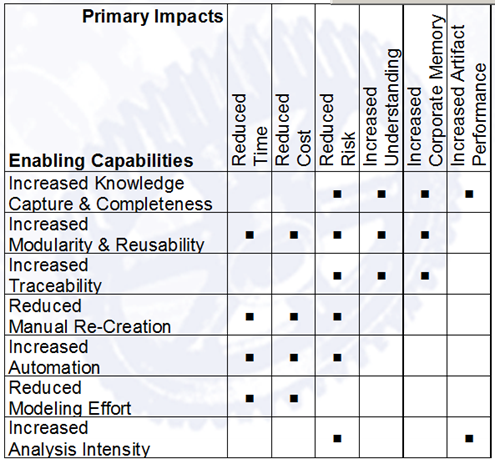
Why would you model?  Consider this matrix for benefits of modeling.

image

Read more