Netflix open sources its HW and SW CDN Solution

Open Compute has started the open sourcing of servers and data centers.  Storage is another big area, and Netflix has shared its design.

The home page is here.

Netflix Open Connect Content Delivery Network

Around the world, people are enjoying nearly a billion hours per month of movies and TV shows from Netflix. Now, Netflix is enabling ISPs to get Netflix video data directly from Open Connect, a single-purpose content delivery network we've established.

Most of you want to see the HW.

Objectives

When designing the Open Connect Appliance Hardware, we focused on these fundamental design goals:

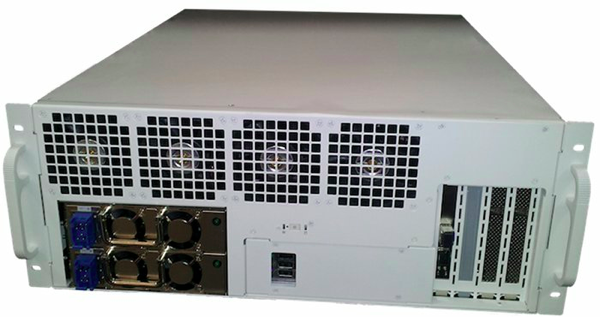
  • Very high storage density without sacrificing space and power efficiency. Our target was fitting 100 terabytes into a 4u chassis that is less than 2' deep.
  • High throughput: 10 Gbps throughput via an optical network connection.
  • Very low field maintenance: the appliance must tolerate a variety of hardware failures including hard drives, network optics, and power supply units.
  • Simple racking and installation. Front mounted power and network ports are the only things to connect at install time.
  • NewImage

 Here is the BOM for the HW.


Bill of Materials


DescriptionVendor & ModelQuantity
Chassis TST custom 1
Motherboard Supermicro X9SCM-F 1
Processor Intel E3-1260L 1
Memory 8GB ECC 1333MHz 4
Hard Drive Hitachi Deskstar 5K3000 3TB 36
Hard Drive (alternate) Seagate Barracuda 7200.14 3TB 36
Controller LSI SAS 9201-16i 16 port 2
Network card Supermicro AOC-STGN-i2S 1
Redundant Power Supply Unit (AC/DC options) Zippy MRW-5600V4V/DMRW-5600V4V 1
Misc. 2U active CPU Heatsink, SATA Cables, NIC optics

Then design has AC and DC power supplies.
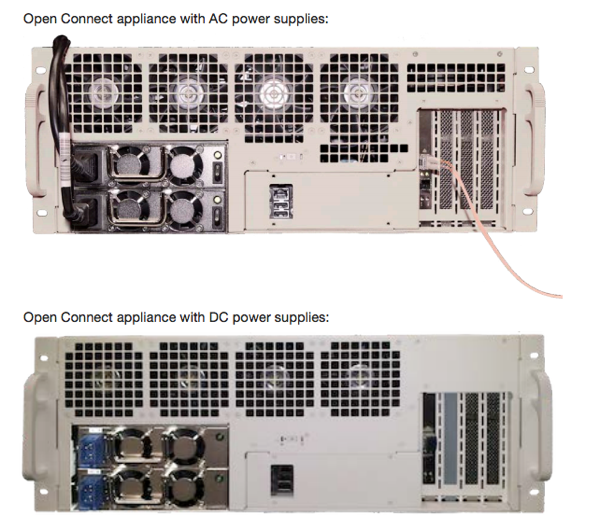
NewImage

There is 1 TB of flash.

We also add 1 TB of flash storage (2 solid state drives) for system files, logs and popular content.

You can get more details on the site.

Open Connect

Open Compute Project is the Open Source Server, Storage, and Rack Brand

Linux is the brand for Open Source Software.  There are many who have built on this brand to build their own open source brand.

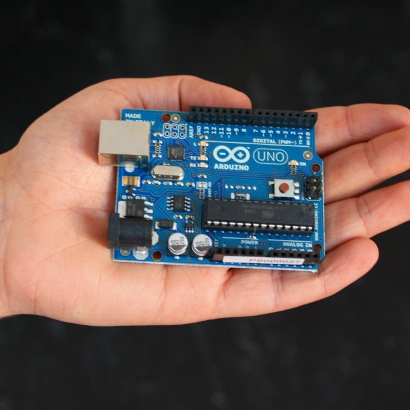
Arduino is a an open source hardware solution for small eletronics prototyping.

Arduino is an open-source electronics prototyping platform based on flexible, easy-to-use hardware and software. It's intended for artists, designers, hobbyists, and anyone interested in creating interactive objects or environments.


Arduino can sense the environment by receiving input from a variety of sensors and can affect its surroundings by controlling lights, motors, and other actuators. The microcontroller on the board is programmed using the Arduino programming language (based on Wiring) and the Arduino development environment (based on Processing). Arduino projects can be stand-alone or they can communicate with software running on a computer (e.g. Flash, Processing, MaxMSP).


Photo by the Arduino Team

When you run a search for Open Source Server Hardware the Open Compute Project shows up as the top results.
 
The challenge for a project that is open source is what is its business model.  Just because the OCP is open source and non-profit doesn't mean they can exist without a business model.

business model describes the rationale of how an organization creates, delivers, and captures value

GigaOm's Stacey Higganbotham attended the Open Compute Summit and she discusses the business model of Open Source Hardware.

More infrastructure, more users, less money.

What’s occurring here is a shift in the value of a server, and thus of server makers. What used to be high-end machines with features driven by the engineers inside Dell, IBM, HP, etc., have now become a commodity, and not a Dell-like commodity either — a really low-end commodity. These servers are stripped-down machines custom-built by the guys who built Dell’s and HP’s boxes. The rise of manufacturers like Quanta has begun.

This rise was a direct result of the industry refusing to listen to the demands of its customers, especially because those demands didn’t seem to involve a way for the server guys to make much money. At first, Rackable, now called SGI, picked up on the business, but as Forrest Norrad, the VP of servers at Dell pointed out on Wednesday at the Open Compute Summit, Dell realized that companies like Facebook were not just one-off complainers. They were the leading edge of a new way of doing business– and IT was a fundamental element of that business.

...

Throw the server vendors a bone and let’s keep moving.

And here’s where the Open Compute Project comes in. Unlike DCS, which was a successful effort to serve the market once Dell had validated it, the Open Compute Project is a coup by the buyers of servers to take control of their hardware destiny. As such, I wondered if this coup would leave room for Dell or HP to continue to build their businesses. After attending Wednesday’s Open Compute Summit, I can say it seems like it will.

 Open Compute is still in the early stages, and it has the potential to be a brand in itself.


A Data Center Analyst walks into Open Compute Summit and says ...

A funny thing happened at the Open Compute Summit, one of the top data center/server analyst is chatting with the OCP staff.  One of his suggestions is OCP should charge for its events.  

The OCP staff asks why?  The analyst responds, well, we charge $1500 for our data center conference, thousands of people go, they leave happily fed with knowledge.  Compared to our conferences you actually learn more at OCP.  You can make a lot of money charging to attend the Open Compute Summit.

Huh.  Who would have thought. Maybe it was the alcohol.