Here is Tim O'Reilly's talk at the Open Compute Summit where he discusses the history of the Open Source movement.
Your Custom Text Here
Here is Tim O'Reilly's talk at the Open Compute Summit where he discusses the history of the Open Source movement.
Stacey Higginbotham has a post on Facebook/Open Compute's announcement that disrupts the server market.
Sitting next to Stacey I get a chance to see what she is going to write before it posts and she does a good job of summarizing Frank Frankovsky's opening keynote.
Facebook and Open Compute just blew up the server and disrupted a $55B market
21 MINS AGONo Comments
 photo: Stacey HigginbothamSUMMARY:
Facebook took aim at the hardware business back in April 2011 with the launch of the Open Compute open hardware program, and Wednesday is fired the killing blow at the $55 billion server business.
The launch of two new features into the Open Compute hardware specifications on Wednesday has managed to do what Facebook has been threatening to do since it began building its vanity-free hardware back in 2010. The company has blown up the server — reducing it to interchangeable components.
With this step it has disrupted the hardware business from the chips all the way up to the switches. It has also killed the server business, which IDC estimates will bring in $55 billion in revenue for 2012.
At the Open Compute Summit, there are 1,900 attendees, three times that last event in San Antonio.
So, what is new?
Frank's beard is bigger. Frank is the founder of the Open Compute Project.

Yet some things don't change with Frank he is still in tennis shoes, jeans, and plaid shirt.


I got a chance to chat with Frank briefly before the conference and the board is spending a lot of time thinking about how to keep the momentum.
Just walking in the door I saw a dozen good friends and met a couple of new people.
I'll have a lot more to write over the next few days.
Open Compute has been making noise in the data center and IT world open sourcing server and and data center design.
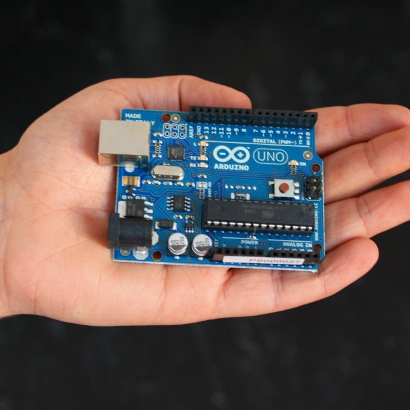
Something that has taken off much bigger is Arduino.
Photo by the Arduino Team
Arduino is an open-source electronics prototyping platform based on flexible, easy-to-use hardware and software. It's intended for artists, designers, hobbyists, and anyone interested in creating interactive objects or environments.
Arduino can sense the environment by receiving input from a variety of sensors and can affect its surroundings by controlling lights, motors, and other actuators. The microcontroller on the board is programmed using the Arduino programming language (based on Wiring) and the Arduino development environment (based on Processing). Arduino projects can be stand-alone or they can communicate with software running on a computer (e.g. Flash, Processing, MaxMSP).
Here is TED video of one of founders explaining how surprising Arduino's growth has been and what it has been used for.
GigaOm's Stacey Higginbotham had a discussion with Facebook's Frank Frankovsky.
BREAKING FREE FROM A VENDOR-DEFINED ECOSYSTEM AND BEYOND
With the Open Compute Project, Facebook helped build a new type of infrastructure for its needs and the needs of other webscale companies that had been locked into a vendor-defined ecosystem. After taking the power in its own hands with Open Compute, Facebook isn't done. Frank Frankovsky, the director of hardware design and supply chain, highlights how to take webscale computing to the next level. Instead of just building data centers for scale, it's time to start thinking about how to operate them at scale too.
Moderated by:Stacey Higginbotham - Senior Writer, GigaOM
Speakers:Frank Frankovsky - VP, Facebook
Stacey reports on her own conversation with Frank.
Like Netflix, Facebook is boosting its edge network
By Stacey Higginbotham Jun. 21, 2012, 10:20am PTUpdated: Facebook is building out its own
content delivery networkedge network to help speed up the delivery of its photos according to Frank Frankovsky, a VP at the social networking company. Frankovsky outed his plans onstage at the GigaOM Structure 2012 event in San Francisco as part of a conversation about how the network plans to continue scaling out its infrastructure. His announcement comes just a few weeks after Netflix announced it was building its own CDN.

Quisque iaculis facilisis lacinia. Mauris euismod pellentesque tellus sit amet mollis.