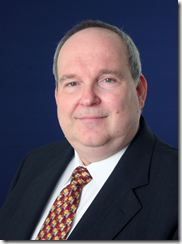
Cisco Lab Manager Chris Noland loses battle with cancer, passes away on June 20, 2011
I just heard from KC Mares that Chris Noland, Cisco Lab Manager passed away last night losing a battle with cancer.
Chris Noland Lab Manager
- Current
- Lab Manager at Cisco Systems
I had the pleasure of meeting Chris 1 1/2 years ago at Cisco to discuss his efforts to educate the Cisco development teams on the energy efficiency of their product designs.
The last time I saw Chris in person was at the Technology Convergence Conference.
Panel Discussion Topic: Data Center Challenges and Solutions in the R&D Lab
Moderator: Mark Thiele, VP of Data Center Strategy at ServiceMesh
Panelist: Chris Noland, Lab Manager at Cisco Systems Inc.
Panelist: Mark Honer, Senior Manager, Customer Service Labs Juniper Networks
Panelist: Val Sokolov, Senior Manager for Engineering lab services at BrocadeUnlike enterprise and production data centers, today's R&D electronics lab is a dynamic and constantly changing work environment with variable demands for power, space and cooling. IT engineers expect as much autonomy and flexibility as possible in the way that they access their IT resources and then develop and test their IT solutions. So, how realistic is it to believe that our new data center standards and "best practices" can be implemented in the IT lab as well? Hear leading laboratory operators describe their challenges and barriers to success and explain how they have modified well established data center solutions to fit the needs of their unique R&D environments.
Chris was one of the guys who had a passion to green the data center by improving the energy efficiency of the network gear.
It is sad to hear I won't see Chris at another data center event.
Robert Gates's 7 management rules for managing the Pentagon, some good ideas for Data Center Executives
I am lucky to spend a lot of time with some really good data center executives. When I read this WSJ article on Robert Gates's 7 rules for managing the Pentagon it reminded me a lot methods I see these guys using. I can name about 7 guys who use these methods. Can you? One who used these rules is my dear departed friend Olivier Sanche.
Guideline No. 1: Symbols matter. Mr. Gates is a Kremlinologist by training, Studying the Soviet Union convinced him that people watch what leaders do, and getting the symbolism right can help win people over. At the Pentagon, rather than calling the combatant commanders to him all the time, Mr. Gates made a point of visiting them.
Guideline No. 2: Listen to the professionals. Mr. Rumsfeld was criticized for running roughshod over the opinion of the Pentagon’s admirals and generals.
Guideline No. 3: Hold the professionals accountable. In the wake of the 2007 scandal overpoor care at the Walter Reed Army Medical Center, Mr. Gates earned a reputation for quickly firing people. But he notes he never fired people for not knowing about a problem. He forced people out after they failed to fix problems once they came to light.
Guideline No. 4: Come alone, work with the existing team. Mr. Gates fell in on Mr. Rumsfeld’s team. And save for a few core people from the Bush administration that Mr. Gates asked to keep, he allowed the Obama administration to choose its own Pentagon political appointments.
Guideline No. 5: Lay out the vision, let the experts execute. Mr. Gates relished making decisions, taking in all the information he could about a problem then deciding where the Department should go. But he was not a micro-manager, and he left the details of how a decision should be executed to the military.
Guideline No. 6: Speak to all the layers of organization. Mr. Gates spread his ideas, like increasing the Air Force’s emphasis on drones, not just by ordering changes at the top, but also by speaking to young officers at the service academies and the war colleges, seeding his ideas in a new generation of leaders.
Guideline No. 7: Leave behind strong leaders. Mr. Gates said he worked hard to remake the Army, change its focus from major combat operations, to a broader array of missions including low intensity conflicts and training of local security forces. And he said thanks to the leaders he has promoted, like Gen. Ray Odierno and Gen. Martin Dempsey, there is little chance the Army will go back to its old ways.
Contrast this with Donald Rusmfeld's long pdf file.
The WSJ today has the full story of Mr. Gates’s evolution as a manager. But as an added bonus, Washington Wire has boiled the wisdom of Bob Gates into seven pithy “Gates’s Guidelines.” (Far fewer than the dozens of tips Mr. Gates’s predecessor, Donald Rumsfeld, collected in his “Rumsfeld’s Rules.”
Data Center Conversation with FieldView Solutions David Schirmacher on getting IT and Facilities together, galvanic corrosion metaphor
Over the past 9 months I have had many conversations with David Schirmacher, Chief Strategy Office of FieldView Solutions.

![]()
David Schirmacher,
Chief Strategy OfficerDavid Schirmacher is Chief Strategy Officer for FieldView Solutions. He has close to 30 years of experience managing the design and operation of millions of square feet of mission critical facilities, representing billions of dollars in corporate investment.
Mr. Schirmacher was most recently Vice President and Global Head of Engineering and Critical Systems at Goldman Sachs & Company, where he was responsible for the design, operation and overall strategy of the firm's data centers, trading and critical business environments throughout the US, Europe and Asia. Previously, David served as Vice President, Director of Operations at Jones Lang LaSalle, and Compass.
David is on the technical advisory committee of Mission Critical Magazine, VP of 7x24 Exchange International and a member of a task force organized by the EPA and other industry influencers to develop an agreed method for measuring and reporting data center infrastructure efficiency.
Dave and I were chatting at Uptime, and he made the point in jest I hadn't written a blog post about him yet. I have been meaning to write about David and FieldView Solutions, but actually have a writer's block posting as I know so much and I don't know where to start. My first conversation with David was a two hour phone call, and we rarely chat for less than an hour as we bounce around many different topics.
An example of areas we will discuss is what is going on in the industry, who is doing interesting work and who isn't, what did we think of a conference. David and I have run into each at DatacenterDynamics, AFCOM's Data Center World, Gartner Data Center Conference, Uptime Institute Symposium, and The Green Grid over the last 6 months. We'll see each other next when I make my first trip to 7x24 Exchange Orlando.

To break the writer's block I gave David a call and discussed some ideas and one topic we discussed is the recommendation that comes from a variety of people that the data center electricity bill should be moved out of facilities and into IT, so IT has an incentive to save electricity.
David and I discussed the fallacy of this recommendation fixing the energy efficient IT problem. Getting facilities and IT to work together is brought up often, but getting the two groups to work together is not easy, and many times does not last as the connection and communications disintegrate after the initial discussions.
Then we hit upon the metaphor of a galvanic corrosion where two metals (IT and facilities) are in contact and one corrodes as electrons flow between the materials.
An infamous example of galvanic corrosion is the Statue of Liberty's copper skin and iron supports.
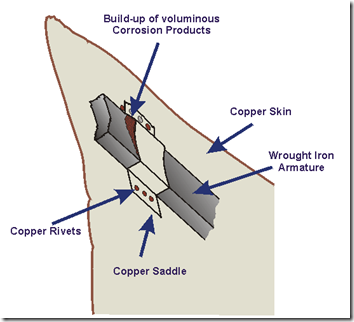
The galvanic reaction between iron and copper was originally mitigated by insulating copper from the iron framework using an asbestos cloth soaked in shellac. However, the integrity and sealing property of this improvised insulator broke down over the many years of exposure to high levels of humidity normal in a marine environment. The insulating barrier became a sponge that kept the salted water present as a conductive electrolyte, forming a crude electrochemical cell as and Volta had discovered a century earlier. The formation of expanded material that followed was typical of confined situations found in crevice corrosion.
When two metals are far apart on the Galvanic series, your corrosion problem gets worse. The same idea applies to IT and facilities, the further apart the groups the unintended consequences (the corrosion) risk is higher. You can mitigate the risks, but you should be aware of the differences up front.
Here are a few words of wisdom from David Schirmacher.
although it is difficult to create a lasting connection between the two groups, in essentially every case, you will find that the best practice operations have succeeded at doing it.
if you don’t have the right stakeholders accountable for performance you run a big risk of only appearing to be proactive.
Data Center Dynamics Seattle, another great time with data center people
It is interesting to contrast Uptime Institute Symposium vs. DatacenterDynamics especially when I attend the conferences back to back. Both of the conferences are good.
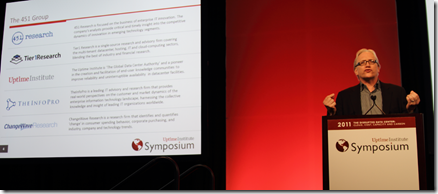
Here is CEO Martin McCarthy, CEO of the 451 Group with some passion.
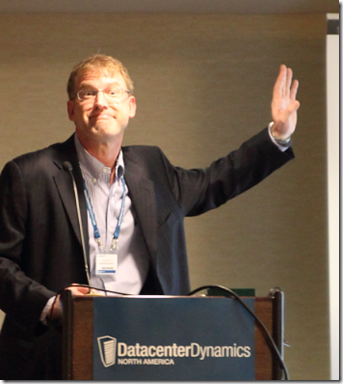
Here is Stephen Worn CTO and CEO of North America, DatacenterDynamics with "talk to the hand" gesture. Actually I don't remember what Stephen was saying.
I hope you get a good laugh looking at this candid picture of Stephen Worn during his presentation. This picture was good for a few laughs from the DatacenterDynamics crew.
I've gone to 3 of the last 4 Uptime, but with all the DatacenterDynamics events around the country, I've had good times with the attendees and the DatacenterDynamics crew in SF, Seattle, Chicago, NY, and London. I typically attended as press, but about 2 years ago I wrote a blog entry about heading to DCD SF and I was going to spend most of my time talking to attendees and not going to sessions. In response to my post, Stephen Worn calls me in 30 minutes and tells me he is going to put me to work and be a hall chairman.
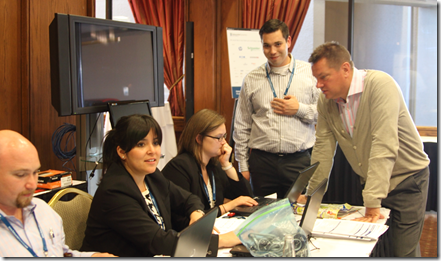
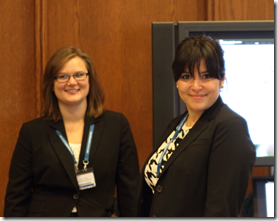
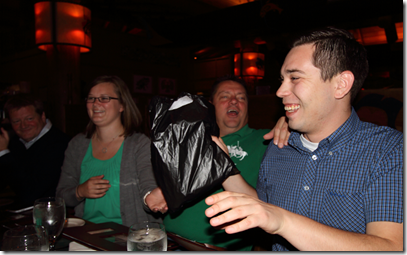
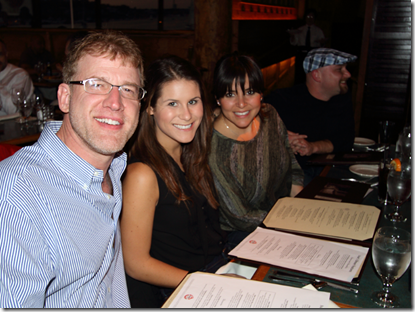
Part of the fun I have with DCD is going out to dinner with the crew after an event and we chat about all kinds of things. Part of the fun is making the new employees play the role of the Birthday person at the dinner table until a new employee comes on board to take their place. Ashley on the left had her first birthday dinner in Chicago, and Anabel had her first birthday dinner in Seattle a year ago.
But, this year it was actually Justin's Birthday, and it was opening day for Copper River Salmon in Seattle, so we headed to the Salmon House for a Birthday dinner.
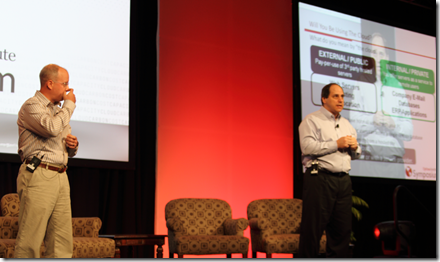
I did have a bit of fun at Uptime Symposium with this picture when I caught Raging Wire's Jim Kennedy with a little nose scratch, and sent the high res 5184x3456 pixels to Raging Wire's VP of Marketing Doug Adams.
Both Uptime Symposium and DatacenterDynamics are great places to meet people. But, as you can tell I have much more fun with the DatacenterDynamics crew. I'll be at DCD SF next on June 30.