VMware Virtual Datacenter OS

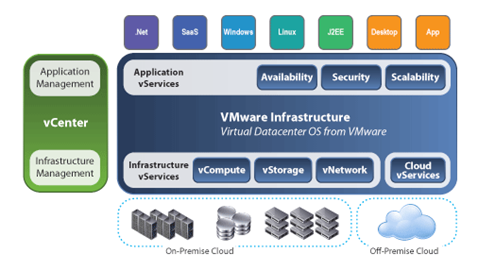
VMware announced their Virtual Datacenter OS, a couple of days ago.  Unfortunately, I’ve been in Chicago in the basement event halls with no internet access, so I am late on getting this up, but I did mention this offering in a panel I was on at Data Center Dynamics.

The traditional IT stack with its tight coupling of software and hardware falls short of supporting customers’ needs. The accelerating rate of business change, non-negotiable requirements for 24X7 business resiliency and inexorable pressure to reduce cost are increasing the pressure on IT. At the same time, IT has dramatic opportunity to change the status quo by leveraging the immense power and attractive economics of x86 hardware, the maturing of virtualization technologies, increasing choice in new application architectures and the availability of vast new clouds of cheap and readily accessible computing power.
image

I have a couple of friends who are at VMWorld, and I’ll check for their impressions of this announcement and the interest from the attendees.

Read more

Sun and Microsoft Virtualization Partners

Application Development Trends writes on Sun and Microsoft being Virtualization partners.

Green extolled the virtues of its partner relationships in the virtualization space, which includes Microsoft. He was joined briefly by Microsoft's General Manager of Virtualization Mike Neil, who declared, "Microsoft and Sun share the same vision of virtualization from the desktop to the cloud." Sun recently became a member of Microsoft's server certification program; the certification ensures that Sun's xVM products will integrate and interoperate with Microsoft's offerings.

In a post press-conference interview, Neil told this site that that shared vision included a conviction that that virtualization will become ubiquitous across the data center and even the desktop.

"We're in a unique situation," he said. "The fact that both Microsoft and Sun are operating system vendors allows us to work together to bring a new capability to the customer. The customer is living in a different environment today. In the past he would have bought a machine with a Sun operating system or one with a Windows OS. With virtualization, you have the opportunity to run those disparate systems on one piece of hardware. And both companies believe that management of that capability needs to go from the physical layer to the virtual machines and the applications. Where we're all headed in the future is the cloud."

Sun, the inveterate sloganeer responsible for "Write Once, Run Anywhere" and "the Network is the Computer," offered a new buzz phrase: "Virtualize Everything, Manage Anywhere."

Unfortunately, Virtualization is getting more confusing with all the choices.

On the eve of VMware's VMworld Conference in Las Vegas, the virtualization announcements are coming fast and furious. Microsoft just held the first of its "Get Virtual Now" event series a few days ago. A month ago, Oracle launched its VM Template virtual machines for Oracle apps and Linux. Xen.org, which manages the open-source Xen hypervisor project on which xVM is based, announced the 3.3 version last month. Linux distro Red Hat just acquired a virtualization company (Qumranet) with technology based on another open source hypervisor (KVM). And Hewlett-Packard is expected to make new products at the upcoming VMworld conference.

"VMware is in a tough situation," Neil said, "because they're not an operating system provider. All the operating system providers -- Red Hat, Novell, Sun, Microsoft -- are providing virtualization solutions as part of their offerings. There's no real magic here; everyone is going to have that capability."

Read more

Dell Trading Up from Manufacturing Hardware to Manufacturing Cloud Computing

There  is a lot of coverage on Dell selling its manufacturing operations.

GigaOm has one speculating Dell is getting out of the hardware mfg business in preparation for building cloud computing.

Just a day after Dell launched it’s own line of mini Inspirons, and after CEO Michael Dell said carriers would likely subsidize such netbooks, creating smaller price tags, the Wall Street Journal speculates that Dell will sell its manufacturing plants, shrinking its operations. This would be good for Dell because it would give it a chance to ditch an aspect of its business with diminishing returns and go after a growth area, like cloud computing.

...

The hardware and operations that comprise a computing cloud will be a low-margin business for those offering it. If Dell can take the lessons of squeezing the costs from a low-margin business like building computers and translate that into helping build, deliver and operate clouds most efficiently, it could win. By tying its range of consumer and corporate devices back into such clouds, it could become a powerful business generator for cloud providers.

When it comes to the utility industry (which is what many cloud providers like to compare their business to), GE sells billions in equipment and services to providers. Dell has made some acquisitions that get it started down that road offering both services and equipment to clouds, but it also has a company culture of exactitude and discipline that can’t be bought. I think if Dell can dump its manufacturing plants, it will head for the clouds.

If there is a Dell built cloud, can Dell build better devices for its cloud? 

Read more

Cisco Data Center Initiative, A View From the Network

Got a tip from another reader on a blog post, Enterprise Cloud Computing - Build your own with Cisco VFrame .

Enterprise Cloud Computing - Build Your Own With Cisco VFrame - Why Wait ?

21 August, 2008 by Greg Ferro

I can see some value in external Cloud Computing, but why not just build your own with Cisco ? Take a bunch of leftover machines, that old storage system and get a demo version and make your own.
It seems clear to me that Cloud Computing is going to go down two quite different paths. The first is the path that Amazon / Google / Joyent represent. Enough said on those technologies.

But why not build a Cloud Infrastructure in your own Data Centre ?

And says Cisco has the solution

Cisco already makes a cloud solution

Sometimes there are so many products in the Cisco catalog that some of them get lost. But one product I have been researching over the last six months is Cisco VFrame.

Now VFrame is software toolset that automatically provisions VMware ESX servers, Cisco Catalyst switches, ACE Application Delivery Controllers1 , FWSM modules, Storage Arrays and Storage Switches and so on. In simple terms, it is programming environment that allows to ‘orchestrate’ the configuration of many separate technologies into a single process.

Let me ay that last bit again ” ‘orchestrate’ the configuration of many separate technologies into a single process.” Thats is the first part of Cloud Computing right there.

What does VFrame do?

So if I have Cisco VFrame, a software tool that automates the following tasks:

  • allocate and create a storage capacity and storage network from my existing storage system
  • allocate and create CPU / RAM resources in the form of a VMWare ESX hypervisor
  • creates the network modifications for firewalling and application acceleration

then that smells lot like Cloud Computing to me.

I am going to forward this entry to a few people i know and get their opinions on using VFrame for building a Cloud Computing environment.

Read more

Thin Clients + The Cloud

GigaOm has a post on the merging of Thin Client and Cloud Computing. Some of these ideas are being driven by Citrix (owner of Xen) who benefits from the adoption of this idea.

Today the organization behind the popular Xen open-source hypervisor announced the latest release of its virtualization software. It’s smaller, has better power management and graphics capabilities, and can run on machines ranging from servers to laptops and mobile phones.

One areas I do agree with is the interest in companies for thin clients to save energy.

Participating in a call related to the semiconductor industry earlier this week, I heard from one of the analyst participants that thin-client sales were on the upswing as management focused on power savings, security and manageability. A virtualized desktop can be delivered via a USB drive, a thin client, and on hypervisor-equipped laptops. The benefit of virtualization to most companies is that mobile users can take USB drives, thin-clients or laptops and recreate the corporate compute environment in a secure and controlled setting. This takes a lot of the expense out of managing hundreds or thousands of desktops.

An idea which agrees with conversation’s I’ve had with others is thin clients connected to cloud computing.

As virtualized servers have been gathered into computing clouds, hooking some kind of virtual desktop to that cloud has become easier to implement and manage, making desktop virtualization more interesting for corporate buyers. That was a reason Microsoft found startup Kidaro interesting enough to acquire in March and is also the value proposition behind MokaFive. The next few years could see some real changes in corporate computing.

Read more