Blogging Tip, Adding a Stock Quote Reference Increases Probability to Get Listed in finance.google.com

In today's post /2008/08/vmwares-hidden.html, discussing VMware's Hidden Competition Executive, I purposely added the stock link to VMW in my post,

One friend said Charles joined Pi Corp, Paul Maritz’s company one week before it was acquired by EMC, reporting directly to Paul. Charles had to have known he was joining EMC’s cloud computing efforts, and I wouldn’t be surprised if he know at the time that there were plans to make big changes at VMware (NYSE: VMW) like Paul’s CEO role.

I write the Green Data Center blog as my own research notebook, and it is more efficient for me to share ideas with friends than writing emails. About twice a month I am running into friends who are thinking about blogs and can use help getting started.  I am going to start adding to my blog, tips for bloggers.

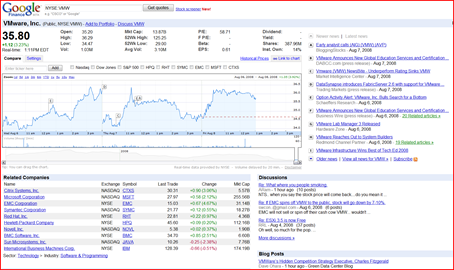
I did this knowing I would get index'd by google finance's blog search in http://finance.google.com/finance?q=NYSE:VMW 

image 

This popped me up to #1 in blog posts for VMW.

image

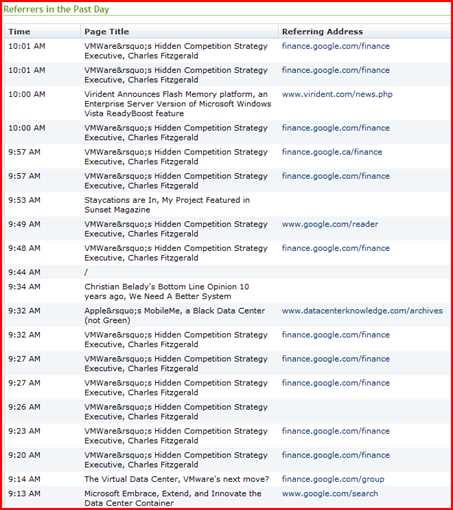
I can see the click stats in TypePad's tools.

image

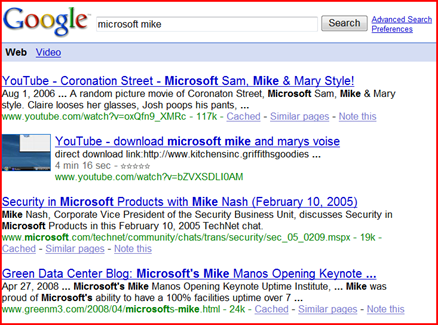
Now let me preface this with I have been blogging for a 10 months on Green Data Center, and I have been watching carefully how well my posts get index'd. One of the interesting Google Webmaster tools shows I get a high search click for "microsoft + mike"

image

Showing up #4 is my blog with Microsoft's Mike Manos.  I have no idea what Microsoft Mike people are searching for, but the fact I show up #4 feels weird.

Another strange one is I beat Dell in Google search for Dell XS23. Maybe I need to get the Dell guys to post a banner ad on my site.  :-)

image

Read more

Microsoft TechNet Article - Filtering the Greenwashing

TechNet has an article I just wrote in print and online, Filtering The Greenwashing.

Sustainable Computing Filtering the Greenwashing

Dave Ohara

Contents

The Need for Numbers
Measuring Energy Usage
Power Factor
Measuring in Production
The Microsoft EnterpriseEngineering Center
Wrapping Up

There are an overwhelming number of products and solutions being marketed as green, as saving energy, as being more efficient. All this marketing hype creates confusion in the market as to what is really eco-friendly. Even after evaluating the specifications on various products, it is difficult, if not impossible, for an IT pro to determine what equipment should be used when environmental impact is a key concern. When you see all the demonstrations, large energy savings are always highlighted, and this leads you to think that the return on investment (ROI) makes the upgrade easier to justify. After all, the energy savings should reduce the total cost of ownership (TCO).

The move by companies of all types to label seemingly everything as environmental and exploit the current interest in green solutions has led to the concept of "greenwashing," which refers to the over-promising of environmental benefits. So what is the truth of energy savings? This isn't as clear cut as, say, installing new energy-efficient lightbulbs in your home.

As interest in sustainable IT efforts increases and the market for environmentally friendly IT equipment expands, many people and organizations jump to the end result of deploying energy-efficient laptops, desktops, and servers, and using virtualization to reduce energy consumption. Yet few organizations run energy audits to determine the true benefits of what they have purchased.

While the ideal scenario is to actively measure in your production environment, that can also be expensive. If you aren't ready to start measuring in production, you can still move forward by performing your energy audit earlier in the process, doing so in your performance and evaluation labs. (Most companies have some lab or group responsible for testing and evaluating equipment before making a purchase.) There you can add energy performance as one of your test criteria and then take those results into account when making purchasing decisions, rather than relying on the numbers provided by manufacturers. So as you test, create your own device power-consumption database. Then you can ignore the greenwashing and see for yourself what works.

Of course, I should point out that if you want highly accurate numbers for operation under your true load, you'll need to monitor in your production environment. The quicker you begin monitoring your production environment, the better for your organization and your bottom line. This process will be critical to your long-term success.

Thanks to the Microsoft folks in the Enterprise Engineering Center, I was able to leverage their experiences in Filtering the Greenwashting.

  1. 1.Turning off a device doesn't necessarily reduce energy consumption as much as you might expect (see Figure 4). In one case involving server hardware, the EEC discovered a device that actually consumed 100 watts when turned off but still plugged in. This surprised many, and the EEC went over the setup many times. They eventually used an infrared thermometer to measure inlet and outlet temperature and verified that the device did, in fact, consume 100 watts while off.
  2. Software can have a significant impact on power consumption. On identical networking switches, with identical hardware and BIOS configurations, running different networking software displayed a 21 percent difference in power consumption. High-end solutions with more processes and features enabled, like security and monitoring tools, often consume more than their simpler low-end counterparts.
  3. In virtualization scenarios, the EEC has measured power consumption versus I/O utilization and CPU utilization to determine when a given piece of hardware maximizes its performance per watt. The EEC found that a narrow focus on CPU utilization could lead to too many virtual machines loaded on a physical machine, actually decreasing the overall performance per watt.
  4. Higher-density devices, as you might expect, have more power and cooling issues. When deploying higher- density systems, your power and cooling facilities staff should be consulted as early as possible. These devices may be good candidates for their own power-monitoring devices in production if you know the environment will be power constrained.
  5. Dual power supplies can consume considerably more power than a single power supply.
  6. Seemingly identical pieces of hardware with identical configurations can have significantly different power consumption. Observed differences were significant enough to make the EEC staff double-check hardware to ensure they were really configured the same.
  7. The watt ratings on the product plate are not actual consumption numbers, but rated capacity for power supplies.
  8. Maintaining a database of energy consumption tests and results per device and subcomponent is essential for retaining knowledge and comparing data.
  9. Different configurations of equivalent amounts of RAM consume different amounts of energy. Fewer DIMMs typically consume less energy—for example, 4 x 2GB DIMMs versus 8 x 1GB DIMMs. But there have been some cases where fewer DIMMs consumed more energy.

And, one of the last minute I was able to get in is the EEC's effort's using real time temperature sensors.

Keeping Cool in the Datacenter

Datacenter cooling offers a huge potential for reducing energy consumption. It is astounding how much heat can be generated in a datacenter and how much energy is used to keep hardware cooled. But if you want to manage your cooling successfully, fix problems, and develop more efficient cooling solutions, you'll need a temperature-monitoring solution. Consider the solution the Microsoft datacenters use.

Microsoft Research built a temperature sensor network for the datacenters that allows for improved temperature control and also enables evaluation of various cooling improvements. For instance, one Microsoft datacenter was evaluating end-of-aisle air curtains to improve hot and cold air separation. After the curtains were installed, some servers started to send overheat alarms. Naturally, the operation engineers increased the air flow from the cooling system to provide more cool air. To their surprise, however, more servers sent overheat alarms. And all these servers were at the bottom of the rack—the bottom, of course, is usually the coolest area from a raised-floor cooling system.

Using the sensor network, the engineers confirmed that the racks were cooler up higher, with the bottom of the rack the hottest. And they soon figured out that hot air was being drawn from the hot aisle between the bottom of the rack and the flooring­—a result of Bernoulli's principle. They easily fixed the overheating by sealing the bottom of the rack and reducing the air flow speed.

This is just the sort of data the Microsoft Enterprise Engineering Center gathers and analyzes when doing performance testing. So the EEC recently notified Microsoft Research that they were ready for a deployment test. Within a day the system was deployed to 10 racks, and the installation took just one hour to complete. The EEC now is able to study and better understand cooling issues and their relationship to hardware performance.

Of course, simply monitoring isn't a solution in itself. The real gain is in your ability to find problem areas that you can fix, make changes, and evaluate various solutions to see if they have the result you are expecting. After all, you don't want to be caught off guard when your new cooling solution unexpectedly causes your racks to overheat.
Read more

Decisions for a Green Data Center, Get Out of Your Own Way

WSJ has a science article which helps to explain why companies are so slow in greening their data centers.

Get Out of Your Own Way

Studies Show the Value of Not Overthinking a Decision
June 27, 2008; Page A9

Fishing in the stream of consciousness, researchers now can detect our intentions and predict our choices before we are aware of them ourselves. The brain, they have found, appears to make up its mind 10 seconds before we become conscious of a decision -- an eternity at the speed of thought.

Their findings challenge conventional notions of choice.

[Image]

Corbis

"We think our decisions are conscious," said neuroscientist John-Dylan Haynes at the Bernstein Center for Computational Neuroscience in Berlin, who is pioneering this research. "But these data show that consciousness is just the tip of the iceberg. This doesn't rule out free will, but it does make it implausible."

Results of their experiments are interesting.

Such experiments suggest that our best reasons for some choices we make are understood only by our cells. The findings lend credence to researchers who argue that many important decisions may be best made by going with our gut -- not by thinking about them too much.

Dutch researchers led by psychologist Ap Dijksterhuis at the University of Amsterdam recently found that people struggling to make relatively complicated consumer choices -- which car to buy, apartment to rent or vacation to take -- appeared to make sounder decisions when they were distracted and unable to focus consciously on the problem.

Moreover, the more factors to be considered in a decision, the more likely the unconscious brain handled it all better, they reported in the peer-reviewed journal Science in 2006. "The idea that conscious deliberation before making a decision is always good is simply one of those illusions consciousness creates for us," Dr. Dijksterhuis said.

As you get teams working together together, are you willing to take risks? Try something no one else has tried to save energy. The answer is a resounding NO from most companies. "This is our data center!" Yet, as this research shows, we are making mistakes in judgement all the time.  And in a corporate environment huge effort is spent to prove we did not make a mistake and the data is there to prove the right decision was made.

When is the last time you heard of a failed virtualization project?  There is tons of data to prove it was the right thing to do. But, you know someone is failing in their execution, but you don't hear the horror stories.  These stories will come with time, because there are way too many consultants making lots of money virtualizing servers.

This is why an energy monitoring system and using metrics like PUE are critical to evaluate objectively in big picture did the green project work.

Is your Green IT team set up to be efficient taking small risks to be more efficient or is it overthinking?

Read more

Centralized vs. Decentralized Green Initiatives

Centralized vs. Decentralized is a debate that has the pendulum swing from side to side. With Green's increased focus, the pendulum swings towards centralized and top down initiatives.  In Uptime Institute this was advocated as "Energy Czar" position.

Here is an example of something which may have seemed obvious on the surface, but ran into problems. University of Washington in Seattle has their #2 administrator, Provost Phyllis Wise, driving the creation of the College of Environment at UW.

To many people, the idea that the University of Washington would create a new College of the Environment seems a no-brainer: Some of the biggest issues facing humanity would get greater academic scrutiny in a city where people seem to care deeply about nature.

But within the UW, details of the plan are sparking intense debate. Many faculty who are in thriving programs have shown little interest in joining a new college. The vision publicly unveiled by Provost Phyllis Wise just three weeks ago — to create the world's largest environment college — appears to be running into serious problems.

Thanks to the college's democratic process, something most corporations do not have, the departments/colleges which would be centralized under the new school have rejected the idea.

Vote against college

In an advisory poll, the School of Aquatic and Fishery Sciences voted by an overwhelming 27-1 against joining the college. In another of the units — the Department of Earth and Space Sciences — the results were even more definitive: 29-0 against.

"Our mandate is to study things from the center of the Earth to the rim of the solar system," said Robert Winglee, who chairs Earth and Space Sciences. "The environment is that thin layer in which we live."

Winglee said faculty were concerned that elements of their study wouldn't fit in with the mandate of a new college. He informed Wise of the vote a month before she released her plan.

Was Winglee surprised, then, to see his department listed on the plan? "Yes," he replied simply, adding that he doesn't want to comment further for fear of becoming embroiled in academic politics.

One of the biggest problems with Green Initiatives and the people behind them is they get so passionate about their cause, they can't see the impact on others or understand why there would be opposition.  Sounds Ironic that a Green Initiative is not aware of the impact to others.

Read more

What I Learned from Donald Trump, the Bottom Line

One of the projects I did in my prior life was to drive a video project at Trump National Golf Club in Westchester, NY. The project was in many ways a mini-version of you're hired/fired. The Golf Course property was at that time run by Carolyn Kepcher who had appearances on The Apprentice. The details are too long for this post, so let's move to the bottom line. What I learned from Donald Trump.

We did not plan on having Donald Trump in the video, but through luck he was on site for the video shoot and agreed to be in the video. I got my cameo shot in the video and you can see me in this video capture.  (I am on the left.)

Dave and Trump

Donald above was asking "How are things working?" The partner responds by discussing how things are working. They have had problems with the Exchanged Server and connecting with HQ's email system. After 30 painful seconds of explaining Exchange and connection issues, Donald asks, "So, how are things now?" The partner responds "everything is OK now."

Then Donald looks at me, and asks, "You work for Microsoft right?" I respond yes. Donald continues, "What do you do?" My response, "I am here to make sure everything works." Donald's response. "Good."

We shoot a bit more. Get Donald with his testimonial.

Trump Waterfall clip

We finish with a closing shot.

Trump golf cart clip

And we are ready to call it a day.  The video producer, partner and I are sitting by the golf cart path, and next thing we know Donald is coming over to talk to us.  Oh no!  What did we do now? Donald starts, "I have one other question. Part of doing business with Trump organization, people assume we have a lot of money to spend. I want to know did my people get a good deal." I responded, "Yes, your people got a very good deal." Donald, satisfied "Good, that's what I want to hear."

Bottom line: out of all the complexity of Green projects, all the various issues, there are only 2 things an executive wants to hear.

  1. Is it working?
  2. Did we get a good deal?

Anything else is not important.

Read more