Boeing and Airbus have their environment sites. This is interesting to look at for companies who have now had to make Green, carbon emissions, energy efficiency part of their everyday communications.


Your Custom Text Here
WSJ has an article on how people are being creative turning off their air conditioning. It is 2nd most popular article today behind the US bolsters fannie and freddie.
As the article cites, get ready for the electricity price increases.
Pulling the Plug: Summer of '08 Sparks Creative Conservation - WSJ.com
Because many power plants run on natural gas, which has shot way up in price, utilities in every region of the nation have imposed -- or are planning -- big rate increases this year, some approaching 30%.
In response, nearly two-thirds of families are cutting back on air conditioning, according to a recent Associated Press-Yahoo News poll. They're buying ceiling fans and programmable thermostats; burning up hot afternoons in malls and movie theaters; and bombarding blogger Erin Huffstetler, who writes about frugal living, with questions about the merits of tinting their windows dark to block the sun.
I know the Microsoft guys say they save energy cleaning the roof. Here is one guy who thinks he saves energy by sprinkling the roof.
On hot afternoons, Mr. Newman runs a hose to the roof and douses the shingles for 20 minutes, which he swears lowers the temperature inside. "I don't know if it's all that good for the life span of the roof," Mr. Newman says, "but when it's 110 degrees, I really could care less."
And WSJ even included a story of a bad move in air conditioning.
And Reba Kennedy, who turned off her central air altogether?
Ms. Kennedy now cools just the three rooms she uses most in her San Antonio home, with window units set at 78 degrees. To her surprise, she has found it pleasurable. With her downstairs windows open, she can smell the honeysuckle in her yard. She loves the look of her sheer curtains blowing in the breeze.
Last week, though, when she reviewed her electric bills, Ms. Kennedy found that her sacrifices haven't translated into savings. In June of 2006 -- with the central air on full blast -- she used an average of 26 kilowatt hours a day. Last month? An average of 44.
Harvey Sachs, a senior fellow at the American Council for an Energy-Efficient Economy, says that isn't surprising, because window units are notoriously inefficient.
But Ms. Kennedy was upset. Since quitting her job as a business lawyer two years ago to take up writing, she has tried to live simply and frugally; conserving energy is central to that goal.
Saw this MSNBC article and it provides a possible explanation for some people who are obsessed with Green practices that have no science backing their actions.
Are you crazy enough to succeed? - Behavior- msnbc.com
I'm at the Obsessive Compulsive Disorders Institute (OCDI), a residential treatment center in McLean Hospital — Harvard's psychiatric center — to see if my own OCD problem wasn't just my secret but maybe also the secret to my success. All my adult life, intrusive thoughts have alternately halted my progress and saved my ass, and I'd finally like to separate the bad from the good.
The medical director at the center, Michael Jenike, M.D., is both a maverick and a pioneer in the OCD community. He founded this facility, the first of its kind, to help sufferers of what he considers the most agonizing of psychiatric disorders.
"I had a 17-year-old who had kidney cancer that was going to kill him in 5 or 6 months. He also had a bad case of OCD. He said he'd rather get rid of his OCD and live only 6 months, than get rid of the cancer and live with the OCD. That's when it first hit me: This is some serious stuff."
The people seeking treatment at OCDI do not have the minstrel-show version of the disorder acted out by Tony Shalhoub in Monk or Jack Nicholson in As Good as It Gets. The institute's residents are seriously impaired. They have the kind of shattering anxiety that would make the rest of the OCD world — roughly 1 percent of all adults, 2.3 million of them in the United States alone — want to scrub their hands. The real numbers could be even higher, because OCD may be underdiagnosed and undertreated. Half of all OCD cases are serious — and that's the highest percentage among all anxiety disorders. On average, people flail about for 17 years and see three or four doctors before they find the right care.
That horror aside, OCD has become cool. Perhaps it fascinates us because it forces otherwise normal people to carry out insane acts — acts that they know are insane. It has great dramatic tension. We secretly enjoy the dissonance of a perfectly rational man becoming convinced that he is fatally contaminated and washing his hands with bleach and a scrub brush, only to repeat the whole routine 10 minutes later. Paging Lady Macbeth.
For any you have started a green program in your company, I am sure you are familiar with people who could possibly be put in the category of having a Green Obsessive Compulsive Disorder.
WSJ’s Environmental Blog points out GE’s strength is now its energy businesses, both traditional and renewable.
GE Earnings: Appliances Out, Energy In
Posted by Keith Johnson
General Electric didn’t disappoint with its second-quarter earnings — they were as dismal as expected, with a profit drop of more than 5%.
The bright spot, as in past quarters? Infrastructure and energy. And regardless of what the ads might say, that isn’t all wind turbines and green energy (though GE’s wind business is going gangbusters). There’s plenty of old energy in there, too, from gas turbines to coal and nuclear.
Which is why GE is rubbing its hands. World leaders are trying to figure out whether their priority is to tackle climate change with a lot more clean energy, or to fight poverty by bridging the energy gap in poor countries with a lot more old energy. Unlike a lot of its specialized rivals, GE has the luxury of cheering on both camps — it can sell wind turbines to Texans and coal plants to India. That helps explain the conglomerate’s makeover away from 100-year old lightbulbs and toward new energy sources.
And closes with the current economic conditions favor GE.
Now, GE’s just got to hope the dollar stays weak. That means pricey oil, more attractive renewable energy, and an easier export story for all of its energy products.
SalesForce.com is another company in cloud computing service that has a service report like amazon.com’s.
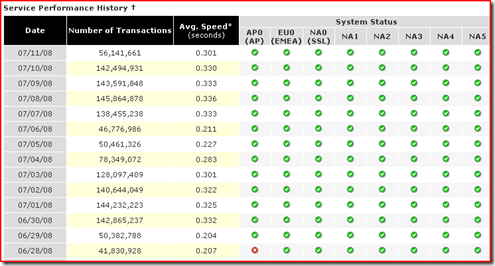
SalesForce.com’s policies are here.
Trust.salesforce.com
Success is built on trust. And trust starts with transparency.
Trust.salesforce.com is the salesforce.com community’s home for real-time information on system performance and security. On this site you’ll find:
- Live data on system performance
- Up-to-the minute information on planned maintenance
- Historical information on transaction volume and speed
- Current and recent phishing and malware attempts
- Information on new security technologies
- Best security practices for your organization
Our trusted, secure, reliable infrastructure is the foundation of our Force.com platform as a service. No other application or platform—on-demand or on-premise—offers a comparable level of transparency.
Trust.salesforce.com was inspired by conversations with our customers. Let’s continue that conversation. What would you like to see here? Post your suggestions on ideas.salesforce.com today.
Quisque iaculis facilisis lacinia. Mauris euismod pellentesque tellus sit amet mollis.