Peter Principle, now 40, Simple Competence

Peter Principle is a classic and has reached 40 years.

The Peter Principle is the principle that "In a Hierarchy Every Employee Tends to Rise to His Level of Incompetence." While formulated by Dr. Laurence J. Peter and Raymond Hull in their 1968 book The Peter Principle, a humorous treatise which also introduced the "salutary science of Hierarchiology", "inadvertently founded" by Peter, the principle has real validity. It holds that in a hierarchy, members are promoted so long as they work competently. Sooner or later they are promoted to a position at which they are no longer competent (their "level of incompetence"), and there they remain, being unable to earn further promotions. Peter's Corollary states that "in time, every post tends to be occupied by an employee who is incompetent to carry out his duties" and adds that "work is accomplished by those employees who have not yet reached their level of incompetence".

Businesweek has an article about hitting 40.

The Peter Principle Lives

Now 40, The Peter Principle resonates even more today, when a lust for accomplishment has led an unprecedented level of incompetence

http://images.businessweek.com/mz/09/15/600/0915_50sutton15.jpg

Illustration by Richard Mia

By Robert I. Sutton

Click here to find out more!The Peter Principle, about to be reissued in a 40th anniversary edition, was a best seller when it was first published. A satiric treatise on workplace incompetence, it touched a nerve with readers because it was so funny. And so true. Much like the film Office Space, NBC's The Office, and Scott Adams' Dilbert comic strips, this book by Laurence J. Peter (a former teacher) and Raymond Hull (a playwright) captured the twisted logic of workplaces—tapping into how ridiculous they feel to insiders. It gleefully emitted a cloud of jargon monoxide and absurd advice as it reached its famous main conclusion: "In a hierarchy, every employee tends to rise to his level of incompetence."

There are good ideas on how to run green programs in the data center.

The cure for our malady? We should return to what Dr. Peter wanted: rewarding ordinary competence and being wary of feats that come too easily. Perhaps the late Ray Kroc is the right role model here. One of his first steps in building the McDonald's empire was to run his own outlet—he cooked, cleaned bathrooms, picked up the trash. The focus on doing ordinary things well was, he believed, key to McDonald's success.

Simple competence was central, too, for former U.S. Marine Lieutenant Donovan Campbell, who led a platoon in bloody street battles in Iraq. As Campbell's account, Joker One, tells us, he earned his men's respect and protected them through simple acts: training them to get in and out of a Humvee quickly, reminding them to eat, and arguing with superiors when those under his command were unnecessarily put in harm's way.

Finally, consider how Captain Chesley Sullenberger III explained his astounding emergency landing of US Airways (LCC) Flight 1549 in New York's Hudson River in January. "I know I speak for the entire crew when I tell you we were simply doing the jobs we were trained to do," he said. As Dr. Peter might have observed, there were no pretenders, blowhards, or shared delusions that day, just the deftly coordinated actions of people who had not reached their level of incompetence.

Keep this last sentence in mind to judge how your green programs are working.

As Dr. Peter might have observed, there were no pretenders, blowhards, or shared delusions that day, just the deftly coordinated actions of people who had not reached their level of incompetence.

Read more

Move to Cloud Computing, Saves 80% Operating Cost

Here is a blog entry about a guy who thinks about green a lot and discusses his move to Amazon Web Services’s EC2.  He discusses servers, green data centers, and how he saves 80% of his operating cost by moving to the cloud.

Cloud Computing: Truly Green Data Centers

Category: Conservation, Save Electricity, Technology – Tom Harrison – 10:54 am

cloud-computing-greenThere has been a lot written about how much power is consumed by the computers that drive the Internet. A lot has been written about “green” data centers. But I think there’s a far more significant trend when, combined with more efficient computers and data centers, will make a 10x or greater reduction in power demand possible: cloud computing.

Data centers, brown or green are huge buildings — they are truly incredible places, with thousands of computers owned by multiple companies. I have negotiated the contracts for “co-location” in a number of data centers: you pay for floor space, bandwidth, and power and get a facility that has great connectivity, power that never goes out, and a carefully cooled environment for the computers. This blog, and most other websites are located at such data centers. Little sites like this one share a “slice” of a server with a number of others. Large sites like the ones we have at the Internet companies I have worked at have our own computers and other equipment “co-located” in data-centers.

Here is his bottom line.

The Virtual Green Cloud is Here

So look at cloud computing from an overall energy standpoint — we use about 80% less server power, thus need that much less cooling and that many fewer computers. Add virtualization and we use even fewer physical resources so the “embedded energy” of the hardware is even less.

The only losers in this whole new paradigm: the data centers (at least the ones who haven’t gone to cloud computing on their own) and the computer manufacturers.

Solar panels on the roof, more efficient cooling, and other “green data center” features are great improvements. But by enabling us to stop wasting power and resources our business, which is just one of many thousands like it, will save money and be green in a cloud computing environment.

Read more

Off to Uptime Institute IT Symposium

Next week is Uptime Symposium.  Rich Miller will be there as well for Data Center Knowledge, and we are both on the same panel.

The Uptime Institute’s four-day Symposium 2009 runs next Monday through Thursday (April 13-16) at the Hilton New York. Day passes are available. In a late addition, Google’s Chris Malone will be on hand to discuss the company’s data center innovation and energy efficiency. “Google is using industry-proven concepts in radically different ways, which has led to millions of dollars in savings for the company,” said Kenneth G. Brill, executive director of the Uptime Institute. “By making appropriate business tradeoffs that optimize reliability, performance, and capital and operational expenditures, the Institute estimates that Google has saved at least $500 million in capital expenditures alone. The point here is that any company with a similar business case, application portfolio and appetite for risk can accomplish equally striking results.” Malone will present on Tuesday at noon. NOTE: I’ll be participating in a panel Tuesday at 3:30 pm on “Sustainable Computing in the News.” If you’re at the conference, stop by to say hello.

Last year, I blogged on Mike Manos’s opening keynote and it was a good one to set the tone for following year.

Microsoft's Mike Manos Opening Keynote Uptime Institute, Green Enterprise Computing

The opening of the Uptime Institute Symposium started with Pitt Turner, saying "what are we doing here?" Green Enterprise Computing is a timely topic for the industry event. I've seen Mike present before, and here is what I got out of Mike's latest presentation as new information to digest.

  1. Mike's call to action for all was to stop being information hogs, and to share with the industry. He gave numerous example, and here are a few Mike shared.
  2. Mike emphasized that in spite of a focus on technology. Microsoft has found having the right people and processes makes bigger impact than technology . Mike states over 50% of data center outages are caused by human error. This contrasts a common method to invest in multiple layers of infrastructure redundancy to achieve uptime.Mike was proud of Microsoft's ability to have a 100% facilities uptime over 7 years by implementing strong and disciplined maintenance programs. Also, redundant infrastructure creates more energy waste.
  3. Technology is not the only answer to energy efficiency. People are the opportunity. Microsoft achieved a PUE improvement from 2.2 to 1.8 with no new technology just by people making changes to existing systems in one of their older facilities.
  4. Mike didn't say this, but bottom line he emphasizes an Amazon.com approach in getting data on everything, and they'll figure out what to do with it after by giving people the information to do the right thing.
Read more

Official Google Blog Post, Efficient Data Center Summit

Google has their official web site on their Efficient Data Center up.

Efficient Data Center Summit
April 1st 2009

On April 1st, we hosted leaders of the IT industry to discuss best practices for improving data center efficiency. The day was spent discussing how to make significant reductions in resource use while meeting service requirements. Saving electricity and water is not just good for the environment, it makes good business sense too. Being "green" reduces operating costs and can keep our industry competitive; it is the economic advantage that makes efficiency truly sustainable.

For those who could not attend in person, you can view the slide decks from the event below, or watch videos of the entire day here:

Part 1: Green Grid, Google's PUE, What's Next

Part 2: Best Practices, Data Center Tour, Panel Q & A

Part 3: Sustainable Data Centers, Water Management, Wrap Up

And, they have their blog post on it to spread the word.

Designing lean, green, energy-saving machines

4/09/2009 12:32:00 PM

Last week Google hosted a Data Center Efficiency Summit, bringing together approximately 160 industry leaders to share insights and best practices. Since it was April Fool's Day, we threw in a few jokes to keep the atmosphere fun (oil-cooled data center, anyone?), but the topic is serious: How can the IT industry keep growing while also exercising good environmental stewardship?
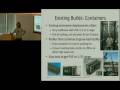
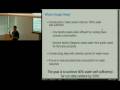
We disclosed for the first time details about the design of our ultra-efficient data centers. We also provided a first-ever video tour of a Google container data center as well as a water treatment facility. We detailed how we measure data center efficiency and discussed how we reduced our facility energy use by up to 85%. The engineers who developed our efficient battery backup solution even brought an actual Google server to the event.

Read more