James Cameron and Eric Schmidt discuss technology and the environment, “We’re the Comet”

Google’s Eric Schmidt moderated a two hour conversation with James Cameron

James Cameron on “Avatar 2″ and the Impending Environmental Crisis

James Cameron

On stage at a private event in Silicon Valley last night, legendary director James Cameron and Google CEO Eric Schmidt held a fascinating two hour conversation that touched on everything from the technology needs of the upcoming Avatar 2 film to the perils that face the environment if action isn’t taken.

Green was a dominant part of the conversation.

The vast majority of the conversation turned toward ecological issues when Eric Schmidt described Avatar as a narrative about the world’s ecology. “Why do you care so much about it?” Schmidt asked Cameron. “What is your responsibility and why are you using your significant perch?”

“Any movie can be a teaching moment, but it has to be wrapped in powerful entertainment,” Cameron stated in response. He says part of the reason Avatar succeeded was that it spoke to the human psyche and heart. Specifically, it spoke to something he believes we all know: that we’re becoming disconnected from nature and that we are on a precipice.

“If we don’t take control over our stewardship of our planet,” Cameron began, “the planet we bequeath to our children and our grandchildren will be in significant danger.”

The next part of the conversation focused around the statistics supporting Cameron and Schmidt’s positions on the environment. They said that 70% of species will be extinct by the end of this century if we do nothing to stop the rise of world temperatures. Both men pointed out that while an average temperature rise of a few degrees would be devastating, the temperature rise would be three times as great at the arctic and antarctic poles.

We’ll see how green the data center environment is for Avatar 2.

One closing quote stuck with the author.

While they covered a lot of ground (more than I can reasonably type up), there was one quote that really summed up Cameron and Schmidt’s thoughts on our treatment of the environment. It was in reference to the comet that killed the dinosaurs.

“We’re the comet this time,” Cameron said.
Read more

Google's Lenoir Data Center, 30 megawatts, 708 Lynhaven St SW, Lenoir, NC

There is a common belief you can't find a Google Data Center using Google Maps.  Well here is the Google Lenoir, NC data center at 708 Lynhaven St SW, Lenoir, NC.  Data Center friends estimate the power to be 10 megawatts for the building maybe 15 max.

image

I found the address here, but Lynhaven is misspelled.

This one was in Lenoir, N.C., nestled in the rolling hills of Caldwell County at 708 Lynnhaven St. Never heard of it? That's okay. Google likes it that way, nice and secretive. For perspective, Lenoir is about 70 miles northwest of Charlotte.

Using Bing Maps you can see what the site looked like before construction.

image

The red circled area shows where the substation will go.  Here are substations added to the site.

image

image

Here is a closer view of the data center.

image

The resolution is quite good and you can see the construction is not complete.

image

Mapquest shows the building further along with cars at the support building.

image

South of the site looks like another data center being built.

image

image
Read more

4 MW vs. 12 MW - CPU vs. hybrid CPU/GPU solution, which is greener?

Nvidia has a press announcement regarding World's Fastest Super Computer.


NVIDIA Tesla GPUs Power World's Fastest Supercomputer


Half the Size, Lower Power and 50% Faster Than World's Top Supercomputer

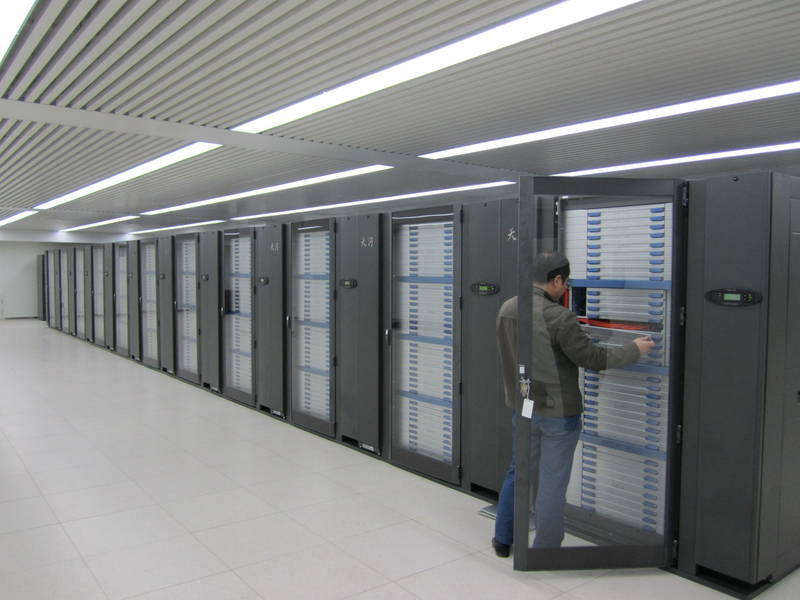
The Tianhe-1A Supercomputer, located at National Supercomputer Center, Tianjin

SANTA CLARA, CA -- (Marketwire) -- 10/28/2010 -- Tianhe-1A, a new supercomputer revealed today at HPC 2010 China, has set a new performance record of 2.507 petaflops, as measured by the LINPACK benchmark, making it the fastest system in China and in the world today(1).

Tianhe-1A epitomizes modern heterogeneous computing by coupling massively parallel GPUs with multi-core CPUs, enabling significant achievements in performance, size and power. The system uses 7,168 NVIDIA® Tesla™ M2050 GPUs and 14,336 CPUs; it would require more than 50,000 CPUs and twice as much floor space to deliver the same performance using CPUs alone.

One of the points in the press release is the power comparison of a an all CPU vs. the Hybrid CPU/GPU solution.

More importantly, a 2.507 petaflop system built entirely with CPUs would consume more than 12 megawatts. Thanks to the use of GPUs in a heterogeneous computing environment, Tianhe-1A consumes only 4.04 megawatts, making it 3 times more power efficient -- the difference in power consumption is enough to provide electricity to over 5000 homes for a year.

Read more

Google’s next Strategic Data Center Purchase in NYC?

Google is rumored close to purchasing 111 8th Ave.


Google Near Purchase of NYC Landmark Building at 111 Eighth Ave.

BySAM GUSTINPosted 6:22 PM 10/27/10

Last month,we told you that the gargantuan 111 Eighth Ave., a building which occupies an entire city block in Chelsea, and which is home to Google's (GOOG) New York headquarters -- is for sale.
Now, it appears that the likely buyer is none other than Google itself. Rumored sale price? A cool $2 billion,accordingto theNew York Post. 111 Eighth Ave. is the former Port Authority headquarters and one of the city's largest buildings, at nearly 3 million square feet.
It also happens to be one of the East Coast's key "telecom hotels" -- centralized locations where groups of communications and networking firms hook up their hardware. Google is already the largest tenant, leasing 500,000 square feet over three floors.

NYDaily says the price may go as high as $2.9 Billion.

Google reportedly to pay four fold increase on $2.9 billion 111 Eighth Avenue building

BY NICOLE CARTER
DAILY NEWS STAFF WRITER

Wednesday, October 27th 2010, 5:22 PM

The building is reportedly the fourth largest office building in the City.

111eigth.com

The building is reportedly the fourth largest office building in the City.

Google is apparently ogling Chelsea’s 111 Eighth Ave. building ... for a mind-blowing $2.9 billion.

Given its carrier hotel status this could be Google’s most expensive data center asset.

Google reportedly already rents 550,000 square feet of space in the building. Because the building is equipped for high-tech businesses, other interested buyers are plenty and include foreign sheiks and wealthy locals, the Observer reports.

Read more

Do you have an Elephant and Pig in your data center? Hadoop momentum continues

I am sure most of your have heard of Hadoop.

I've started studying Hadoop and its adoption in data centers.  Google started the effort with its MapReduce and Google File System.

Apache Hadoop is a software framework that supports data-intensive distributed applications under a free license.[1] It enables applications to work with thousands of nodes and petabytes of data. Hadoop was inspired by Google's MapReduce and Google File System (GFS) papers.

Why should you care about Hadoop? Look at who the users are - Amazon Web Services, Adobe, AOL, Baidu, eBay, Facebook, Google, Hulu, IBM, LinkedIn, Quantcast, Rackspace, Twitter, and Yahoo.

Yahoo! is proud of being the largest Hadoop user.  Here is their 2009 #'s 25,000 nodes.

image

And, 2010 38,000 servers for 170 PB of storage

image

Apache Pig is a platform for analyzing the large data set.

Pig

Apache Pig is a platform for analyzing large data sets that consists of a high-level language for expressing data analysis programs, coupled with infrastructure for evaluating these programs. The salient property of Pig programs is that their structure is amenable to substantial parallelization, which in turns enables them to handle very large data sets.

At the present time, Pig's infrastructure layer consists of a compiler that produces sequences of Map-Reduce programs, for which large-scale parallel implementations already exist (e.g., the Hadoop subproject). Pig's language layer currently consists of a textual language called Pig Latin, which has the following key properties:

Read more