Green The Data Center Network with OpenFlow, ElastricTree Demonstration using Google data

OpenFlow is going to change data centers as it redefines the network.  Look at the company Nicira that was started by the professors who defined OpenFlow.

image

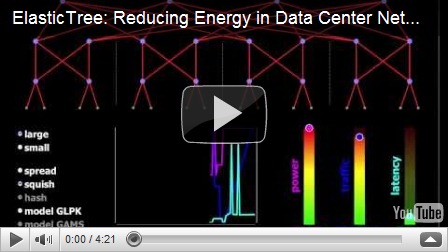
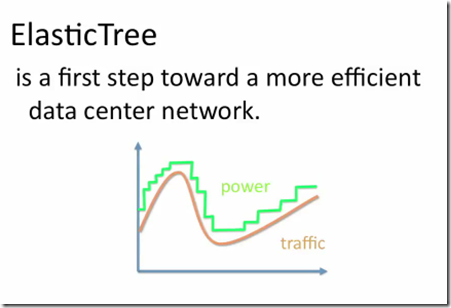
One of the demonstrations of OpenFlow is ElasticTree which can be used for lower energy use in the data center.

image

The ElasticTree paper is here.

image

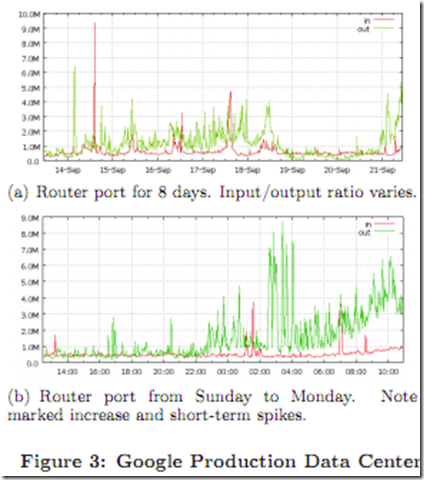
The authors had access to data from Google.

image

It looks like this team had access to Google data centers back in 2008.

Traffic in a Realistic Data Center
In order to evaluate energy savings with a real
data center workload, we collected system and network
traces from a production data center hosting an
e-commerce application (Trace 1, §1). The servers
in the data center are organized in a tiered model as
application servers, file servers and database servers.
The System Activity Reporter (sar) toolkit available
on Linux obtains CPU, memory and network statistics,
including the number of bytes transmitted and
received from 292 servers. Our traces contain statistics
averaged over a 10-minute interval and span 5
days in April 2008.

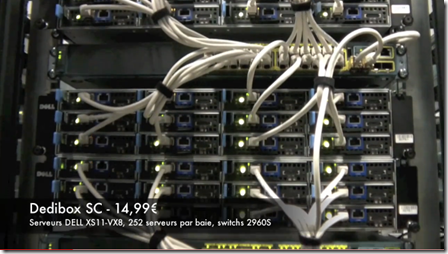
French Data Center Tour with Dell Servers, 14,000 views

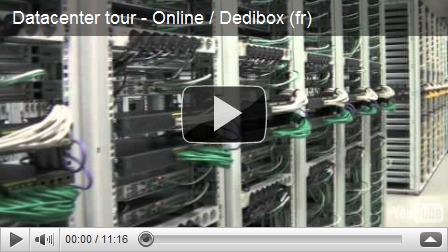
I was reading Barton George’s blog and he pointed to a YouTube video tour of online.net.

DCS Microserver allows French hoster to enter new market (and grab big market share)

Rate This

Online.net, owned by the Iliad group, is the second largest hoster in the French market.  The company had traditionally been focused on the higher end of the dedicated hosting market with services starting at 29.99 euro/month and predominantly based on Dell’s rack mounted servers.  About three years ago they began exploring the possibility of providing a lighter weight entry-level offering targeted at SMBs.

Online engaged Dell’s Data Center Solutions (DCS) group and the two teams began brainstorming around system designs to meet the needs of this new segment.  The design that DCS came up with was the Via processor-based microserver the Dell X511-VX8, code name“Fortuna” (please note I had nothing to do with the official naming of this product:) ). The system handles one OS and app per server, has one 1 CPU per server and features 12 servers per chassis.

Online.net's "START" line of offerings, beginning with the microserver enabled, Dedibox SC.

The video has 14,0000 views in a month.

Here is one of the money shot for Dell and there a bunch others in the video.

image

The text is all in French, but it still is one of the more interesting data center videos as it shows the whole data center including servers(Dell), networking (Cisco), and storage (NetApp).

Starting Viral Content watching the Twitter Data Center Migration Story

At 9:36a PT Mike Abbot posted the Great Migration story.

MONDAY, MARCH 21, 2011

The Great Migration, the Winter of 2011

If you look back at the history of Twitter, our rate of growth has largely outpaced the capacity of our hardware, software, and the company itself. Indeed, in our first five years, Twitter's biggest challenge was coping with our unprecedented growth and sightings of the infamous Fail Whale.

Posted by @mabb0tt at 9:36 AM

I posted my blog post at 10:16AM.

Twitter's Data Center Migration Story on its 5th Birthday

MONDAY, MARCH 21, 2011 AT 10:16AM

At 7p I decided to check on the Twitter Data Center news and saw way more posts/articles than I would expect on a data center migration project.

DataCenterKnowledge

DataCenterDynamics

GigaOm

AllThingsDigital

CIO

SeattlePI (which uses the exact urls I referenced)

All these data center posts without a press release from Twitter, just a post on Twitter’s engineering blog.

And a little help from the Green Data Center blog.

What will be missed by most is the data center story by the Twitter engineering team.

Twitter Engineering

Some of my most consistent readers are media and PR related.

We’ll see when Twitter tells their next data center story and how fast that story spreads.

Thanks for reading Green Data Center blog.

Africa's Mobile Internet is built on a spoken tradition, voice-activation opportunity

The Economist's Intellgient Life has an article on Digital Africa.  Think of about this.

digital Africa will become a spoken tradition. African cultures are among the most oral in the world. Storytelling under the tree is still commonplace. Speaking is still preferred to writing and Africa happens to have timed its digital age to coincide with new voice-activated technologies. The generation gap between those who were trained to guide a fountain pen with their fingers, those whose kinetic memory is dominated by their thumbs, and those even younger who are used to the sweeping movements of the touchscreen, will give way to the return of voice—Africa’s voice.

Most don't even think about Africa, but I would bet as a percentage growth Africa is the largest data center expansion than any other continent.

Ethan Zuckerman's blog on Africa has some interesting posts.

I’m also utterly fascinated by this graph:

It’s a visualization of round-trip ping times between a test server and servers around the world. Basically, it’s a way of testing actual speed, rather than promised speed, of internet connectivity in different corners of the world… and it’s a reminder that there are many countries (at least when this data was generated in 2009) that are connected primarily by satellite, where packets take more than half a second to make the round trip.

But the data set I’m most enjoying is this one: the number of Facebook Friends various African leaders can claim. Some leaders have official pages, some private, personal pages. A large number simply have fan pages, put together by a community of supporters. Nigeria’s President Goodluck Jonathan leads the pack – by a lot – with 341,759 friends in December 2010. He’s embraced Facebook rather aggressively, going as far as to announce his candidacy for the presidency on the site, probably to preempt the announcement of a rival.

A close look at African leaders with lots of Facebook friends might offer a caution for Jonathan. Here are the top leaders, in terms of followers, as of December 2010″

341,759 Goodluck Jonathan, Nigeria
232,424 Zine El Abidine Ben Ali, Tunisia
61,510 Mwai Kibaki, Kenya
59,744 King Mohamed VI, Morocco
57,072 Morgan Tsvangirai, Zimbabwe (Prime Minister to Robert Mugabe)
21,306 Jakaya Kikwete, Tanzania
15,723 Hosni Mubarak, Egypt
15,377 Laurent Gbagbo, Ivory Coast
14,714 Jacob Zuma, South Africa
12,658 Abdelaziz Bouteflika, Algeria

Back to the Digital Africa Article, three companies are highlighted in the article - Facebook, Google, and Nokia

The first is Facebook. This social network, born at Harvard and based in Palo Alto, California, is not just a skin on internet-enabled African mobiles, it is the skin. Pricing is driving its popularity. The site was zero-rated in 2010—that is, made almost free of data charges in several African markets (the bill is footed by Facebook, the network operators and the phone manufacturers). “The zero-rating of Facebook was the most significant tech story in Africa in 2010,” says Erik Hersman, who has two influential blogs, White African and Afrigadget. So while text messages are cheap, sitting on Facebook is even cheaper. Facebook’s own numbers show growth coming fastest in Egypt, Morocco, Nigeria, Kenya and South Africa.

Google is next, but note the mention that Google is adding data center capacity in Africa.

The second company is Google, the search and advertising colossus, also based in Palo Alto. In Africa, Google looks omniscient. It wants to make the internet a part of everyday life in Africa by eliminating entry barriers of price and language. Even with the drop in prices, Africans still pay many times more for broadband than Europeans do. Google hopes to bring the price down further by establishing data caches in Africa, greatly reducing the time taken to reach popular websites—particularly those with African content. Detractors say Google is buying up swathes of Africa’s digital real estate at bargain prices: it seeks transparency of others, but reveals little of itself. How much is it spending on the new infrastructure? “We don’t discuss numbers,” says a Google executive, “but we are committed to Africa.”

Nokia gets mentioned as the biggest cell phone provider.

The third big player in Africa’s digital revolution is Nokia, the mobile-phone maker from Tampere in Finland, which has history and substance in African eyes. It claims a 58% market share in Africa and vies with Coca-Cola as the continent’s most recognised brand. It was Nokia’s ability to distribute phones through subsidies in rich countries that allowed it to sell basic models at low prices in Africa. Nokia has lost ground at the high end in rich countries to Android and the iPhone. Nokia executives admit the company has “lost the thought leadership” in some markets, but not in Africa.

Apple and Nokia are mentioned.

Apple is nowhere in Africa and shows little interest in democratisation, but Nokia is facing stiff competition at the top of the market from BlackBerry, the smartphone made by Research in Motion, based in Waterloo, Canada. The head of BlackBerry’s Africa office, Deon Liebenberg, says his company’s sales defy logic. BlackBerry had seen itself as providing a secure platform for businessmen and government officials. Now it is selling models with consumer appeal: rounded phones in shades of tangerine and strawberry lipgloss. To the young African professional, the smartphone is highly aspirational: it is the house and car you can’t afford. In a culture where so much is shared, the smartphone is a space which is all yours—your music, your plans, your tomorrow.

Ex-Goldman Sachs programmer gets 8 years for stealing high-frequency trading code

Reuters has the news on an Ex-Goldman Sachs programmer sentenced to 8 years in prison.

Ex-Goldman programmer gets 8 years for code theft

Sergey Aleynikov and his lawyer, Sabrina Shroff, depart from federal court in New York February 17, 2010. REUTERS/Chip East

By Grant McCool

NEW YORK | Fri Mar 18, 2011 10:55pm EDT

(Reuters) - A former Goldman Sachs Group Inc (GS.N) computer programer was sentenced to eight years in prison on Friday for stealing secret code used in the Wall Street bank's valuable high-frequency trading system.

Sergey Aleynikov, was arrested by the FBI and charged in July 2009 with copying and removing trading code from Goldman before taking a new job at Teza Technologies LLC, a high-frequency trading startup firm in Chicago.

But, who would believe his statement?

"I very much regret the foolish thing of downloading information," theRussian-born father of three said at his sentencing on Friday. "Part of this information was proprietary to Goldman. I never meant to cause Goldman any harm or harm anyone at the bank."

He goes to Teza Technologies where his actions were traced.

But the strange thing is that even though Aleynikov was a software expert, (his credentials are impressive - Read Linkedin profile), the mistake he made was downloading so much source code to his home computer since his programming commands were recorded by Goldman's back-up systems, as reported by The New York Times (see below). The bank also noticed the surge in data moving from its servers.

This is what happened according to New York Times DealBook: "...just before he left (Goldman Sachs), according to the complaint, Mr. Aleynikov used his desktop computer at Goldman's New York offices to upload a stream of code to a Web site hosted by a server based in Germany. Later, he downloaded the files again to his home computer, his laptop computer and to a memory device."

The case sheds light on the secret world of high frequency trading, but also attests to the security precautions taken by investment banks. Meanwhile, ZeroHedge points out that Aleynikov was arrested the day after he joined Teza Technologies, co-founded by Misha Malyshev, a former head of high-frequency trading at hedge fund Citadel Investment Group LLC. (Teza was reportedly paying hin $1.4 million.) Aleynikov was suspended without pay and Teza is cooperating with the investigation, according to a Teza spokesman's statement, which also said the firm was not aware of alleged misconduct.The case sheds light on the secret world of high frequency trading, but also attests to the security precautions taken by investment banks.