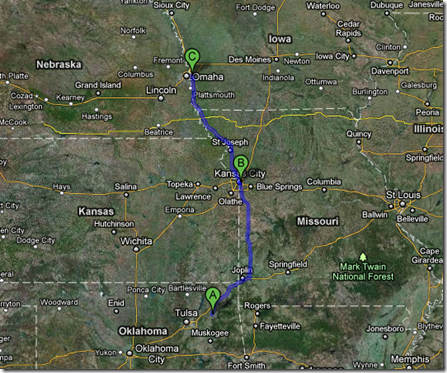
Looking at a map it's pretty obvious why Google picks Kansas City for high-speed project, midpoint between 2 DCs

I worked with one city that was bidding for the Google high speed internet project, and today Google announced they picked Kansas City, Kansas.

Ultra high-speed broadband is coming to Kansas City, Kansas

3/30/2011 09:00:00 AM

As part of our overall goal to make the web better for users, last year we announced a new project: to provide a community with Internet access more than 100 times faster than what most Americans have today. The response was overwhelming—nearly 1,100 cities felt theneed for speed—and we were thrilled by the enthusiasm we saw across the country for better and faster web connections. Thank you to every community and individual that submitted a response, joined a rally, starred in a YouTube video or otherwise participated.
After a careful review, today we’re very happy to announce that we will build our ultra high-speed network in Kansas City, Kansas. We’ve signed a development agreement with the city, and we’ll be working closely with local organizations, businesses and universities to bring a next-generation web experience to the community.

One of the points I made to the city I was working with is the proximity to Google data centers.  Well look what happens when you plot Kansas City (B)vs. the two local Google data centers in Council Bluffs, IA (A) and Pryor, OK (C).

image

How can you argue with the logic for network placement at the midpoint between two Google data centers?  Maybe when some of the loser cities look at this map, they'll realize it is hard to argue with the logical placement.

Update 4:15PM: We’ve heard from some communities that they’re disappointed not to have been selected for our initial build. So just to reiterate what I've said many times in interviews: we're so thrilled by the interest we've generated—today is the start, not the end the project. And over the coming months, we'll be talking to other interested cities about the possibility of us bringing ultra high-speed broadband to their communities.

HP targets large data center workloads with future server design, think Google, Facebook, Microsoft, Yahoo, Amazon

This is month old news, but I missed it so I figured many of you did too.

HP's corporate blog has a post on future server design for where data centers are going for the big guys.

HP nanotechnology research looks to sustain HP server market leadership for the long run

by ETHAN BAULEY (Ethan_Bauley) a month ago - last edited a month ago

(Update: read the 2/28/11 The New York Times story "Remapping Computer Circuitry to Avert Impending Bottlenecks" for more on this subject)

“What will future computer systems look like?” asks HP Labs distinguished technologistParthasarathy Ranganathan in a cover story for Computer magazine, the flagship publication of the IEEE Computer Society.

In his article [PDF], Ranganathan suggests computer science is at what he calls an ‘inflection point,’ one that will provoke a radical rethink of traditional computer system design.

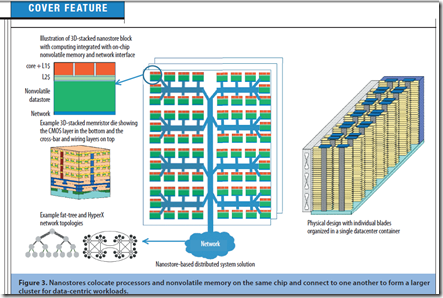
In the PDF, there are mentions of the big guys in data centers  - Google, Microsoft, Facebook, Yahoo, and Amazon.

image

Recent data-centric workloads have been characterized by
numerous commercially deployed innovations in the software
stack—for example, Google’s BigTable and MapReduce, Amazon’s
Dynamo, Yahoo’s PNUTS, Microsoft’s Dryad, Facebook’s Memcached,
and LinkedIn’s Voldemort. Indeed, according to a recent
presentation, the software stack behind the very successful Google
search engine was significantly rearchitected four times in the past
seven years to achieve better performance at increased
scale.
The growing importance of this class of workloads,
their focus on large-scale distributed systems with
ever-increasing memory use, the potential inadequacy
of existing architectural approaches, and the
relative openness to software-level innovations in the
emerging workloads offer an opportunity for a corresponding
clean-slate architecture design targeted at
data-centric computing.

The HP server designed was covered in the NYTimes.

Remapping Computer Circuitry to Avert Impending Bottlenecks

By JOHN MARKOFF

PALO ALTO, Calif. — Hewlett-Packard researchers have proposed a fundamental rethinking of the modern computer for the coming era of nanoelectronics — a marriage of memory and computing power that could drastically limit the energy used by computers.

Enlarge This Image

Noah Berger for The New York Times

BIG NEW IDEA Parthasarathy Ranganathan and his prototype of a data center.

Today the microprocessor is in the center of the computing universe, and information is moved, at heavy energy cost, first to be used in computation and then stored. The new approach would be to marry processing to memory to cut down transportation of data and reduce energy use.

Note the last mention of "reduce energy use."  Green data center ideas are no longer as rare as they used to be.

Skipping the Green Data Center Conference, May 24 - 26, 2011

I go to a lot of data center conferences - Gartner, Uptime, Data Center Dynamics, Data Center World, SVLG, and many others as a blogger, but one I'll be skipping ironically is the Green Data Center Conference in SF on May 24 - 26, 2011.

image

Given I've been blogging on the Green Data Center topic and have 1,700 posts you may think how can I not go to the event.  And, I know my friends would ask me why I didn't go.

Here are a few reasons why.

  1. I know many of the speakers and those I don't know I could get access to if I needed for a blog post, so I don't expect to learn much sitting in the audience.
  2. The conference agenda  for 2 days doesn't excite me.
  3. Most of the sponsors I have access to, so I don't need to travel to talk to the companies as they are usually contacting me.
  4. Uptime Institute's seminar is May 9 - 12 in Santa Clara and will have much better quality content than Green Data Center Conference and a much higher caliber set of attendees.  And, this conference I get to attend with a media pass and plan on meeting a lot of the sponsors/exhibitors to get caught up on the latest green technologies.
  5. There is the opportunity to network, but there are plenty of other networking opportunities.

I'll contact some of the speakers after the event and see what they thought and whether it is worth their time.

A 10X increase in GreenM3 traffic increases latency, what was hitting my site?

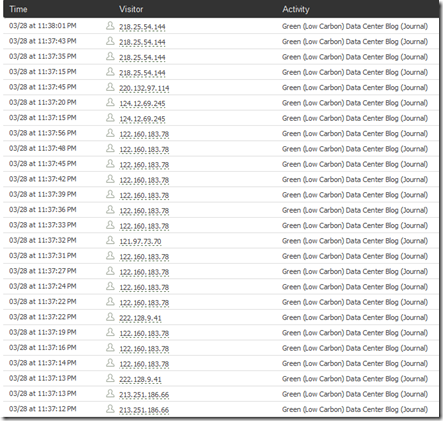
Last night I wrote about Amazon.com’s Cloud Drive, and noticed a 10X increase in traffic.

image

Which was actually unrelated to the post as a dump of the traffic shows a bunch of repeated URLs hitting only the home page.

image

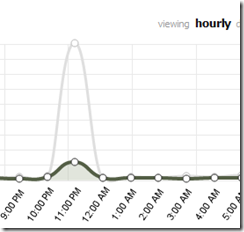
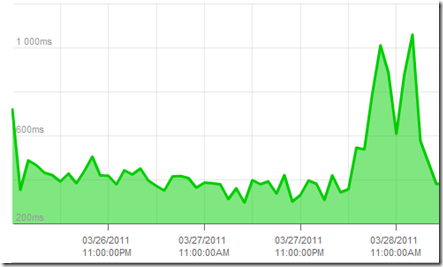
Latency spiked, but the site stayed up.  The following is from Pingdom monitoring www.greenm3.com.

image

Curious I am going to contact SquareSpace support to see if they were showing any other activity like this to their site.

The quick response from SquareSpace gave me the answer in 3 minutes.  Very cool.

This is a form of spam. Robots attempt to add comments on pages with forms in hopes that your website posts comments without moderation. They're not actually trying to hack into your account -- they're seeing the form and trying to leave a reciprocal link for the site they're promoting.
We've been trying to block these, but occasionally they slip through. No need to block the IP -- the fact that they hit the site so many times will alert our spam filters.
Sorry for the troubles.

Amazon Announces Cloud Drive, that explains Amazon’s data center build out in Oregon

Amazon.com, Inc. (NASDAQ:AMZN) just announced Cloud Drive along with Cloud Player.

image

Introducing Amazon Cloud Drive, Amazon Cloud Player for Web, and Amazon Cloud Player for Android

Buy anywhere, play anywhere and keep all your music in one place
Start with 5 GB of free Cloud Drive storage - upgrade to 20 GB free with purchase of any MP3 album

SEATTLE, Mar 29, 2011 (BUSINESS WIRE) --

Amazon.com, Inc. (NASDAQ:AMZN) today announced the launch of Amazon Cloud Drive (www.amazon.com/clouddrive), Amazon Cloud Player for Web (www.amazon.com/cloudplayer) and Amazon Cloud Player for Android (www.amazon.com/cloudplayerandroid). Together, these services enable customers to securely store music in the cloudand play it on any Android phone, Android tablet, Mac or PC, wherever they are. Customers can easily upload their music library to Amazon Cloud Drive and can save any new Amazon MP3 purchases directly to their Amazon Cloud Drive for free.

"We're excited to take this leap forward in the digital experience," said Bill Carr, vice president of Movies and Music at Amazon. "The launch of Cloud Drive, Cloud Player for Web and Cloud Player for Android eliminates the need for constant software updates as well as the use of thumb drives and cables to move and manage music."

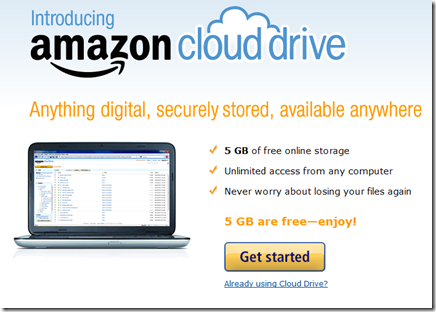
Here is the site for Cloud Drive.
image

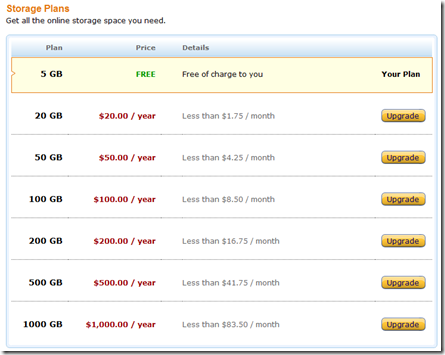
After 5 GB here is the pricing.

image

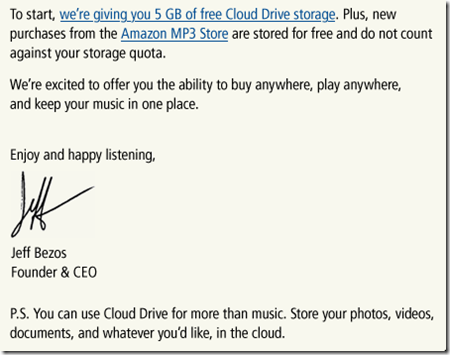
The music battle between Apple iTunes and Amazon MP3 Store are turned up a notch.
image

Here are some technical details on what is behind cloud drive.

A Drive in the Cloud

To build Amazon Cloud Drive the team made use of a number of cloud computing services offered by Amazon Web Services. The scalability, reliability and durability requirements for Cloud Drive are very high which is why they decided to make use of the Amazon Simple Storage Service (S3) as the core component of their service. Amazon S3 is used by enterprises of all sizes and is designed to handle scaling extremely well; it stores hundreds of billions of objects and easily performs several hundreds of thousands of storage transaction a second.

Amazon S3 uses advanced techniques to provide very high durability and reliability; for example it is designed to provide 99.999999999% durability of objects over a given year. Such a high durability level means that if you store 10,000 objects with Amazon S3, you can on average expect to incur a loss of a single object once every 10,000,000 years. Amazon S3 redundantly stores your objects on multiple devices across multiple facilities in an Amazon S3 Region. The service is designed to sustain concurrent device failures by quickly detecting and repairing any lost redundancy, for example there may be a concurrent loss of data in two facilities without the customer ever noticing.

Cloud Drive also makes extensive use of AWS Identity and Access Management (IAM) to help ensure that objects owned by a customer can only be accessed by that customer. IAM is designed to meet the strict security requirements of enterprises and government agencies using cloud services and allows Amazon Cloud Drive to manage access to objects at a very fine grained level.

A key part of the Cloud Drive architecture is a Metadata Service that allows customers to quickly search and organize their digital collections within Cloud Drive. The Cloud Player Web Applications and Cloud Player for Android make extensive use of this Metadata service to ensure a fast and smooth customer experience.

DataCenterKnowledge just posted on expanded data center growth by Amazon in Oregon, speculating on AWS growth, but the big growth is Amazon Cloud Drive & Player which is specifically in Amazon S3.

Amazon’s Cloud Goes Modular in Oregon

March 28th, 2011 : Rich Miller

The data center arm of Amazon.com is building data centers at three sites in Oregon, according to local media, who report that two of the sites are using a modular design. A third site, which has been the focus of on-and-off construction activity for several years, appears to be employing a more traditional design.

With the new projects, Amazon.com joins major cloud builders Google, Microsoft and Yahoo in embracing factory-built components as a strategy to reduce the cost and deployment time for data center capacity. The Oregon construction is part of a larger effort by Amazon to prepare for a significant expansion of its data center capacity to accommodate the growth of its cloud computing business, Amazon Web Services (AWS). Amazon has also been acquiring property near Dublin, Ireland to expand the European data center hub for AWS.