Wind Farms have environmental impact, like bat population

Wind and Solar are championed by many as better for the environment, but almost any change in power generation has an environmental impact somewhere.  Bird migration is many times mentioned when discussing wind turbines, but other animals are affected like bats.  Most people don’t like bats, but they are an important part of the ecosystem.  Times writes on the economic costs of losing bats.

The Economic Cost of Losing Bats

Posted by BRYAN WALSH Thursday, March 31, 2011 at 2:09 pm

6 Comments • Related Topics: wildlife , agriculture, bats, crops, disease, extinction, insects, pests, science, white-nose syndrome, wildlife

U.S. Fish & Wildlife Service / Bloomberg / Getty

It can be hard to feel much sympathy for bats. Like snakes or spiders or sharks or bunnies (OK, maybe the last one is just me), there's something primordially alarming about bats, something that activates the lizard part of the brain and shutters empathy. Bats aren't actually "flying rodents," but you likely won't see them on the next endangered species poster.

Read more: http://ecocentric.blogs.time.com/2011/03/31/the-economic-cost-of-losing-bats/#ixzz1IHp03F2Z

One point mentioned in the article is the effect on Wind Turbines on the bat population.

It's not just WNS that is striking down bats. Wind turbines are apparently killing migratory bats as well—by 2020, an estimated 33,000 to 111,000 bats are predicted to be killed by turbines in the mid-Atlantic Highlands alone. The authors in the Science paper worry that as wind power ramps up in the U.S., more bats will end up pureed by the blades.
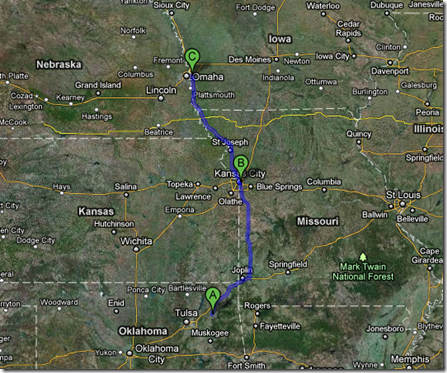
Looking at a map it's pretty obvious why Google picks Kansas City for high-speed project, midpoint between 2 DCs

I worked with one city that was bidding for the Google high speed internet project, and today Google announced they picked Kansas City, Kansas.

Ultra high-speed broadband is coming to Kansas City, Kansas

3/30/2011 09:00:00 AM

As part of our overall goal to make the web better for users, last year we announced a new project: to provide a community with Internet access more than 100 times faster than what most Americans have today. The response was overwhelming—nearly 1,100 cities felt theneed for speed—and we were thrilled by the enthusiasm we saw across the country for better and faster web connections. Thank you to every community and individual that submitted a response, joined a rally, starred in a YouTube video or otherwise participated.
After a careful review, today we’re very happy to announce that we will build our ultra high-speed network in Kansas City, Kansas. We’ve signed a development agreement with the city, and we’ll be working closely with local organizations, businesses and universities to bring a next-generation web experience to the community.

One of the points I made to the city I was working with is the proximity to Google data centers.  Well look what happens when you plot Kansas City (B)vs. the two local Google data centers in Council Bluffs, IA (A) and Pryor, OK (C).

image

How can you argue with the logic for network placement at the midpoint between two Google data centers?  Maybe when some of the loser cities look at this map, they'll realize it is hard to argue with the logical placement.

Update 4:15PM: We’ve heard from some communities that they’re disappointed not to have been selected for our initial build. So just to reiterate what I've said many times in interviews: we're so thrilled by the interest we've generated—today is the start, not the end the project. And over the coming months, we'll be talking to other interested cities about the possibility of us bringing ultra high-speed broadband to their communities.

HP targets large data center workloads with future server design, think Google, Facebook, Microsoft, Yahoo, Amazon

This is month old news, but I missed it so I figured many of you did too.

HP's corporate blog has a post on future server design for where data centers are going for the big guys.

HP nanotechnology research looks to sustain HP server market leadership for the long run

by ETHAN BAULEY (Ethan_Bauley) a month ago - last edited a month ago

(Update: read the 2/28/11 The New York Times story "Remapping Computer Circuitry to Avert Impending Bottlenecks" for more on this subject)

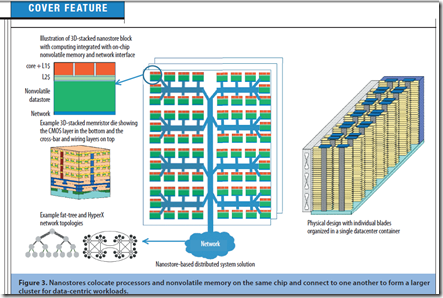
“What will future computer systems look like?” asks HP Labs distinguished technologistParthasarathy Ranganathan in a cover story for Computer magazine, the flagship publication of the IEEE Computer Society.

In his article [PDF], Ranganathan suggests computer science is at what he calls an ‘inflection point,’ one that will provoke a radical rethink of traditional computer system design.

In the PDF, there are mentions of the big guys in data centers  - Google, Microsoft, Facebook, Yahoo, and Amazon.

image

Recent data-centric workloads have been characterized by
numerous commercially deployed innovations in the software
stack—for example, Google’s BigTable and MapReduce, Amazon’s
Dynamo, Yahoo’s PNUTS, Microsoft’s Dryad, Facebook’s Memcached,
and LinkedIn’s Voldemort. Indeed, according to a recent
presentation, the software stack behind the very successful Google
search engine was significantly rearchitected four times in the past
seven years to achieve better performance at increased
scale.
The growing importance of this class of workloads,
their focus on large-scale distributed systems with
ever-increasing memory use, the potential inadequacy
of existing architectural approaches, and the
relative openness to software-level innovations in the
emerging workloads offer an opportunity for a corresponding
clean-slate architecture design targeted at
data-centric computing.

The HP server designed was covered in the NYTimes.

Remapping Computer Circuitry to Avert Impending Bottlenecks

By JOHN MARKOFF

PALO ALTO, Calif. — Hewlett-Packard researchers have proposed a fundamental rethinking of the modern computer for the coming era of nanoelectronics — a marriage of memory and computing power that could drastically limit the energy used by computers.

Enlarge This Image

Noah Berger for The New York Times

BIG NEW IDEA Parthasarathy Ranganathan and his prototype of a data center.

Today the microprocessor is in the center of the computing universe, and information is moved, at heavy energy cost, first to be used in computation and then stored. The new approach would be to marry processing to memory to cut down transportation of data and reduce energy use.

Note the last mention of "reduce energy use."  Green data center ideas are no longer as rare as they used to be.

Skipping the Green Data Center Conference, May 24 - 26, 2011

I go to a lot of data center conferences - Gartner, Uptime, Data Center Dynamics, Data Center World, SVLG, and many others as a blogger, but one I'll be skipping ironically is the Green Data Center Conference in SF on May 24 - 26, 2011.

image

Given I've been blogging on the Green Data Center topic and have 1,700 posts you may think how can I not go to the event.  And, I know my friends would ask me why I didn't go.

Here are a few reasons why.

  1. I know many of the speakers and those I don't know I could get access to if I needed for a blog post, so I don't expect to learn much sitting in the audience.
  2. The conference agenda  for 2 days doesn't excite me.
  3. Most of the sponsors I have access to, so I don't need to travel to talk to the companies as they are usually contacting me.
  4. Uptime Institute's seminar is May 9 - 12 in Santa Clara and will have much better quality content than Green Data Center Conference and a much higher caliber set of attendees.  And, this conference I get to attend with a media pass and plan on meeting a lot of the sponsors/exhibitors to get caught up on the latest green technologies.
  5. There is the opportunity to network, but there are plenty of other networking opportunities.

I'll contact some of the speakers after the event and see what they thought and whether it is worth their time.

A 10X increase in GreenM3 traffic increases latency, what was hitting my site?

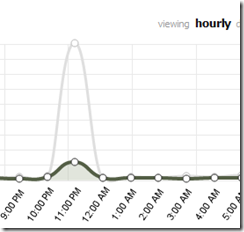
Last night I wrote about Amazon.com’s Cloud Drive, and noticed a 10X increase in traffic.

image

Which was actually unrelated to the post as a dump of the traffic shows a bunch of repeated URLs hitting only the home page.

image

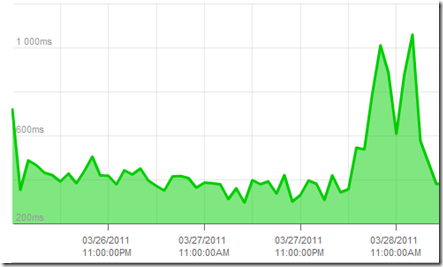
Latency spiked, but the site stayed up.  The following is from Pingdom monitoring www.greenm3.com.

image

Curious I am going to contact SquareSpace support to see if they were showing any other activity like this to their site.

The quick response from SquareSpace gave me the answer in 3 minutes.  Very cool.

This is a form of spam. Robots attempt to add comments on pages with forms in hopes that your website posts comments without moderation. They're not actually trying to hack into your account -- they're seeing the form and trying to leave a reciprocal link for the site they're promoting.
We've been trying to block these, but occasionally they slip through. No need to block the IP -- the fact that they hit the site so many times will alert our spam filters.
Sorry for the troubles.