Google posts Sustainable (Green) Data Center Operations Manager position

I don't know how long this job post has been up, but it is worth blogging.

Manager, Sustainable Data Center Operations - Mountain View

...

As the Sustainable Data Center Operations Manager you will be responsible for growing the team that continually raises the bar on sustainability at Google. This includes keeping our commitment to carbon neutrality, advancing efficient computing across the industry, and ensuring Google’s infrastructure, products and services are sustainable. You will provide leadership for Google’s sustainability efforts, defining goals, organizing teams, and working closely with product engineering, operations, policy, and communications teams.

Good Luck to Google to hire a Green Data Center Operations Manager.

Three Rules for Writing Blog Posts - build relationships, tell me why, be different

One of my friends is starting a technical blog and he sent me a draft of his first post.   I made a few comments and I found this post that had same good ideas buried down towards the end of the post.  I could try to paraphrase this, but the author made some good points to consider and he didn't a good job explaining three good rules to post on.

I'll insert some comments in his text.

Impact on your writing: three critical concepts you must adhere to

This is why most press releases fail to be viral, and quite dull, and in general the more corporate PR gets involved in the messages the less people read it.

1.  Build relationships with your audience

Social networks like a personal approach.  They want to see your personality.  They want you to share. They want you to evoke emotions.  These elements are key to creating engagement not just with your content, but with you.  Social networks make you more accessible to your potential readers and can play a significant role in growing your reach.

Think of this point as what do people want vs. what do you want?  You may want to be viewed as an authority and trusted advisor, but do people trust someone they do not know?  People want to feel like they can trust the information.  People trust people.  People get suspicious of information they cannot look up where the information came from.  Ahh, the information came from this person.

I remember when I first began publishing sites on the Web, the approach I used was dry and academic.  This was the strategy I used to communicate authority and trust.  I am beginning to think that this is no longer the right approach.  Do you trust the advice of a university professor that you have never spoken to?  Or does the combined opinions of your friends count for more?

This is why being a blogger is part of the social web.

The wisdom of the crowd is very much upon us and it is only going to get stronger.  As a writer, you need to accept the notion that trust comes from familiarity with you, and your ability to be approachable will enable you to communicate your message.

I totally agree with this point and from the day I started blogging,  I was frustrated with blogs that pointed to things, but didn't say why I should care about this post and what was in it.

2.  Tell me why I care

The other big factor that emerges from the ability to get all the world’s information online is that there is too much information. We are more impatient than ever.  If I am going to spend the time reading your article, whether or not I trust you, tell me why I should read this article in the first paragraph.  Get to the point.

Do you want to a thought leader or a follower?  Who reads the followers?  Think of stuff no one else does.  Or at least try.

3.  Strive for uniqueness, not “me too”

Lastly, don’t waste your time writing “me too” content.

Amazon's HW Engineering Product Manager position focuses on delivering new server designs

Amazon has a different approach than I've seen others take.  Opening a product manager position in HW Engineering.

The Product Manager is responsible for the discovery and aggregation of new and emerging technologies in our industries. They collaborate with our engineering staff to define and deliver new server designs for use by all Amazon.com and AWS services. They manage the technical relationships with the key players in our vendor ecosystem, and own the development and execution of our business metrics.

The job is in this group.

The Amazon Hardware & Operating System Engineering team, within the Infrastructure group, provides the server platform for our innovative web service and e-commerce technology platforms. This platform is industry-leading in terms of frugality and operational excellence, and is critical to the success of the AWS business and the thousands of customers who use utility computing today.

Data Center Expert sees Biomass-Powered as the next step, Yea! another vote for the Grass Fed Data Center

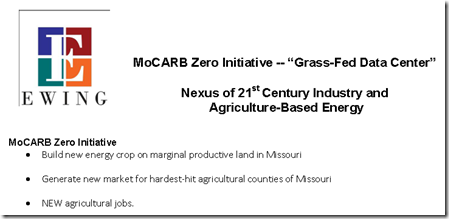
Emerson's Jack Pouchet has an article on the step for Green IT being a Biomass-Powered Data Center.  I know Jack and I've been working on the Biomass data center (aka Grass Fed Data Center) for 2 years that Jack refers to in Missouri.

Biomass-Powered Data Centers: Next Step for Green IT?

Jack Pouchet

Over the past several years, those of us in the data center industry have seen dramatic strides in Green IT, primarily focused on improving energy efficiency. It is now much more common to see data centers designed to meet the LEED standards of the U.S. Green Building Association (USGC).  In addition, through the efforts of The Green Grid, the industry has adopted a standard method for assessing the energy efficiency of data center infrastructure, known as power usage effectiveness (PUE). This standard gives data centers a better tool for messaging progress when evaluating ways to improve energy efficiency.
Director of Energy Initiatives
Emerson Network Power
...

These are important steps. But, as President Josiah Bartlet used to ask on The West Wing: “What’s next?” I think onsite generation of green energy would be a major step forward. For instance, several companies, including Emerson, have addedsolar power to their data centers as a supplementary power source. Wind power also scales nicely to data center energy demands.

Biomass, however, may offer the best near-term route to onsite power generation as a primary energy source for a data center. Biomass-to-energy facilities convert just about any organic material made from plants or animals into electricity. Examples include wood and sawdust from forest slash or lumber mills, or agricultural wastes from plants or animals. It’s a clean, renewable energy source that reduces CO2 emissions.

Jack lists three Biomass projects.

Plans for biomass data centers are underway in several states. As reported in Environmental Leader last year, HP Labs has developed a system that could power a 1 megawatt data center using manure from a 10,000 cow farm – with enough electricity left over the run the farm. In Missouri, community leaders are pushing for a data center to be powered by grass, wood or hay.

Closer to completion is the Vineyard Data Center Park in Colorado Springs, which will feature 100 percent renewable power. It’s scheduled to open this year. The 50-megawatt facility has been dubbed a “trash-burning data center” for its planned use of bio-solids and municipal waste. Based on recent discussions with industry experts, biomass projects are in various stages of development in Ohio and Georgia.

Jack even mentions the idea of siting a data center at an old pulp & paper mill.  This is what Google did by going to Hamina, and this idea has been kicked around by a few us for over three years.

I started thinking about this after talking to a friend from high school about a paper mill closing in Hoquiam, Washington. We concluded that maybe it’s time the high-tech electronics industry that is rapidly displacing the need for paper could be the solution to reinvigorating these communities, buildings, and local economies.

Renewable baseload energy is coming to green the data center.

Here is more information about the Missouri project.

image

Wal-mart uses its purchasing power to change the supply chain, an idea worth considering

WSJ has an article on Wal-Mart going Local for sourcing more produce.

'Local' Grows on Wal-Mart

By MIGUEL BUSTILLO And DAVID KESMODEL

Wal-Mart Stores Inc., which scours the globe seeking the lowest-cost suppliers, is finding it can save money by buying more fruits and vegetables grown closer to its stores.

Other food retailers, including Supervalu Inc. and Safeway Inc., also are racing to expand the amount of locally grown food they offer, as more Americans flock to farmers markets and gourmet grocers such as Whole Foods Market Inc. in search of fresher produce.

Wal-mart has been able to go greener and save money.

Wal-Mart, the largest grocer in the U.S., with more than $120 billion a year in food sales, encourages its managers to buy produce grown within 450 miles of its distribution centers, even if local peaches, for example, cost more than those produced across the country in California.

That's because the Bentonville, Ark., giant has determined that, in an era of high diesel prices, trimming the number of "food miles" produce travels cuts fuel costs. Buying locally also reduces produce spoilage, Wal-Mart says, though it won't quantify the savings.

...

Wal-Mart spokesman says the retailer believes that saving money and improving the freshness of foods are not mutually exclusive ideas, adding that its is committed to doing more than just buying local to save money.

Wal-mart is using its purchasing power to change where produce is grown.

But Wal-Mart's drive to buy local is proving popular with some farmers. "They drive a hard bargain in Bentonville, but I know what I am getting paid before I put something in the ground, and for a farmer that is huge," says Sharon Heer of Fewel Farms, in Yakima, Wash., which is growing jalapeños for the chain, and has previously grown pumpkins for it.