Microsoft Deploys Samsung's Green RAM in Technology Center, demonstrating Performance and Energy Efficient Private Clouds

Back when Mike Manos worked at Microsoft the both of us went to a Microsoft Technology Conference in Barcelona and met Frank Koch, one of the early believers in Green Data Centers.  It's been four years since Frank made the early efforts, and I just saw this press release between Microsoft and Samsung.

Microsoft and Samsung Collaborate to Enable Optimized Performance and Power Efficiency for Server Systems

...

Frank Koch, infrastructure architect and Green IT lead of Microsoft Germany summarizes the joint efforts: "The world notices a dramatic increase of energy usage in data centers with more and more people leveraging their IT and moving to a private cloud. With the innovative memory modules from Samsung, we do not only measure higher throughput and performance for our hyper-v cloud solutions but a lower power consumption of the involved server systems, too. This is a great win-win situation for everyone."

The specific power savings was 15% for a 30 watt per system decrease.

Samsung's 30nm-class Green DDR3 was tested in eight gigabyte registered dual inline memory modules, installed on server systems running virtualized environments with the Windows Server 2008 R2 Enterprise operating system. They delivered power conservation levels of up to 15 percent for a 30-watt per system decrease, compared to systems using 50nm-class DDR3.

This gives a good reason to reach out to Frank and get more specifics on the energy efficiency projects he is working on.

Microsoft expands Data Center Capacity in Dublin and Virginia

Data Center locations are kept secret by many, but what is harm of the public knowing where a company has its data centers?  You can create many scenarios where you can worry about worst case scenarios.  But, one good side of sharing where your data center sites are located is it mproves your relationship with the local community.  When Google first built the Dalles data center, multiple people including the local officials were held to confidentiality agreements.  Contrast that with Google openly discussing its latest data center in Hamina with sea water cooling.

Microsoft's Dublin data center was disclosed by gov't officials.

According to an Irish business news report, Microsoft is planning to spend millions of euros expanding its two-year-old US$500m data center in Dublin by more than a third.

...

At the opening of the data center, then Irish Prime Minister Brian Cowen said he believed that in the future companies would rely on cloud-based delivery models, emphasizing the importance of large scale investments in infrastructure services such as those seen by Microsoft in Ireland.

Microsoft's Virginia Data center expansion had local officials disclosing details.

Microsoft plans $150 million expansion in Mecklenburg
September 23, 2011 1:29 PM

Microsoft Corp. plans to expand its data center in Mecklenburg County, creating 10 new jobs.

The company’s $499 million investment last year created 50 jobs and represented the largest economic investment in Southern Virginia. The expansion will increase the data center’s cloud infrastructure and services capacities.

Microsoft will spend $150 million to build a new facility at its site.

“Securing this state-of-the-art data center was an important win for the commonwealth, and additional growth will further establish Virginia as an Information Technology leader,” Gov. Bob McDonnell said in a statement.

With Google and Microsoft relaxing its data center location disclosures of site location, the benefits of disclosure look like they are winning vs. secrecy.  Facebook's Open Compute Project is another example of openness and disclosure.

One Way to Build Real-Time Energy Controls for the Data Center, Inventory all your assets with an IP address

DCIM is a hot topic and a lot of what people are trying to do is get control over their data center assets.  One of my data center friends heard that the current count is up to 59 companies provide some form of DCIM solution.

The people who have been the early adopters of DCIM have learned that no one tool does it all, and they need to put together multiple products to solve their DCIM problem.  What is lacking is an architecture for the DCIM that meets the needs of their enterprise.

What is an architecture?  Merriam-Webster definition.  #1-4 is what most people think about.  I am referring to #5 for computer systems.

Definition of ARCHITECTURE

1
: the art or science of building; specifically : the art or practice of designing and building structures and especially habitable ones
2
a : formation or construction resulting from or as if from a conscious act <the architecture of the garden>b : a unifying or coherent form or structure <the novel lacks architecture>
3
: architectural product or work
4
: a method or style of building
5
: the manner in which the components of a computer or computer system are organized and integrated

Great architecture solves problems

So what problem are you trying to solve?

The problem is most don't even know what problems they have that need to be solved.  For example, what knobs and dials exist in the data center to control the energy consumption in the data center?  Who gets to turn the knobs and dials?

NewImageNewImage

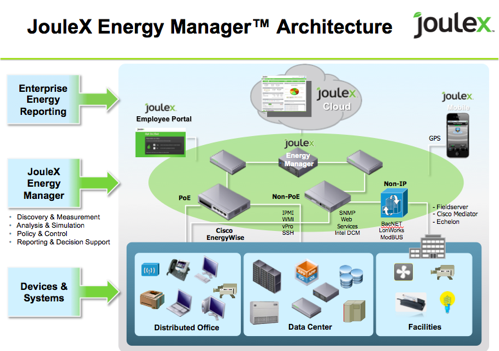
If you think you want to control the energy consumption of your IT assets you need to know all your assets and be able to talk to them, to control them.  One approach is JouleX's latest product.

Other highlights of JEM’s expanded capabilities include:

  • New device control features allowing for integrated power capping, central processing unit (CPU) performance leveling (for Windows, VMware, Linux), and support for VMware vCenter, and Distributed Power Management (DPM).
  • More granular control using power, temperature and utilization metrics to migrate virtual machines and optimize server performance and energy consumption using VMware vMotion.
  • Detailed analytics and reporting for sustainable procurement (analysis of device models for energy efficiency, for device replacement planning, and for measuring energy and carbon savings from virtualization projects)
  • Virtualization and utilization reporting to identify under- and over-utilized devices. This identifies candidates for upgrading, retiring, and virtualizing.
  • Additional device support for rack and floor power distribution units (PDUs) as well as computer room air conditioning (CRAC) and uninterruptable power supply (UPSs).
  • NewImage

JouleX CEO Tom Noonan explains the latest version.

“We continue to accelerate our technology development in terms of creating actionable energy intelligence for our customers to make quicker decisions, optimize their existing infrastructure, and reduce their operating expenses,” said Tom Noonan, president and CEO at JouleX.

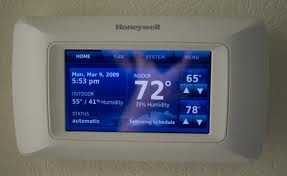
But, I think of it as Real-time Energy Control system.  Your energy thermostat for the data center.

One approach is JouleX and there are many others.  The hardest question that almost no one asks is what is the architecture of your DCIM solution?  What problems are you trying to solve?

We have a long ways to go in DCIM.


Michael Dell vs. Meg Whitman who will win the Enterprise battle? Dell is favored over HP

HP has some seasoned enterprise executives that could be CEO.

Better choices would include HP enterprise chief Dave Donatelli and PC head Todd Bradley, two names that had also made the rounds in Silicon Valley for the top job after Mark Hurd's ouster in August 2010, he added.

But, it is too late now, and HP's Board has made their decision.  And, wow they actually listened to the employees and shareholders.

In late August, some board members began looking into how employees, investors and others viewed the CEO, one of the people said. They learned that the CEO failed to rally his troops well and staffers believed "he was not clear on the strategy, not articulating clearly what the direction was,'' this person said.Board members also learned that some H-P investors were upset over the proposed Autonomy takeover because Mr. Apotheker privately promised them that H-P wasn't "going to make any big acquisitions that will make you lose sleep,'' this person said.

Read more: http://online.wsj.com/article/SB10001424053111903703604576586753827390510.html#ixzz1YnIgItCT

So, the HP board picked Meg Whitman who has been a major purchaser of HP enterprise products.

"Some might be saying maybe Meg Whitman isn't the right person, either. She's not a hardware person," said Auriga analyst Kevin Hunt. But HP "just needs someone to set the direction."

Defending her track record, Whitman said as head of eBay she had been a major purchaser of HP enterprise products.

"So I actually understand this space relatively well," she told Reuters in an interview. "What I bring to this table is leadership, management skills, strategic vision, communications and an execution orientation to deliver the result."

Meg has a few tweets.  One today.  Another Aug 13. and another July 4th.


Meg Whitman
Excited and honored to lead HP. I'm a true believer in the future of this Silicon Valley icon.
Meg Whitman
Yesterday was the 30th birthday of the PC. Happy birthday! Where would we be without you? 
Meg Whitman
Happy 4th of July!

Compare this to Michael Dell's tweets over the last 2 days.


Michael Dell
Thanks to our customers for the trust and confidence you place in us! ...Dell is the clear winner if there is no 
Michael Dell
Looking forward to speaking at Oracle OpenWorld in a couple of weeks! 
Michael Dell
Check out fun Dell  videos from . These are visually amazing! 
»
Michael Dell
Check out the latest servers in our Dell Modular Data Center

Who has more credibility in the enterprise?  Michael Dell or Meg Whitman?


A different way to think about data center training

I mentioned the TED video of Salman Khan, leveraging Youtube videos for education.

Sal got $2 million from Google for his non-profit and here he is presenting at Google after his TED presentation where he explains more of his insights on how videos can be used in education

Here are a couple of points that caught my attention.  "you want other people to be around you. When you're actually trying to solve a problem."  This makes sense, but how convenient is this to do.  "Hey Tom, I could use your help looking at this problem I am working on."  But, Tom is on the East Coast and you are on the West Coast.  The best guy to help me out is Tom, and my alternative is to go at it alone, wait, or search for someone else who can help me.

NewImage

The irony is the one time you usually have lots of people around you is when you are listening to a lecture, passively with the rest.  This is when watching a video makes a lot of sense.  Part of what keeps you from watching great videos is the event ecosystem that has a business model to get people to attend conferences.  What would happen if you published the conference videos ahead of time to the attendees, then had sessions where you discussed the ideas interactively with the audience.

NewImage

Sal did an experiment at the Los Altos elementary school where they shared the math videos with the kids, and let them go at their own pace.

NewImage

If the attendees were working on problems, then the teacher/lecturer would intervene on the kids who were stuck.  This is where there is problem solving in a group.

Sound radical.  Imagine how much more you could learn.

NewImage

I was talking to David Schirmacher the other day and he said how many people had sitting in his DCIM presentation at AFCOM.  I am going to pass this idea by him for maybe a future 7x24 Exchange presentation.