Mike Manos is new Huffington Post CTO, Technology iterating as fast as the news

Mike Manos has been on demand as a Data Center executive going from Microsoft to Digital Realty Trust to Nokia and his latest job at AOL.  Mike let me know of his latest job being CTO for Huffington Post.  First question of course is what what happened to your old job?

on taking the responsibilities of CTO of the Huffington Post Media Group. . .

image

Today I was asked to take over the responsibilities of Chief Technology Officer for the Huffington Post Media Group and I can tell I am extremely excited for this opportunity. This new set of responsibilities will be in addition to my current role as Senior Vice President of Technology at AOL where I have responsibility for the Operations and Day to Day Delivery of all AOL products and services.

OK, so Mike still has his old job at Sr VP of AOL Technologies.  So, what is his new job as CTO of Huffington Post?

Some people familiar with this type of industry may think its nothing more than a simplified website with a custom CMS. I can tell you that the back end systems, custom CMS, widget interfaces and overall flexibility that these systems operate on and develop to are part of the reason for the platforms overall success. In a world where ‘Internet time’ generally means an aggressively accelerated rate of time, the Huffington Post Platform operates at a Faster than Internet time rate. Its an incredible challenge and one I cant wait to sink my teeth into.

Huh, Mike is kind of like a Sr VP of DevOps, expanding into the development of content and web site design.

In computing, "DevOps" is an emerging set of principles, methods and practices for communication, collaboration and integration between software development (application/software engineering) and IT operations(systems administration/infrastructure) professionals.[1] It has developed in response to the emerging understanding of the interdependence and importance of both the development and operations disciplines in meeting an organization's goal of rapidly producing software products and services.

I've known Mike for quite a few years and we always enjoy discussing big ideas.  So, what can a Sr VP/CTO who gets the paradigm of DevOps do?  When you see how the pieces work together. You can implement changes.  What type of changes?  For Huffington Post it can be how do you create a better web site.

First the integration between the Editorial, Design, and Technology components of the company are truly three equal and dependent legs in the overall delivery of the service. Unlike many media companies where Technology plays a secondary role, at the Huffington Post its an essential and core part of the overall product and delivery strategy. Technology literally iterates on a daily basis.

One of the choices you have is to change when the pain of staying the same is more than the pain of change, but in IT services that can be too late.  Isn't it wiser to change before the pain comes?  Think of the ultimate pain as an outage.  Do you want to wait for an outage before you change?  Of course not.  The slow performance degradation of a site with increasing costs is what people would run into more often, and is a more realistic pain.

Mike discusses the idea of change in his blog post "Breaking the Chrysalis"

Breaking the Chrysalis

What has come before

When I first took my position at AOL I knew I was going to be in for some very significant challenges.   This position, perhaps more-so than any other in my career was going to push the bounds of my abilities.

...

AOL has been around for over 27 years.  In technology circles, that’s like going back almost ten generations.   Almost 3 decades of “stuff”.  The stuff was not only gear and equipment from the natural growth of the business, but included the expansion of features and functionality of long standing services, increased systems interdependencies, and operational, technological, and programmatic “Cruft” as new systems / processes/ technologies were  built upon or bolted onto older systems.

This “cruft” adds significant complexity to your operating environment and can truly limit your organization’s agility.

Mike's latest change to CTO and Sr VP of Technologies may be the future of what companies need to replace the CIO and/or CTO role.

AllthingsD reports on the other changes at AOL.

More AOL Tech Moves: HuffPo Tech Head Tim Dierks Out After 5 Months

Yet more change at embattled AOL: Tim Dierks, the top engineer at its Huffington Post Media Group unit, is out, less than six months after he joined the company. AOL tech SVP Michael Manos will replace him, at least temporarily.

Dierks left Google to work for Tim Armstrong and Arianna Huffington back in September. He was first hired as Huffpo’s senior vice president of engineering, andeventually replaced chief technology Paul Berry, who had helped Huffington build the site and left in February, a year after she sold the company to Armstrong.


Does AT&T's unlimited data violate FCC/FTC's Truth in Advertising Act? Yes? No?

CNET has news about a person who won $850 in small claims court vs. ATT Wireless's unlimited data plan throttling his data use after 1.5-2GB.

Throttled iPhone user takes AT&T to court, wins $850


by  February 24, 2012 4:07 PM PST

A customer who filed a complaint against AT&T after having his wireless data speeds throttled has come out the victor.


One of the points made is ATT is looking to appeal

The victory could be short-lived for Spaccarelli, the AP said. AT&T spokesman Marty Richter told the outlet the company was "evaluating" the possibility of an appeal.

Some have said ATT has a case because no where in the contract does it say it cannot throttle the unlimited data plan.

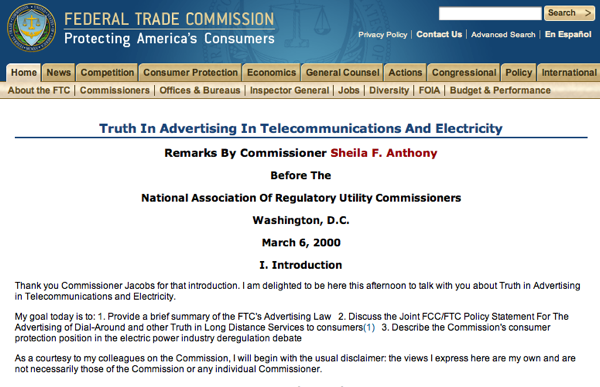
But, maybe the FCC and FTC can come to the rescue of consumers.  How?  Remember those overhyped long distance plans, that had restrictions in contracts that were not mentioned in the ads?  The FTC and FCC did something about that and created the "Truth in Advertising in Telecommunications and Electricity" dated Mar 2000.

NewImage

Here are some parts that should get you and ATT thinking.  Maybe the rest of the mobile carriers and even Comcast's Internet throttling over 250 GB should consider this as well.

The FTC's of truth-in-advertising law that has been developed through Section 5 of the FTC Act, which prohibits "unfair or deceptive acts or practices," provides helpful guidance to long distance carriers.

...

A. General Concepts of Advertising Law

Today, I will describe how the concepts of advertising law apply to the advertising of telecommunications services and electricity. In general, Commission law requires that advertising be truthful, fair, and substantiated.

Each of these concepts is detailed in formal policy statements adopted by the Commission or addressed by statute. A deceptive act is one that contains a misrepresentation or omission that is likely to mislead and be detrimental to consumers who are acting reasonably under the circumstances.(2) An unfair act or practice is one which causes or is likely to cause substantial consumer injury, not reasonably avoidable by consumers themselves, and not outweighed by countervailing benefits.(3) Although the Commission challenges conduct that is unfair, the majority of our actions in the advertising area target deceptive ads.

ATT claimed unlimited data plan.

In all advertising cases, the Commission must determine exactly what claims are made, and whether there is substantiation to support those claims. We look at both express and implied claims. Express claims are claims that unequivocally state the representations. For example, an ad which says: "long distance services to 100 countries" makes an express claim. Implied claims are anything else and range on a continuum from language that is virtually express to language that literally says one thing but strongly suggests something else. For example, an ad which says: " 7 cents a minute" may make an implied claim that there is no minimum charge for each call. In determining the claims that an ad conveys, the Commission examines "the entire mosaic, rather than each tile separately."(5)

Advertisers must make truthful claims and substantiate all objective claims. These rules of the road, of course, apply both to advertisers using traditional media and those who market their products and services on the Internet, telephone, e-mail or through any other media.

Was throttling omitted from ads and should have been disclosed in advertisement?

B. Deception by Omission

Ads can be deceptive because of what they do not say. Let me give you a few examples. If an ad omits material information, an ad can be deceptive even if everything else in the ad is truthful. This is called deception by omission. An ad will be deceptive if it fails to disclose qualifying information that, in light of the representations made, would be necessary to prevent consumers from being misled. We determine whether material information has been omitted by examining a typical buyer's expectation and understanding of the advertiser's claims.

In the Dial Around context, if an ad represents that all calls are 10 cents a minute, but fails to disclose that all calls are subject to a 50 cent minimum charge, the ad would likely be deceptive. A reasonable consumer would likely conclude that a one minute call would be 10 cents, not 50 cents. The same would be true if an ad made specific per minute price claims but failed to disclose that there was a mandatory monthly fee.

C. Material Limitations on Service should be disclosed

Advertisers for Dial-Around and other long distance services must take special care to make certain that material limitations on services are disclosed in the ads. Given the importance of price information, any significant conditions or limitations on the availability of the advertised rates should also be disclosed clearly and conspicuously. I will talk more in a moment about what makes a disclosure clear and conspicuous. But, clear and conspicuous disclosures are important in advertising law generally, and they have special meaning in the Dial-Around context because ads are the primary source of price information for consumers.

Let me give you some examples of situations where disclosures should be used to avoid deception. If an ad features the phrase "10 cents a minute" and that rate is available only during certain times of the day, the failure to clearly and conspicuously disclose the restriction would be deceptive. Likewise, if there are significant geographic restrictions, that fact should also be disclosed. Additionally, terms such as "Basic Rate" should be used only if the meaning of that term is clear to consumers.

An ad cannot refer to a toll-free number or a website to make disclosures that should be made in an ad. While advertisers are encouraged to use customer service numbers and websites to offer consumers more information, these sources cannot cure misleading claims in the ad itself.

When you signed up for ATT's unlimited data plan did you feel like you knew 1.5 - 2GB was the cut off?

In simple terms, disclosures should be presented so that consumers actually see them and understand them. That means disclosures should be clear, prominent, and in close proximity to the claim being modified. There should be no distracting visual or audio elements surrounding the disclosures. Also, legalistic disclosures or those buried in fine print will not be effective. The FTC has a lot of experience with disclosures in a variety of contexts. We enforce certain statutes and regulations that are very specific as to how and when disclosures should be made.

You would think that some of the same people who worked on this FCC/FTC truth in advertising act are still around and they are watching ATT.  Remember those old Bell System commercials?

This Sprint ad from 2002 has disclosures.


Thinking about Mobile and Cloud, my phones - AT&T iPhone 4S, AT&T Galaxy Note, Verizon Galaxy Nexus

I spent much of my career working at HP on computers, Apple on computers and OS, and Windows on OS with Windows XP the last OS.  Now I spend more time thinking about data centers, cloud, and mobile.

How much am I working on Mobile? I have three phones - AT&T iPhone 4S, Verizon Galaxy Nexus, AT&T Galaxy Note

NewImage

As much as the PC is powerful, it is interesting what you develop when you make a mobile device your primary device with cloud infrastructure.

The above smartphones have dual core ARM processors, 32 GB of storage, 5-8 megapixel back, and 2-3megapixel front cameras.  Each of the above have some advantages over the other.  This is not about arguing what is best for an individual, but what works best for a usage scenario.

It is amazing how the kids want to play on these devices, and never ask to use my laptop.


Group-think most likely big contributor of Stevens Pass avalanche disaster

This year my family switched to Crystal Mountain Ski resort, but for the last 4 years we skied at Stevens Pass where the Avalanche disaster took three people's lives.

Avalanche killed experienced backcountry skiers

Three skiers killed in a Washington state avalanche on Sunday were highly experienced at backcountry skiing, according to media reports, and one was the head judge of the Freeskiing World Tour, a competitive circuit for extreme skiers in the United States, Canada and South America.

The three, ski tour judge Jim Jack, Chris Rudolph and John Brenan, were among a group of a dozen or so skiers who were attempting to ski down a slope near the Stevens Pass ski area in the Cascade Mountains, about an 80-mile drive from Seattle. Among the group were staffers of both ESPN and Powder magazine, who identified the victims and gave accounts of the incident.

We checked with some of our Stevens Pass friends it was a somber day on the mountain as many knew someone in the group.

One of the points made in the CNN article

Doug Schnitzspahn, editor-in-chief of Elevation Outdoors magazine, told CNN that a kind of group-think takes over in these situations, with skiers wanting to be there with their peers.

"You think, 'All these people are either professional skiers or they knew what they're doing, they are out here,'" he said. "You're trained to make certain decisions, but it's not always humanly possible. If I had been there, I would have skied that line with those guys. That's what shakes me up."

Think about this, the editor-in-chief of Elevation Outdoors would be with these people skiing.  Is this a decision or a group-think mindset?

Identifying group-think-

  • Group members stereotype non-members and label them as enemies or outsiders not worth negotiating with or worrying about
  • People hesitate to air any discomfort, doubts or uncertainties they feel about the group decisions or policies, so that consensus seems unanimous
  • Reluctant to shatter complacency group members do not bring information or evidence that does not conform to the groups expectations and stereotypes to the groups attention
  • The group discusses only a few alternatives and reaches a decision quickly concentrating only on good points
  • The group feels invulnerable leading to excessive optimism and risk taking
  • The group ignores or rationalises warnings or signs that it is operating under false assumptions, making poor decisions or developing poor strategy
  • There is strong pressure on group members to conform to group norms

Many disasters are caused by group-think.  Consider this when you build your data center teams.  How many data center disasters have group-think as a major cause?

My wife and I never ski back-country, because it is not worth the risk.  I don't think we have super human strength, and no technology is going to save you if something really bad happens.  Skiing fresh powder in low traffic areas may be a thrill, but other than your ego being satisfied, does it do any really good?

When we ski with our kids we are always telling them they need to ski with a buddy and be safe.  and, they are skiing faster than mom and dad now.

NewImage


Accepting the Middle Age Mind, 40 - 65 is not that bad

I've had a bit of a break skiing with the kids, staying at a cabin, and had plenty of time to read with no internet access.  One of the next books I am reading next is about the middle-age mind.

NewImage

The NYTimes has a review.  Here are a few excerpts.

Good news.


Q.

Doesn’t that make sense, since our young adult lives are often marked by bad decisions?

A.

I think most of us think that while we make bad decisions in our 20s, we also have the idea that we were the sharpest we ever were when we were in college or graduate school. People think if I tried to go to engineering school or medical school now, I couldn’t do it. Because of these memory problems that happen in middle age, we tend to think of our brains as, on the whole, worse than in our 20s. But on the whole, they’re better.

Q.

So what’s happening in middle age that leads to these improvements?

A.

What we have by middle age is all sorts of connections and pathways that have been built up in our brain that help us. They know from studies that humans and animals do better if they have a little information about a situation before they encounter it. By middle age we’ve seen a lot. We’ve been there, done that. Our brains are primed to navigate the world better because they’ve been navigating the world better for longer.

There also are some other physical changes that they can see. We used to think we lost 30 percent of our brain cells as we age. But that’s not true. We keep them. That’s probably the most encouraging finding about the physical nature of our brain cells.

And guess what a lot of those ideas about middle age brains are myths.


Q.

What was the most surprising thing you learned about the middle-aged brain?

A.

The hope I saw from real scientists was surprising. A lot of the myths we think of in terms of middle age, myths that I grew up with, turn out to be based on almost nothing. Things like the midlife crisis or the empty nest syndrome. We’re brought up to think we’ll enter middle age and it will be kind of gloomy. But as scientists look at real people, they find out the contrary. One study of men found that well-being peaked at age 65. Over and over they find that middle age, instead of being a time of depression and decline, is actually a time of being more optimistic overall.

Maybe the media trying to sell the products to make you young were ones who convinced us middle age was bad.

I don't know about you, but I enjoy being 51 better than being 21, or 31.  41 wasn't too bad.  Oh yeh, that's when I started middle age.