Dyn throws a great party at SXSW, another example where the key are good people

Part of going to SXSW is going to the parties.  After going to four different tech parties, one thing was clear the most important part for putting together a good party is the people you work with.  I am amazed at how many times people think of picking companies to do the work, and miss the point that is all about what people specific get assigned to the project.  A good or bad project manager can make all the difference in your schedule, budget and performance in a data center.  The same idea applies to many other complex things, like throwing a popular party.

One of the funnest parties was the Dyn party on Tues night at Cedar Street Courtyard.
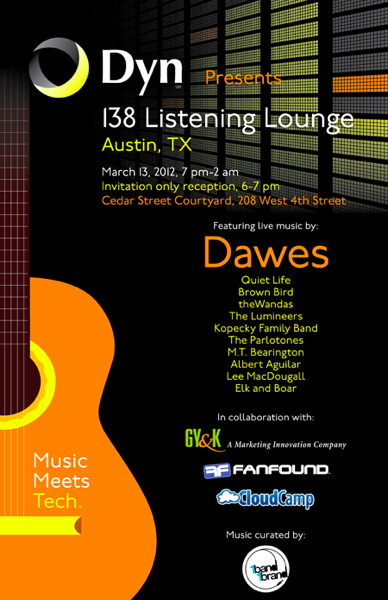
NewImage

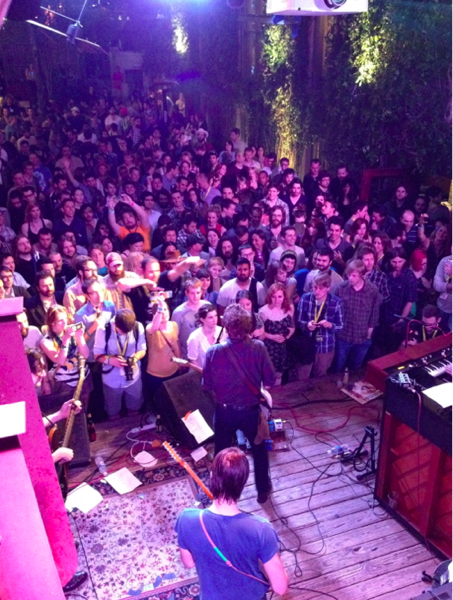
The venue was the location for GroupMe and FourSquare as well, and my vote goes to the Dyn party with 11 live bands and an in crowd of tech and music people.

This party had lots of people.

NewImage

Same venue opposite angle.

Which party would you like to be at? The first one or the Dyn one?
NewImage

The Dyn party above had 11 live bands vs. the 1st one had a DJ with dancing audience.  The 2nd one had a bunch of the musicians hanging around to watch the headline act, Dawes.

Talking to some of the event people it was interesting to see how much work Dyn spent thinking about how to throw a good party at SXSW.  Here is a blog post from last year.

Last year, I flew to SXSW Interactive on a mission. I hit Austin, TX, to take it all in and see what campaign slogan of ours had more legs: ‘Tweet Nerdy To Me’ versus ‘DNS Is Sexy’.

I was also super excited to check out trailblazing people and brands from the Web congregate for five days of networking events, parties, schmoozing, boondoggling, drinking, BBq’ing and concert going. The truth is that it was an epic week of hanging with clients and partners like SimpleGeo, Twitter, Media Temple, Mashable and Revision3.

It was the center of the Internet universe and we were right in the middle of it. Well, almost…

The only problem? I was running around like a chicken with my head cut off, hustling but alone, rogue and tired with no event or home base of our own. I traveled with two great friends and Dyn supporters, who both agreed that our disruptive and unique company could make great noise at an event like this.

NewImage

What became clear as I listened to the 11 live band line-up and chatting with the folks there, there was a lot of time spent to make sure the right people worked on the event.  A typical approach would be to pick a budget, pick a venue, and allocate the money to support the event.  A smarter approach is to find the people who have hosted many events at the venue and at SXSW and ask "what works?"  What does it take to pull off an awesome event that people will twitter about?  Then, you look at your budget and see if there is good value.  If it is a good event, it is much easier to get sponsors to support the event.

One recurring theme even in data center discussions is getting the right people. People who understand how important people are to the solution are much easier to work with.


If there can be an Open Data Standard for Food, why can't the same be done in data centers?

Attending SXSW it can look like it is all about location.

SXSW: Location, location, location fuels mobile apps

A spate of location-based apps generates buzz at SXSW

By Cameron Scott, IDG News Service |  Software Add a new comment

Soon FourSquare won't be the only cool kid on the location-based apps block: A new wave of startups, including Highlight, Zaarly, TaskRabbit and Localmind, are generating buzz at South by Southwest by drawing on smartphone location data to deliver a range of social, commercial and informational experiences.

Highlight is a "social discovery" app that notifies users when they are near someone they don't know with whom they might share interests. It runs in the background, only requiring the user's attention when it has found a potential social contact.

A group of us got a chance to chat with GigaOm's Stacey Higginbotham and asked her as an Austin native what is hot at SXSW.  Food and Health.  Here is a post that Stacey threw up this morning on Open Data Standards for food.

This is cool: An open data standard for food

An open data standard for food has emerged on the web. With such a tool, restaurants, food apps, grocery stores, the government and other interested parties can tell that arugula is also called rocket salad, no matter where on the web it occurs or what a restaurant menu or recipe app calls it. Right now, that’s an impossible task, which leads to inefficiencies in both consumer-facing apps and the supply chains of restaurants and grocery stores.

A group of folks concerned about sustainable foods have built the seeds of an open food database hosted on Heroku, with the code pertaining to it located at Github. The group, which gave an awesome panel at South by Southwest in Austin, consisted of a restaurateur, an urban gardening movement, someone from Code for America and someone who rates sustainable restaurants.

What is cool about this idea is what could be done if we had Open Data Standards for the components in data centers.  Like how? Knowing the ingredients in a recipe is useful.  Wouldn't it be great if you could get details on the components in any piece of equipment.?

He texted me after the panel to say that his primary concern was that the effort be cautious about how it tries to attribute things to restaurants. For example, while he might gain value from starting from such a database, his real value is the taxonomy his team has created around dishes. So, if one checks out catfish po’ boys on Tasted Menu, his app could use the Open Food data for the catfish or the breading, but his app will also note that the food is Cajun or Creole, fried, a sandwich and other things that will help real users figure out where they want to go and what they want to eat.

I don't know about you, but I am much more excited about the idea of open data standards than another location app.

CleanWeb makes a showing at SXSW amongst the mass of SoLoMo

What is SoLoMo?

NewImage

SOCIAL-LOCAL-MOBILE

Venture Capital maven John Doerr of Kleiner Perkins Caufield & Byers coined the acronym SoLoMo to sum up this convergence of 3 major powers and acknowledges they are affecting all aspects of business faster than most managers have realised.

GigaOm's Katie Fehrenbacher phttp://gigaom.com/cleantech/amidst-solomo-tacos-cleanweb-peeks-out-at-sxsw/osts on a clean tech presentation at SXSW.

Amidst SoLoMo & tacos, Cleanweb peeks out at SXSW

Sunil Paul, Spring Ventures, at Green:Net 2011There’s never a big focus on next-generation energy solutions at the annual geekfest South by Southwest — I’ve skipped the show over the past few years. But Spring Ventures founder Sunil Paul braved the rain and the ever-present SoLoMo apps to give a rendition of his presentation on the Cleanweb, or using computing, mobile, and the web to address resource constraints for energy, food and water.

I saw Sunil at GreenNet.  Here is his talk at the event.

Geoloqi's Amber Case Keynote at SXSW on Location Services

One of the best presentations at SXSW Interactive was Geoloqi's Amber Case.

Cybernetic anthropologist Amber Case spoke to a full house at SXSW this week, in one of the more thought-provoking sessions that I attended. She started off by declaring, "Every time you use that mobile phone of yours, you have a symbiotic relationship with it: you are a cyborg." Perhaps one of the most interesting points that she made was that current mobility interfaces take way too much of our time.

News.com also reports on Amber's presentation.

How cutting edge geolocation can change everything

Q&A At South by Southwest, Geoloqi CEO Amber Case spoke to CNET about the state of the art in geolocation, augmented reality, and heads-up displays.

Geoloqi CEO Amber Case speaking during her keynote address today at SXSW.

(Credit: CNET,James Martin)

AUSTIN, Texas--These days, smartphones seem like they're everywhere. And with their wide array of built-in sensors, those devices--iPhone, Androids, Windows Phones, and others--can provide us with more and more data about where we are and what's around us than ever before.

Amber's presentation was on Sunday afternoon which is when we were hosting a BBQ for a data center crowd, but luckily I had started interacting with Amber last year and visiting Geoloqi is on my list of 5 companies to touch base when I am next in Portland.

Geoloqi Extends Platform with Appcelerator, Factual and Locaid Partnerships

Geoloqi Extends its Reach to 350 Million Mobile Devices, 1.6 Million Mobile Developers, and a Database of 60 Million Places Globally, Giving Carriers and OEMs a Location-Based Platform Like Never Before

Austin, TX (SXSW Interactive) – March 11, 2012 – Geoloqi, a powerful platform for next-generation location-based services, today announced strategic new partnerships with Appcelerator, a leading cross-platform mobile development platform; Factual, a large-scale data aggregation platform with a Global Places API; and Locaid, the world’s largest carrier location platform. Through these partnerships, Geoloqi is significantly enhancing its location data and analytics offering while expanding its reach to millions of new developers and end users through Locaid and Appcelerators’ customer bases.

Geoloqi has a press release corresponding to Amber's keynote.

Why spend so much time thinking about location services?  Because there is a huge opportunity to revolutionize industries when you think the way Amber presents.  One of Amber's concepts in geofencing which could be viewed as a different way to do what an RFID solution would.

Let's use that example of a supermarket. With the accuracy of an iPhone's GPS, how far outside the boundaries of the store would you have to set the geofence?
Case: You could set it and encompass the parking lot and you'd be able to trigger it quite well. We've taken the native, significant location updates and how iPhone and Android handled that, and amped it up and said, well, if you had your GPS running and sending up data to the server every five seconds, your phone would run out of battery. But if you figure out how to intelligently handle it, like if I get to a new area and there are geofences here, then turn on the GPS, or just slowly monitor in the background. Then it's able to converse battery plus get the resolution when it's necessary. We saw that this was a big pain in the industry. When we released a sample app, carriers and enterprises and governments and developers started showing up and saying, This has been a big pain for us, what a relief that somebody else is trying to solve this problem.

Can you explain a little more about geotriggers?
Case: They're called geotriggers or geonotes. Geonotes are just text you leave inside a geofence, but a geotriger can trigger anything in life, so lights to turn on in your house, or you can do a lot of machine to machine communication.

Part of what Amber and I had discussed is the opportunities to apply some of her concepts in enterprise scenarios.  I missed out being in standing room only keynote of 3200 people, but sitting down in a conference room in Portland is much more useful.

BTW, I did find Amber Case when I was looking up last year who was presenting at SXSW.  When I saw her company is in Portland, I reached out to one of my friends who pretty much knows all the start-ups there and asked for an introduction.  Why wait to talk to a though leader when you can connect other ways.  Conferences are useful, but it can hard to connect with the popular people.

Human Errors cause Windows Azure Feb 29th outage

On Mar 1, I met with an out of friend guest in Bellevue and one of the other people who joined us was an visiting Microsoft MVP.  In the conversation, he brought up the outage on Feb 29 of Windows Azure, and he shared his views on what had gone on, and how could Microsoft make a leap year mistake.  How? Human error is an easy explanation.

Here are a few of the media posts.

Microsoft tries to make good on Azure outage


GigaOm - 1 hour ago
In his post, Bill Laing, corporate VP of Microsoft's server and cloud division, said the outage affectedWindows Azure Compute and dependent services ...
Microsoft Offers Credit for Azure Cloud Outage‎ Data Center Knowledge
Microsoft details leap day bug that took down Azure, refunds customers‎ Ars Technica
Microsoft Azure Outage Blamed on Leap Year‎ CloudTweaks News

A high level description is provided by GigaOm's Barb Darrow.

Microsoft tries to make good on Azure outage

Microsoft is issuing credits for the recentLeap Day Azure outage. The glitch, which cropped up on Feb. 29 and persisted well into the next day, was a setback to Microsoft, which is trying to convince businesses and consumers that its Azure platform-as-a-service is a safe and secure place to put their data and host their applications.

But, I want to point out some interesting details in Bill Laing's blog post.

There are three human errors that could have prevented the problem.

Prevention

  • Testing. The root cause of the initial outage was a software bug due to the incorrect manipulation of date/time values.  We are taking steps that improve our testing to detect time-related bugs.  We are also enhancing our code analysis tools to detect this and similar classes of coding issues, and we have already reviewed our code base.
  • Fault Isolation. The Fabric Controller moved nodes to a Human Investigate (HI) state when their operations failed due to the Guest Agent (GA) bug.  It incorrectly assumed the hardware, not the GA, was faulty.  We are taking steps to distinguish these faults and isolate them before they can propagate further into the system.
  • Graceful Degradation. We took the step of turning off service management to protect customers’ already running services during this incident, but this also prevented any ongoing management of their services.  We are taking steps to have finer granularity controls to allow disabling different aspects of the service while keeping others up and visible.

Another human error is the system took 75 minutes to notify people that there was a problem.

Detection

  • Fail Fast. GA failures were not surfaced until 75 minutes after a long timeout.  We are taking steps to better classify errors so that we fail-fast in these cases, alert these failures and start recovery.

Lack of communication made the problems worse.

Service Dashboard.  The Windows Azure Dashboard is the primary mechanism to communicate individual service health to customers.  However the service dashboard experienced intermittent availability issues, didn’t provide a summary of the situation in its entirety, and didn’t provide the granularity of detail and transparency our customers need and expect.

...

Other Communication Channels.  A significant number of customers are asking us to better use our blog, Facebook page, and Twitter handle to communicate with them in the event of an incident.  They are also asking that we provide official communication through email more quickly in the days following the incident.  We are taking steps to improve our communication overall and to provide more proactive information through these vehicles.  We are also taking steps to provide more granular tools to customers and support to diagnose problems with their specific services.

One of the nice thing about Cloud Service is the need for transparency on cause of outages.  This is a marketing exercise that needs to make sense to a critical thinking technical person.

Conclusion

We will continue to spend time to fully understand all of the issues outlined above and over the coming days and weeks we will take steps to address and mitigate the issues to improve our service.  We know that our customers depend on Windows Azure for their services and we take our SLA with customers very seriously.  We will strive to continue to be transparent with customers when incidents occur and will use the learning to advance our engineering, operations, communications and customer support and improve our service to you.

The Feb 29th outage was like a Y2K bug that caught Microsoft flat footed.  There was little to point blame on a hardware failure.  What caused the problems were human decisions made in error.