Knowledge -> Epistemology -> Information Infrastructure

My wife has said I like to think about thinking.  And, recently at a girl's get away during charades one of the hints was a person spending a lot of time thinking, and then typing.  Thinking more, then typing.  And, they guessed Dave Ohara. :-)  So, outside of work even in social neighbor time, I have the reputation of thinking a lot and writing a lot.

One of the interesting problems I have been working on is what can change the data center industry.  Information architectures is what I have been study lately.

Then yesterday, I saw a talk by John Leslie King Titled - Knowledge Infrastructure: Mechanism and Transformation in the Information.  One of the slides that got my attention was this one.
NewImage

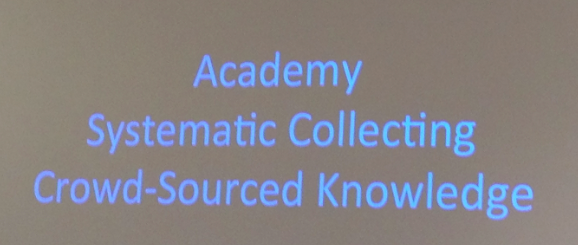
The role of the Academy in a systematic collecting of information for a crowd-sourced knowledge.

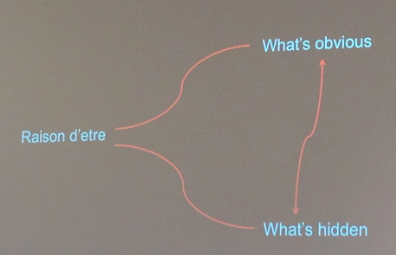
A great point was the knowledge in a perspective of reason for existence, and how what's obvious leads to thinking what's hidden.
NewImage

The other big concept John discussed was Epistemology.

Epistemology Listeni/ɨˌpɪstɨˈmɒləi/ (from Greek ἐπιστήμη (epistēmē), meaning "knowledge, science", and λόγος (logos), meaning "study of") is the branch of philosophy concerned with the nature and scope (limitations) of knowledge.[1][2] It addresses the questions:

  • What is knowledge?
  • How is knowledge acquired?
  • To what extent is it possible for a given subject or entity to be known?

Much of what John King presented is in this PDF.  The last paragraph summarizes the opportunity.

Epistemic infrastructure grew up around selection processes evolved by curators, librarians, and archivists to filter knowledge according to professional norms and standards, subject and domain knowledge, and attentiveness to the needs of user communities. This kind of systematic collecting builds trust in knowledge resources. A knowledge economy built on digital information will likewise depend on clear indicators of quality, authoritativeness, and authenticity. The lessons from the building of epistemic infrastructure in the 19th and early 20th centuries are powerful guides in this evolution. The knowledge economy will undoubtedly need new tools as it grows, but it already has a great deal of capacity and capability in the traditions of museums, archives and libraries. Handled carefully, this traditional epistemic infrastructure will simultaneously build the value of knowledge in the society and decrease disparities between information “haves” and “have-nots” with respect to ability to acquire, evaluate, manipulate, and generate information. This infrastructure is modern society’s most vibrant and effective resource for dealing with extraordinarily challenging and conflicting demands. Those working at the forefront of the knowledge economy should recognize and strengthen it.

If Yahoo, Bing, Yandex, and Baidu fail as search providers, does Google get defined as a monopoly?

The future of Yahoo is not good.

Yandex is having its problems.

Yandex Sinks on Profit Concern as Google Grows: Russia Overnight

Yandex NV (YNDX) tumbled the most this year on speculation the owner of Russia’s most popular Internet search engine will report net income faltered last quarter as competitors such as Google Inc. (GOOG) encroached on its market share.

Baidu is down on weak forecasts.

Baidu shares decline on a weaker than expected forecast

Baidu's chairman introduces the company's search engine Baidu has seen a robust growth in advertising revenue in recent years

Related Stories

Shares in Chinese biggest search engine Baidu fell more than 10% in after hours trading after the firm issued a weaker-than-expected revenue forecast.

Bing is speculated to be sold to Facebook.

The rumor, which started as a prediction in an e-book written by an "anonymous" marketing executive trying to cash in on Facebook's IPO, turns out to be truer than anyone could have guessed.

According to a nugget buried in a New York Times report on Facebook's patent strategyMicrosoft executives approached Mark Zuckerberg to see if he'd like Facebook to acquire Bing.


If no one but Google can make money on search and competitors fold shop, is it possible in the future that Google becomes the monopoly of search?
If Microsoft, Baidu, and Yandex can't beat Google, it seems like governments around the world would think they need to regulate Google Search.

Where in the World should I put my Data Center? 2012 Data Centre Risk Index by Cushman&Wakefield

If Greenpeace had its wish your #1 criteria for where your data center goes is the renewable energy content.  But, as we all know anyone who would do this wouldn't have a job in the data center business.  Renewable energy is important, but it is not the the #1 criteria.  #1 issues are Energy availability and cost, Bandwidth, and Ease of doing business.

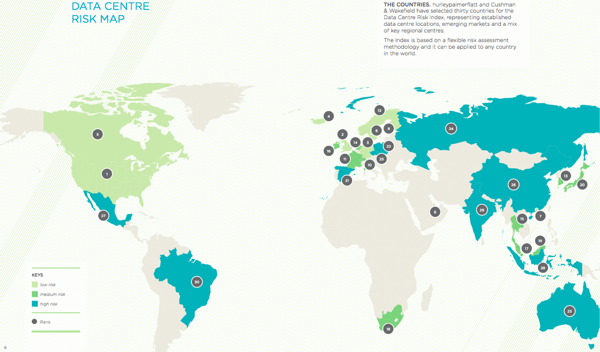
Cushman&Wakefield just released their 2012 data centre risk index that provides a perspective in line with current data center thinking.  Here is a data center risk mapped to the world.

NewImage

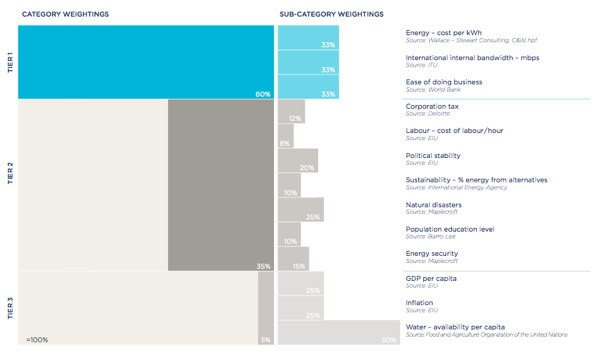
Here is the criteria that Cushman&Wakefield used to rate countries. Note the sustainable energy is in Tier 2 which is 35% and 10% of the area is for sustainable energy, equalling 3.5% out of the total.

NewImage

Should Greenpeace be protesting Cushman?  Will they?  Most likely not.

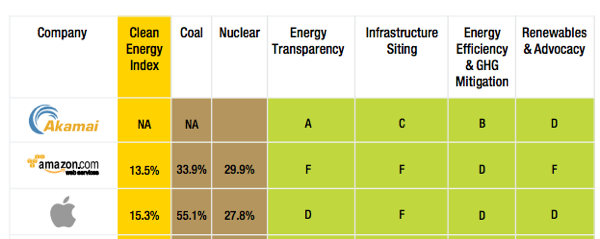
Greenpeace's criteria for what makes a good data center site is here.

NewImage

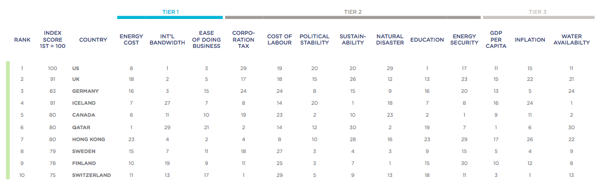
Cushman's study shows the following as the top 10 countries for data centers on page 7 of their report.

NewImage

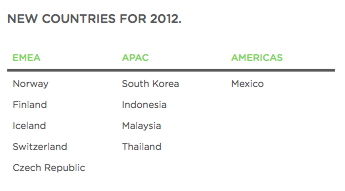
It is good to see Cushman added more countries to its report for 2012.

NewImage


Map of other data centers connected to NSA's Mega Utah Data Center

Found this image that shows the information connected to the NSA's new Utah data center.

NewImage

The above image comes from this Wired article.

Biggest Spy Center (Watch What You Say)

Photo: Name Withheld; Digital Manipulation: Jesse Lenz

The spring air in the small, sand-dusted town has a soft haze to it, and clumps of green-gray sagebrush rustle in the breeze. Bluffdale sits in a bowl-shaped valley in the shadow of Utah’s Wasatch Range to the east and the Oquirrh Mountains to the west. It’s the heart of Mormon country, where religious pioneers first arrived more than 160 years ago. They came to escape the rest of the world, to understand the mysterious words sent down from their god as revealed on buried golden plates, and to practice what has become known as “the principle,” marriage to multiple wives.

The Real Data Center, lessons from The Real CSI, How reliable is the science behind forensics

PBS Frontline has a video on The Real CSI.

NewImage

Watch The Real CSI on PBS. See more from FRONTLINE.

Watching this video brings into questions of science behind fingerprints, blood tests and bite marks.

The one method that has trumped a bunch of these techniques is DNA testing.

It is interesting talking to the people who  have lots of data center experience, and in some ways it feels like these are the people who haved figured out the science of data centers, and what really works.

in the same way that fingerprints and blood testing are popular and accepted by the mass public, it doesn't necessary mean there is science behind the techniques.

Are you practicing data center science or using the common accepted methods?  There is a difference.