The Games The China Web Companies Play

What is going on in the China data center market is quite complicated.  I've had a variety of people talk to me about working on projects in China, and I have passed so far.  I used to go to Asia every 6 weeks, but those days are long gone.  But, I do talk to a lot of people who go, so I can still get information on what is going on.

China has successfully driven out Google, eBay, Facebook, Twitter, and many other big web brands.  This leaves the Chinese companies to reach the China market.  The reasons for this could be a long, long post in itself.  Let's treat it as a fact that China wants Chinese companies to build its web.

Now for years, the provinces and many other groups have attempted to be entrepreneurial in building their own web services in data centers scattered around China. In the same way that there are empty ghost cities in China. 

Ordos: The biggest ghost town in China

Empty apartment blocks, Ordos, Inner Mongolia

In Inner Mongolia a new city stands largely empty. This city, Ordos, suggests that the great Chinese building boom, which did so much to fuel the country's astonishing economic growth, is over. Is a bubble about to burst?

There are ghost data centers in China.  Many are in these ghost cities, but also scattered around.  Can you imagine if the US Federal government decided where data centers should be built?  The data centers would be built where polticians would benefit most.  

Given the censorship requirements of the China Web, the costs are increasing substantially decreasing profits.  The WSJ reports on this situation with Tencent, Sina, and others.

Similarly Sina said it would continue to invest heavily in its Weibo microblog, though a timeline for profitability remains unclear. Chief Executive Charles Chao said the company expects to earn revenue from the site by the second half of the year, but added it would take several quarters to judge advertiser interest in the platform, which has more than 300 million users.

Revenue increased 6% from a year earlier to $106.2 million, but operating expenses jumped 61% to $67.2 million. Sina attributed the rise primarily to personnel and infrastructure costs associated with Weibo.

The company didn't elaborate, but analysts also say the company is hiring censors to help it delete posts considered too sensitive for China's tightly controlled Internet. China has cracked down on Internet content ahead of a once-a-decade leadership transition that begins later this year—a process made even more sensitive by the recent ouster of a former Chinese Communist Party highflier, Bo Xilai.

 This is all part of the game played to build data centers in China.  One of the interesting parts is how data center infrastructure - land, power, water, and network access are being used to regulate who builds.  In the past data centers would be built if you had enough money.  Now even money won't get you past the 3 year approval cycle for a 10MW substation.  You need the approvals from the right agencies to get past this hurdle any quicker.

There are a handful of companies that can do this.  Do you know who they are?


How big is the water on Earth? a sphere 860 miles in diameter

One of the things Compass Data Center's Chris Crosby, Google's Joe Kava and I will regularly discuss is the lack of appreciation for how scarce water is.

How scarce is water on the earth?  Consider this image that shows how big all of the Earth's water is compared to the size of Earlth.

Picture of Earth showing if all Earth's water (liquid, ice, freshwater, saline) was put into a sphere it would be about 860 miles (about 1,385 kilometers) in diameter. Diameter would be about the distance from Salt Lake City, Utah to Topeka, Kansas, USA. (Credit: Illustration by Jack Cook, Woods Hole Oceanographic Institution; USGS)

Picture of Earth showing if all Earth's water (liquid, ice, freshwater, saline) was put into a sphere it would be about 860 miles (about 1,385 kilometers) in diameter. Diameter would be about the distance from Salt Lake City, Utah to Topeka, Kansas, USA.
Credit: Illustration by Jack Cook, Woods Hole Oceanographic Institution (©); Howard Perlman, USGS.
View the picture full size. View full size


 About 70 percent of the Earth's surface is water-covered, and the oceans hold about 96.5 percent of all Earth's water. But water also exists in the air as water vapor, in rivers and lakes, in icecaps and glaciers, in the ground as soil moisture and earthgwaquifer.html, and even in you and your dog. Still, all that water would fit into that "tiny" ball. The ball is actually much larger than it looks like on your computer monitor or printed page because we're talking about volume, a 3-dimensional shape, but trying to show it on a flat, 2-dimensional screen or piece of paper. That tiny water bubble has a diameter of about 860 miles, meaning the height (towards your vision) would be 860 miles high, too! That is a lot of water.
 

The Earth's water would be 860 miles in diameter, and the Earth is 7,900 miles in diameter.

Water seems much more scarce now doesn't it.

Pleasure: Great People attending Uptime Symposium, Part 1

i didn't attend Uptime Symposium, but I had a 11:30 meeting with Dell so I headed over to the hotel bar. 12 hrs later I was still at the bar.

One of the great things about the data center industry are the people.  Some of the companies I was able to chat with are the following. I am sure there others I missed someone, and my apologies for not listing your company. 

Compass Data Centers

RagingWire

Fieldview Solutions

Jones Lang LaSalle

Norland

RTKL

AOL

DELL

HP

Spencer Fane

Walsh Construction

Verizon

Data Foundry

Digital Realty Trust

Ramprate


Skipping the Vendor/Analyst Pay to Play Dance

Observation:

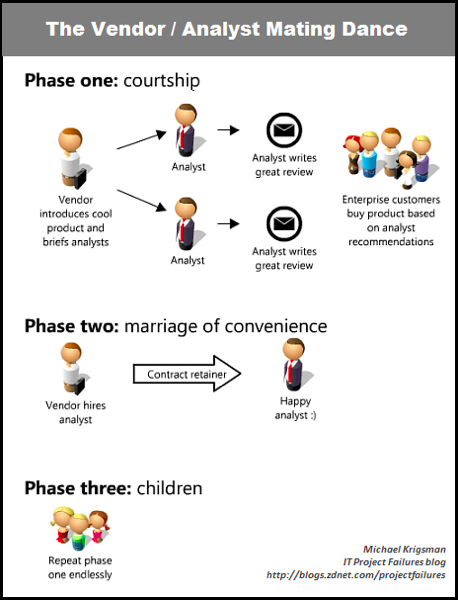
The data center industry is part of the pay to play dance that exists between vendor and analyst organization.  ZDNet does a pretty good job of describing the situation.

NewImage

One of the comments explains the dilemma of an analyst in the pay to play.

I was an analyst for many years at a pay-to-play analyst firm, and like many of my peers, I strove to maintain my personal integrity, despite the many, many pressures I felt to say the right thing. At the end of the day, I found it was impossible, and I quit doing that kind of work. 

It wasn't the overt stuff. Despite many, many suggestions, I never, ever wrote anything that I thought was untrue. But in this business, the nuances matter. You end up giving people the benefit of the doubt, when you shouldn't have.

You also found that it was impossible to call a spade a spade. If some poor guy plunked down $20,000 of his savings to get our firm to say that his nonsense software had some merit--this really happened, the company now long-gone--it was hard for me to look the guy in the eye and say, "No way," and as for my boss, well, he's the guy who negotiated the deal. So you try to thread your way through with phrases like "interesting" and "still some way to go." 

Many data center vendors feel compelled to be at all the trade shows as a lack of presence would indicate you are not commited to the market.  So, your marketing expenses grow as you "ante up" to play the game.  In addition to the trade shows, you pay the analysts to analyze your company.  You up your event sponsorship to get more leads.  Arghh!  This is so frustrating when it doesn't pay off.


It is so appealing to skip this dance.

One of the best ideas I heard at Uptime Symposium, Don't print your marketing material

Yesterday, I went to Hyatt Hotel next to the Uptime Symposium.  I said I wasn't going to the Uptime Sympsium and I didn't.  I walked in the hotel bar at 11a and I didn't leave the hotel bar until 11p.  I spent 12 hrs in the bar.  Well the bar, the patio, the bathroom, and the restaurant.

NewImage

I think I saw all the people I wanted to see without taking one step into the conference or exhibit area.  Now, it was not my plan to be there for 12 hrs.  It was just once I stepped in I kept on running into people I know.  I am so glad the the 451 Group's media group changed their media pass requirements and I didn't have a badge.  If I was sitting in presentations or in the exhibit hall then i would miss the people who I saw in the bar, and i would need to commit more than 12 hrs.

Hanging in the hotel bar is a typical way to network, but yesterday was an extreme and I hope I don't make this a regular habit.  Although I must admit it was time efficient and cost effective.

One of the guys I spent the most amount time catching up with is Chris Crosby at Compass Data Centers. I like Chris because he is one of the few who have a computer science degree and we can talk about some really cool ideas.  

NewImage

One of the best ideas I think Chris is doing is one of the greenest environmentally sensitive things a start-up can do.  Don't print your marketing material.  Create documents and videos to explain your company, solution, and technology.

Here is the brilliant part of what Chris is doing and why I think it is one of the best ideas.  The typical old school way is I need to give the potential customer material.  i don't know about you, but how many people are walking around with bags of marketing material?  Compared to 20 years ago the amount of paper is hopefully less than 10%.  I never grab marketing material anymore.  How many of you think your printed marketing material gets share?

So besides saving the environment why is this so good?  Because, Chris has taken it to the next level.  When you have a potential customer you can create a custom folder on a file sharing site and send the customer the link.  This link with GBs of information can be shared with cowokers.  OK, but why is this so much better.

Because Chris has added Google Analytics so now he can measure effectiveness of his material and information he has given to potential clients.  He can see how long people stay on his site. Where they enter from.  IP addresses, Company names from domains.  Countries, Cities that look at the content.  Let's see you do that with your printed material.

NewImage

This idea would never make it into an Uptime Symposium session, but it did make it into a conversation in the hotel bar.  

There are many other things Chris and I talked about and we'll both be blogging about more ideas discussed in the hotel bar.