Building a Room to Think, high ceilings work

After three days in the bay area it is nice to get home.  Home is a place to reflect on the week's activities. To meditate.

Meditation is thought of as a self improvement, but I also use the technique of meditation to think of the data center industry.

Meditation is any form of a family of practices in which practitioners train their minds or self-induce a mode of consciousness to realize some benefit.[1][2][3] 

Last week with the DCD Seattle event I got a chance to chat with a bunch of folks who were in town and it turns out some were in town longer than they expected as they flew out from the East Coast and where then going to Uptime Symposium. Fieldview Solutions's John Consoli was one of those who was sticking around so we decided to grab lunch on Friday.  I told him to take a cab over to my house, and we could go to lunch and i would give him a ride back to his hotel.  I gave Fred the 3 minute tour as a complete tour of the house, office, and beach house can take an hour, and is a workout walking down the 200 steps to the beach and back.

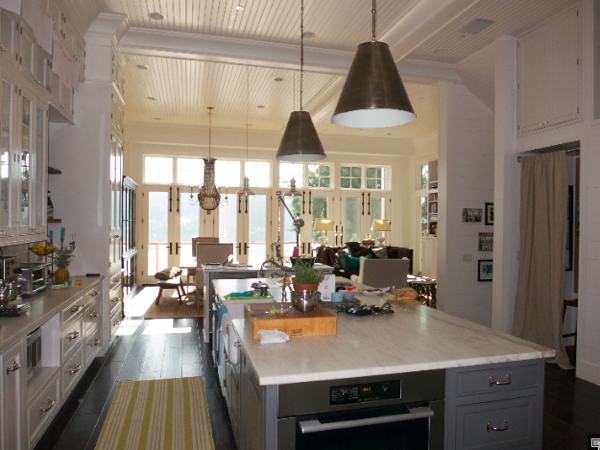
When I ran into Fieldview Solutions's CEO Fred Dirla in Santa Clara, he heard about my house and 30ft ceilings.  Actually the ceiling is 13ft, not 30. 

NewImage

I spend more time than I expected in this room, even choosing to work in the room.  Why? I think being in a tall ceiling feels good.  WSJ has a post on the concept.

Today, it turns out, the real cutting edge of architecture has to do with the psychology of buildings, not just their appearance. Recently, scientists have begun to focus on how architecture and design can influence our moods, thoughts and health. They've discovered that everything—from the quality of a view to the height of a ceiling, from the wall color to the furniture—shapes how we think. 


...


It's not just color. A similar effect seems to hold for any light, airy space. In 2006, Joan Meyers-Levy, a marketing professor at the University of Minnesota's school of management, studied the relationship between ceiling height and thinking style. She demonstrated that, when people are in a high-ceilinged room, they're significantly better at seeing the connections between seemingly unrelated subjects. In one experiment, undergraduates came up with nearly 25% more connections between different sports, such as chess and basketball, when sitting in a loft-like space than in a room with an 8-foot ceiling. Instead of focusing on particulars, they were better able to zoom out and see what various things had in common.

I found the research paper by Joan Meyers-Levy on ceiling height.


NewImage
...

We believe that the effects produced by high or low ceilings actually occur because such ceiling heights increase or
decrease vertical room volume, which in turn stimulates
alternative concepts and types of processing. Indeed, this
logic corresponds with Hall’s (1966, 77) earlier discussed
thesis that chapels versus cathedrals communicate our theorized (i.e., confinement vs. freedom-related) associations
“by virtue of the space they enclose.”


FYI, we did not specify 13ft ceilings.  It was the height we needed to make the garage above us be level with the road.  We have no regets having little choice, and made the height one of the main features of the room, and a great place to think.


Greenpeace's claims vs. the facts, Apple fan digs up some facts

Greenpeace and Apple are having a PR war regarding the Maiden Data Center.

Here is a post I found that the data center community is going to like.  The author goes beyond the claims made and looks at the logic of when things occur vs. the perception of events.

NewImage

...

Furthermore, the Maiden land deal didn’t “just happen” over the course of a few fevered weeks following Greenpeace’s April charm offensive. Anyone that’s ever purchased land, especially agriculturally zoned land like Apple acquired to site their second solar array, knows it takes months to negotiate a deal, gain regulatory approval and process the sale.

Apple’s been working on this for months if not years and there’s a paper trail a mile wide showing exactly what they’ve been up to if anyone had chosen to follow it.

If Greenpeace is a public watchdog, what exactly have they been watching? My guess is they’ve been breathlessly watching themselves on TV.

The author then gets more critical.

In “How Clean Is Your Cloud,” Greenpeace claimed Apple’s NC data center would use 60MW of power and that the overwhelming majority of that would be coal-generated electricity from Duke Energy. However, Apple’s public statements and public filings clearly state the facility would use just 20WM — a difference of 300 percent.

Digging up more facts about energy composition.

Moreover, Greenpeace overstated Duke Energy’s reliance on coal (55 percent), citing 2007 data, despite the ready availability of 2010 data filed with regulators showing a greatly reduced coal footprint (45 percent) in its generating mix.

i wonder if the author of this post lives in NC.

And, the NCUC approval process included a public comment period and public hearings — Apple was on the ball and ready to deliver 100 percent green-powered data centers months ago and information showing that was readily available to the public.

Few including the media have spent this time researching the facts that exist in public disclosure.

I like green. I seek out green products and work hard to reduce, reuse and recycle. I despise Greenpeace…


AOL's 3 steps to save $5mil in IT Operations

I met a bunch of Mike Manos's IT team from AOL in Santa Clara.  They were in town for Uptime Symposium and we invited the AOL team to meet some of the thought leaders in the bay area.  We gave Mike's team a bunch of Mike Manos's stories as there were a lot of people who used to work in Mike's group at Microsoft and Digital Realty Trust. Plus his brother Steve Manos was there as well.

I've gotten to know Mike as I used to help him on his presentations.  I met the presenters Chisty and Julie, so besides sharing the slides and writing a post, let me take a stab at telling the AOL story in a different way.

The opening slide is this.

NewImage

After going through the slides i would try "AOL's 3 steps to save $5mil in IT Operations"

Clearing the Cruft is not going to get people's attention.  Saving $5mil does.

The results are summarized here early on.  This is good.

NewImage

The order of the three steps presented are AOL Cloud, Power Absurdity, and Power Hog.

I would change the order. Put Power Hogs first.  Find those wasteful things.

NewImage

Some of these power hogs are not only wasteful, but also absurd.  Project Absurdity after Power Hogs

NewImage

What is left should try to go to AOL cloud.  The last step is the stuff left over gets moved to the cloud.

Although I bet you there are a bunch of VMware consultants who will gladly move the Power Hogs and Power Absurd to the cloud as well.  The more VMs the more they make.

NewImage

The list of steps taken are good, but I would reorder them and use it is a good chance to make fun of their absent leader Mike Manos.  Without an executive sponsor a project this is impossible.  I wonder if Mike calls his staff Donkeys for not taking up the challenge.

NewImage

Excellent slide with energy savings and carbon reduction.

NewImage

Overall this is a well thought out presentation.  I only suggest some changes in the order of the content, changing the title, and adding some humor.

Good job AOL team.  Hope to see you soon.


Cutting through the Myth, what is a Modular Data Center

I've been writing about modular/container data centers for a while and I stopped trying to post on all the different news.  How bad is it?  How about 35 suppliers.  See what DatacenterKnowledge posts.

A Shift in the Modular Conversation

This year’s Uptime Symposium reflected an ongoing shift in the industry discussion of modular designs, with a growing focus on economics and other factors directly tied to purchasing decisions. The event featured three keynotes and an entire content track on the economics of modular data centers, along with a modular data center campus in the expo hall featuring offerings from four providers.

“We’re tracking 35 suppliers,” said Lawrence. “They think this is a market worth chasing. It’s undeniable that it is a very effective means of deploying data center space for some users. The adoption won’t be linear, and won’t be universal.”

Compass Data Centers is trying to educate.

“Modular—Composed of standardized units or sections for easy construction or flexible arrangement”—Random House American Dictionary 

But, I think this still goes over many heads.  Let's try this for an explanation.  

All this stuff about Modular is just the idea of interchangeable parts at data center scale.  I am going to scrape parts from the wikipedia post in interchangeable to illustration a few points http://en.wikipedia.org/wiki/Interchangeable_parts

Ok first what are interchangeable parts?

Interchangeable parts are parts that are, for practical purposes, identical. They are made to specifications that ensure that they are so nearly identical that they will fit into any device of the same type. One such part can freely replace another, without any custom fitting (such as filing). This interchangeability allows easy assembly of new devices, and easier repair of existing devices, while minimizing both the time and skill required of the person doing the assembly or repair.

Ford assembly line, 1913. The magneto was the first to be assembled.

The concept of interchangeability was crucial to the introduction of the assembly line at the beginning of the 20th century, and has become a ubiquitous element of modern manufacturing.

Yep. I want my data center to built on interchangeable parts that does all of the above.  Much clearer explanation than I want modular.

What was the technology behind interchangeable parts?

Interchangeability of parts was achieved by combining a number of innovations and improvements in machining operations and the invention of several machine tools, such as the slide rest lathescrew-cutting latheturret lathemilling machine and metal planer. Additional innovations included jigs for guiding the machine tools, fixtures for holding the workpiece in the proper position, and blocks and gauges to check the accuracy of the finished parts.[1] Electrification allowed individual machine tools to be powered by electric motors, eliminating line shaft drives from steam engines or water power and allowing higher speeds, making modern large scale manufacturing possible.[2] Modern machines tools often have numerical control (NC) which evolved into CNC (computerized numeric control) when microprocessors became available.

Cutting tools made of high speed steel allowed steel rather than wrought iron to be used for parts.[3][4] The ability to machine hardened parts eliminated the problem of warping and dimensional changes associated with heat treatment hardening of parts after machining.[5] Modern cutting edges also use materials such as tungsten carbide. Other innovations were drop forging and stamped steel parts, which reduced or eliminated the amount of machining in the United States.

Being able to put the pieces all together just like above is the goal.

Now somehow with the momentum of Modular Data Centers you are lead to think that the past data centers were custom built.  Like the way guns were made before the 18th century.

Before the 18th century, devices such as guns were made one at a time by gunsmiths, and each gun was unique. If one single component of a weapon needed a replacement, the entire weapon either had to be sent to an expert gunsmith for custom repairs, or discarded and replaced by another weapon. During the 18th and early 19th centuries, the idea of replacing these methods with a system of interchangeable manufacture was gradually developed.[6][7] The development took decades and involved many people.[6][7]

This is of course ridiculous to think that the last 5 years of data centers are custom built.  

The data centers built 25 years were custom, but now everyone uses interchangeable parts. 

Eli Whitney showed how interchangeable parts could revolutionize gun manufacuring.

Eli Whitney and an early attempt

In the US, Eli Whitney saw the potential benefit of developing "interchangeable parts" for the firearms of the United States military. In July 1801 he built ten guns, all containing the same exact parts and mechanisms, then disassembled them before the United States Congress. He placed the parts in a mixed pile and, with help, reassembled all of the weapons right in front of Congress, much like Blanc had done some years before.[8]

Doesn't the sound like presentations and videos that have been shown that all the pieces go together.  

Eli Whitney sold Congress.

The Congress was captivated and ordered a standard for all United States equipment. Interchangeable parts removed problems concerning the inability to consistently produce new parts for old equipment without significant hand finishing that had plagued the era of unique weapons and equipment. If one weapon part failed, another could be ordered, and the weapon wouldn't have to be discarded. The catch was that the Whitney's guns were costly and handmade by skilled workmen.

Note this last part. "costly and handmade by skilled workmen."  

Eli Whitney overpromised and under delivered.

Whitney was never able to design a manufacturing process capable of producing guns with interchangeable parts. Fitch (1882:4)[6] credited Whitney with successfully executing a firearms contract with interchangeable parts using the American System, but historians Merritt Roe Smith and Robert B. Gordon have since determined that Whitney never achieved interchangeable parts manufacturing. His family's arms company, however, did so after his death.

Now welcome to the part of Modular Data Center construction that almost no one talks about, especially in public.  The projects that don't work.

I was sitting next to a Telco data center guy at dinner on Tuesday night. And, modular data centers came up and I said yeh, those overhyped heavily marketed containers.

He pulls out his phone shows pictures of his containers he would like to sell.  I wonder if he can get them  listed on eBay or Craigslist?  He hates his containers.  

They are expensive to operate and hard to repair.

So, does this mean modular data centers will not work.  No.  

But, the probability of users being able to pick the right solution with 35 companies and heavy marketing, the odds are not good.


News on Apple's Green Data Center

ZDNet's David Chernicoff posts on Apple's Green Data Center.

Is a 100% green datacenter practical, or even plausible?

By  | May 18, 2012, 6:01am PDT

Summary: 100% renewable energy sounds great. But when you start to do the research the picture is much less clear.

Working hard to keep up their public face of being the company of unicorns and rainbows, Apple seems to be making themselves the standard bearer for green power for the datacenter.  After constant negative publicity from Greenpeace on the use of power from non-green sources, Apple is taking the approach that a commitment to green power will be a major win, at least in the field of public opinion.

This post would lead some to believe that Greenpeace is creating pressure for Apple to use renewable energy.  The green data center effort in my opinion was actually most influenced by our departed friend Olivier Sanche, and his efforts are just now becoming public.

It will be interesting as Greenpeace continues its environmental PR war with Apple. The one thing different about Apple vs. other Greenpeace targets is the Apple PR machine and the Apple loyal user base are 10X bigger than any other past Greenpeace targets.  Who will win the PR battle?  uhh, Apple vs. Greenpeace. Who do you love?  A user base who users their products hours and hours a day?  BP, Nestle, Unilever and other Greenpeace targets have how many people who love their brand?

If you don't have a green data center strategy, then you better get ready.  All this press wakes people up to the environmental impact of data centers.

Apple Data Center Will Be Totally Green by 2013

BusinessWeek - ‎19 hours ago‎
By Peter Burrows on May 17, 2012 Apple Inc. (AAPL) (AAPL), targeted by Greenpeace International over its energy consumption, said its 500000- square-foot data center in Maiden, North Carolina, will be powered entirely by renewable sources by the end of ...
 

Apple's data center will be completely green by 2013, company says

San Jose Mercury News - ‎18 hours ago‎
By Poornima Gupta Apple (AAPL) plans to power its main US data center entirely with renewable energy by the end of this year, taking steps to address longstanding environmental concerns about the rapid expansion of high-consuming computer server farms.
 

Apple to power data center with renewable sources

San Francisco Chronicle - ‎13 hours ago‎
DATA CENTERS Renewable power for Apple Apple, criticized by Greenpeace International over its energy consumption, said its 500000-square-foot data center in Maiden, NC, will be powered entirely by renewable sources by the end of the year.
 

Apple's main data center to go fully renewable this year

CNET - ‎17 hours ago‎
Apple is doubling up on solar energy at its Maiden, NC, data center, and plans to make it run entirely off renewable energy by the end of 2012. by Josh Lowensohn May 17, 2012 12:49 PM PDT Follow @Josh Apple today said it plans to make its Maiden, NC, ...
 

Apple scrubs dirty iCloud data centre with second solar wash

Register - ‎1 hour ago‎
By Gavin Clarke • Get more from this author Apple is flying the green flag on the North Carolina data centre that will power iCloud – the very same one that was slammed by Greenpeace for being dirty. The iPad shop has disclosed information on a second ...
 

Is a 100% green datacenter practical, or even plausible?

ZDNet (blog) - ‎18 minutes ago‎
Working hard to keep up their public face of being the company of unicorns and rainbows, Apple seems to be making themselves the standard bearer for green power for the datacenter. After constant negative publicity from Greenpeace on the use of power ...
 

Main Apple data center to tap only renewable power

msnbc.com - ‎20 hours ago‎
(Reuters) - Apple Inc plans to power its main, North Carolina data center entirely with renewable energy sources by the end of this year, taking steps to address longstanding environmental concerns about the rapid expansion of high-consuming computer ...
 

Apple's iCloud data center to use 100% renewable energy by end of year

Apple Insider - ‎19 hours ago‎
By Slash Lane Apple's main iCloud data center in Maiden, NC, will be powered entirely by renewable energy by the end of this year with the construction of two solar array installations. The feat will be accomplished with the construction of both new ...
 

Apple's Data Centers Will Be Powered Entirely By Renewable Energy

Gizmodo - ‎14 hours ago‎
Greenpeace has been on the offensive against Apple this week, blasting the company for sourcing the power for its energy-intensive data centers from coal power plants. Today, Apple fired back with some remarkable facts, claiming it's a clean and ...
 

Apple: iDataCenter Power Will Be 100% Green

Data Center Knowledge - ‎17 hours ago‎
This map shows the location of the facilities in maiden, North Carolina where Apple will be generating renewable power for its data center. Click to view a larger version. (Image:AppleApple is doubling the size of its already-huge solar array at its ...
 

Apple Announces Its Data Center Will Be Powered Entirely By Renewable Energy

iClarified - ‎18 hours ago‎
Apple has announced that its Maiden, North Carolina data center will soon be powered entirely by renewable sources. To accomplish this, Apple is building its own facilities that will provide over 60 percent of the clean power needed.
 

Apple commits to 100% renewable energy for N. Carolina data center

DatacenterDynamics - ‎17 hours ago‎
Apple released a plan to get 100% of energy required by its new Maiden, North Carolina, data center from renewable sources. The plan – whose details the company published on its website Thursday – is a mixture on on-site generation and direct ...
 

After Greenpeace Protests, Apple Promises to Dump Coal Power

Wired News - ‎17 hours ago‎
By Robert McMillan Greenpeace landed a giant iPod at Apple HQ on Tuesday to protest Apple's use of coal power. Photo: Greenpeace The computer company says that by early next year, the energy used to power its worldwide data centers will all come from ...
 

Apple's North Carolina Data Center Will Be Totally Green By The End Of 2012

AppAdvice - ‎18 hours ago‎
BY Brent Dirks on Thu May 17th, 2012 greenpeace icloud Apple is planning on powering its huge North Carolina data center entirely from renewable energy by the end of this year, according to Reuters. Apple announced today that it is building two solar ...
 

Apple Receives Regulatory Approval for 20-Megawatt Solar Farm at North ...

Mac Rumors - ‎20 hours ago‎
The North Carolina Utilities Commission today officially approved (PDF) Apple's proposal to construct a 20-megawatt solar farm across the street from its data center in Maiden, North Carolina. The Public Staff presented this matter to the Commission at ...
 

SunPower Spikes; To Supply Apple's NC Solar Farm

Forbes - ‎18 hours ago‎
SunPower shares are trading sharply higher Thursday after Apple said it will use equipment from the the solar products company in two solar array installations in Maiden, North Carolina, near its core data centerApple said the solar farm when fully ...
 

Apple breaks ground on second solar farm for North Carolina data center

Engadget - ‎15 hours ago‎
By Joseph Volpe posted May 17th 2012 5:26PM Last February, Apple came clean about its efforts to clean up the environment, detailing intentions to make its Maiden, NC data facility a greener place. That site, already home to one solar farm, ...
 

Apple pledges to power data center entirely with renewable energy by 2013

The Verge - ‎12 hours ago‎
By Scott Lowe on May 17, 2012 08:28 pm 25Comments Apple today announced its plans to power its Maiden, North Carolina data center with solely renewable energy sources by the end of the year. The company will combine the 100-acre, 20-megawatt solar ...
 

Apple bows to pressure over renewable energy

TG Daily - ‎4 hours ago‎
Apple's now announced that by the end of this year, its controversial data center in Maiden, North Carolina, will be fuelled entirely by renewable sources. The announcement follows a demonstration outside Apple's Cupertino headquarters earlier this ...
 

iCloud goes 100% green in 2012

SlashGear - ‎17 hours ago‎
According to CFO Peter Oppenheimer, Apple's North Carolina facility dedicated to iCloud data will be run entirely on renewable energy by the end of 2012. This data center is not the only one of its kind made for this purpose for and by Apple...
 

(sorry, you need Javascript to see this e-mail address)

Cult of Mac - ‎18 hours ago‎
Following heavy complaints from activist group Greenpeace, Apple announced today that all of its data centers will be powered by 100% renewable energy. Apple has also received approval to build its 20-megawatt solar farm next to its other data center ...
 

Apple gets approval for 20-megawatt solar farm, will power entire North ...

The Next Web - ‎20 hours ago‎
Today, Apple received approval for a 20-Megawatt Solar Farm at its North Carolina Data Center, as highlighted by Macrumors. It has also pledged to convert the entire center, which provides data for its iCloud and iTunes Store services—along with other ...
 

Apple's 20-megawatt solar farm near NC data center gets NCUC approval

9 to 5 Mac - ‎20 hours ago‎
The North Carolina Utilities Commission approved (PDF) Apple's proposal to build a 20-megawatt solar farm today. Early filings suggested Apple aimed to position the farm by Nov. 1 across the street from its Maiden, NC, date center, with operations ...
 

Apple's Data Centres Will Be Powered Entirely By Renewable Energy

Gizmodo UK - ‎6 hours ago‎
The company has also been granted regulatory approval to use renewable energy at its data centre in Newark, California, which should be completed by February 2013. But what's more impressive are Apple's initiatives in Maiden, North Carolina where the ...
 

Greenpeace butts heads with Apple again

iTWire - ‎7 hours ago‎
(Businessweek reports that Apple CFO Peter Oppenheimer said Apple's renewable energy plans were set last year.) Apple has now stated that its Maiden data centre will generate 60% of its 20MW power draw with onsite solar panels and fuel cells, ...
 

Apple Publishes New Renewable Energy Page, Tells Greenpeace to STFU

Macgasm - ‎18 hours ago‎
Apple's data center in Maiden, North Carolina, will draw about 20 megawatts of power at full capacity. We'll be producing an unprecedented 60 percent of this power onsite. To do that, we're building what will be the nation's largest private solar ...
 

Apple Planning a 100% Renewable Energy iCloud

iPhone FAQ - ‎15 hours ago‎
Apple is working on powering its massive data centers from 100% renewable energy sources. A 20-megawatt solar photovoltaic electric generating facility has just been approved for the Maiden, NC facility. 60 percent of the facility's electricity ...
 

Apple Will Build Two Solar Systems Instead of Only One

Popsop.com - ‎3 hours ago‎
Apple has unveiled its plans to build two solar array installations near its North Carolina iCloud data centre. Previously the tech giant said it would build only one solar farm. The systems that will employ high-efficiency solar cells and an advanced ...
 

Apple gets OK for Maiden solar farm

Charlotte Observer - ‎14 hours ago‎
By Bruce Henderson Apple won state approval Thursday for a 20-megawatt solar farm, the biggest proposed in North Carolina, near its data center in Maiden. No complaints were filed and the project passed muster under environmental standards, ...
 

Apple announces solar powered future and ditches coal

Cogeneration & On-Site Power Production Magazine - ‎3 hours ago‎
Solar manufacturers SunPower Corp and Bloom Energy are currently being engaged by Apple to build two solar array installations near its North Carolia Data Center in the US. Once up, the solar farm will supply 84m kWh of energy annually.