Wouldn't it be great if Microsoft told the XBox Live Data Center story

Harvard Business Review has a post on how cool XBox is. 

Xbox Live is easy to miss. It's a $2 billion revenue business embedded within the $9 billion revenue entertainment/devices business of the $73 billion revenue of Microsoft overall. If Xbox Live was a standalone business, its 40 million members would be dwarfed by user base of Linkedin, Twitter, Zynga and Facebook. But while Xbox Live's membership is less than 20% of the size of Zynga (a comparable gaming company), it likely has nearly double the gross profit that Zynga generates. Not bad for the old guy.

I discovered Xbox Live first via my brother-in-law Joel, a technology executive and gaming enthusiast from Seattle, and my junior high buddies, Emmett and Reid, from Hawaii. I hadn't played video games in years, but Xbox Live was a game changer. We were able to play each other and talk to one another despite living thousands of miles apart. It was a way to compete with one another as we caught up. We could also compete as a team against others, much like playing pick up sports at the park or having poker night. I positioned it to my wife (who was less than enthusiastic) as a way of keeping up with my friends from home. This worked at first, although the jig was up when she would ask how Emmett's family was doing and I'd respond with, "Um...I forgot to ask, but his sniper skills are just fine."

This got me thinking.  How cool would it be to have the XBox Live guys to give a talk at a data center conference.  Being ex-Microsoft, I have some friends over there, I could give it a try.

I wonder which data center conference I would try to get them in.  Huh, the one that says I don't have media status and cannot attend as media and has a focus on its analyst  services and vendor sponsorship.  Nah.  To be clear there are two data center conferences I think of when I eliminate the media status issue.

What conference would be supportive and give a good spot for a presentation and have a large attendance?  The list is short.

Part of the HBR story is how the XBox live story is an inspiration for old established companies.  I think I just thought of some other people who I could contact at Microsoft.

Best Part for a Data Center Geek's ride of Harry Potter Dragon Challenge - View of Cooling Towers

7x24 Exchange in Orlando just finished and I have a bunch of posts queued in my head.  One is on the party on Tues night.

“An Evening at Universal Orlando®”

Get ready for an incredible event with 7x24 Exchange—a special event that fills three different venues at Universal CityWalk® in Universal Orlando® Resort. Take a side trip to New Orleans at Pat O’Brien’s®, explore the home of the king of reggae at Bob Marley–A Tribute to FreedomSM, and take the stage atCityWalk’s Rising Star nightclub.

Immediately following, you’ll enjoy desserts, rides and entertainment in The Wizarding World of Harry Potter™. In addition to taking in the sights and sounds of the incredible Hogsmeade™ village, you’ll also have access to thrilling attractions like Harry Potter and the Forbidden Journey™Dragon Challenge™and Flight of the Hippogriff™!

It’s an entire evening of magic and excitement—and it’s all yours!

Now, you can argue that this type of event is not needed at a Data Center conference.  There are plenty events that you pay more for and don't have theme park parties. One of the benefits of a good party though is people share their experiences.

The gang I hang out got the first ride on Harry Potter Dragon Challenge.  Skip the alcohol go straight to the best ride.  No lines.  Well there was a line of 8 people in front on us for the front row.  We rode the third row which was fortunate because the third row has the seat for "big shoulder guys" which meant we could accomdate the big shoulder guy in our group, not me.  The ride was awesome.  We then went for beers, wandered around.  We went back later and rode it again, but waited the extra 5 minutes to get in the front.  The front row is way better than the back seats!

NewImage

How much better is the front?  You can see the cooling towers!!!  And, the experience is much better being thrown out in the front.

NewImage

Later we were chatting with a water treatment systems sales person, chatting about the Dragon Challenge.  She told us how great the ride was and the ride operator said the best seat was in the back.  We laughed.  No way.  The best seat is in the front.  And, you can see the cooling towers.  We went back for one more ride.  She saw the cooling towers, and agreed she was oversold by the ride operator that the back was the best.  

How much better the front vs. back seat is a common debate amongst roller coaster fanatics.  

For data center geeks though, a view of the cooling towers clearly makes the front better than any of the seats to the back.

If you go to Harry Potter Dragon Challenge, sit in the front, see the cooling towers.  oh, that may be hard and painful waiting an hour or more.  You should have joined us at 7x24 Exchange.  We rode Dragon's Challenge 4 times, including the last ride of the night at 11:30, sat in the front three times and got multiple views of the cooling towers.

And, we have told this story many times to friends we ran into who were at the park as well.  A good party supports the sharing of the experience.


Captain Jim Lovell's 7x24 Exchange Keynote: a successful failure from the crew's view

I was lucky to sit down at the breakfast table with Captain Jim Lovell this morning at 7x24 Exchange, so i got a bit more time to think about what Captain James Lovell's presentation as I heard him tell stories.

What has Captain Lovell been doing since retirement from Nasa?

In 1973, Lovell left the space program to join the Bay-Houston Towing Company.  He became President and CEO of Bay-Houston Towing in 1975 and then furthered his corporate experience by joining Fisk Telephone Systems, again as company president.  The Centel Corporation acquired the company in 1980 and Lovell became executive vice president.   Today, Lovell is president of Lovell Communications; a business devoted to disseminating information about the United States Space Program.  He serves on the Board of the following companies:  Federal Signal Corporation, GCCUS, and Surgi-Vision.  He also serves on the following philanthropic boards:  Chairman - Astronaut Scholarship Foundation, United States Naval Academy Foundation; Juvenile Diabetes Foundation International Board and the Smithsonian National Air & Space Museum.

NewImageNewImage

The presentation was inspiring and a good story, but there are no slides to share.

NewImage

The Apollo 13 movie of course has made this story famous and Captain Lovell told the story after 11 drafts, the story eventually reached a story he felt good about.

Here is an interview by Reuters of Captain Lovell.

"A 'successful failure' describes exactly what 13 was - because it was a failure in its initial mission -- nothing had really been accomplished," Lovell, the commander of Apollo 13, now 82, told Reuters Television in an exclusive interview.

But he hailed the nerve-racking mission, which had gripped the world in April 1970, as "a great success in the ability of people to take an almost certain catastrophe and turn it into a successful recovery."

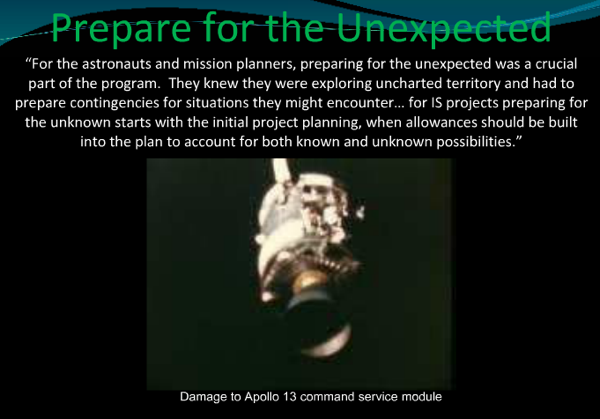
In researching Captain Jim Lovell, I actually found a presentation by someone else who applied the Apollo 13 lessons to IT, and dedicated his presentation to his Dad who worked on Apollo missions.

NewImage

The presentation that I'll embed at the end does a pretty good job of using the lessons of Apollo 13 and applying it to Apollo 13.
Captain Jim Lovell's quote is to "Always prepare for the Unexpected".
"We always were able to solve a crisis as it came up some way, jury-rigging, or doing something to keep our spacecraft going, and finally for a safe landing," Lovell said.
NewImage
The CO2 scrubbers demonstrate improvisation.
NewImage
NewImage
Here is the presentation that used the Apollo 13 story to tell an IT Story.  But, some of the best stories i heard were at Bfast that are good stories for the bar.

Lobster on the menu at 7x24 Exchange, do you get this kind of food at your data center conference?

The folks at 7x24 Exchange have learned the lesson that good food keeps the attendees happy.

The conference has a record attendance this year.  A good test of how a conference treats its attendees is the food served.

Sunday's Welcome Reception had lobster.

NewImage

I wrote about this same topic last year and 7x24 Exchange is consistent.

Why is good food important?  How many parties have you been to that are a great experience with mediocre food?

What is the impact of a water drought on your data center operations?

Water is getting more attention as a critical resource for a data center.  Compass Data Center's Chris Crosby has a post on Water.

Water, Water, Everywhere…


Water, Water, EverywhereAs Coleridge made clear, water is essential for survival. Since data centers hadn’t been invented when he published The Rime of the Ancient Mariner in 1798 he didn’t mention them. But if they had, he certainly would have included them in his epic poem since water is too often a common requirement for their operation. This water dependency is an area of consideration that businesses should factor into their plans for upcoming data centers.

A high percentage of today’s data centers use water-based cooling methods to keep them from becoming the equivalent of a Hopi sweatbox in the desert. Although evaporative cooling, whether through traditional towers or “advanced” swamp coolers, remain highly effective cooling methods, when you’re planning a new data center you may want to consider the impact of the weather and water availability on your decision.

Chris mentions the drought in Eastern Washington in 2001.

The other element that water can have a substantial impact on is your data center’s power. Specifically if your new site will be serviced by a utility using hydro-electric power. I was recently reading an article that stated, “Quincy, WA—Big Data Centers Leverage Abundant, Inexpensive Renewable Energy”. Fair enough. But Quincy is located in Eastern Washington, an area that is largely desert-like and relies exclusively on the power produced by the Wanapum and Priest Rapids dams. What would happen if this area fell into a period of pro-longed and severe drought?

We actually have a pretty good idea of what would happen since the area experienced a severe drought in 2001 and a slightly lesser one in 2005. In both instances, water restrictions forced the lay-offs of thousands of nearby aluminum factory workers as the water available wasn’t enough to generate the power to run the factories’ smelters. In both cases, electrical prices also rose substantially as power had to be imported from California. 

What is interesting is the price of power was so high that Alcoa figured out it could make more money selling power than selling Aluminum.

ALCOA:
"Why Sell Aluminum When We Can Make a Bigger Profit Selling Electricity?"

Jun 25, 2001

Alcoa Aluminum's main smelter in Washington state has been shut down, as have the smelting operations of four other aluminum companies on the Northwest Coast.

They weren't shut down because of a lack of buyers for aluminum –nor for a lack of workers. The big aluminum producers shut down simply because they could make more money by reselling electricity than they could by producing and selling aluminum.

Alcoa, for example, had longterm contracts to buy electric power from the federal government's Bonneville Power Administration at a rate of $22 a megawatthour. But deregulation of the electric power industry opened the road to enormous price increases. By last winter, electric power was selling on the open market at rates running between $250 and $500 a megawatthour. Shutting down aluminum production to resell electricity let Alcoa pocket the difference.

The result was an enormous increase in Alcoa's profits. Its profits in the first quarter of this year 120 million dollars - were over ten times as high as what they had been in the same period a year ago, before they started selling electric power.