Cloud Oxymoron: 91% IT decision makers like the cloud, yet 43% business users skip central IT

Rackspace has a press release on its survey that finds nine in ten IT decision makers support the cloud.

Rackspace Hosting Reports Nine in Ten IT Decision Makers in National Survey Have Positive View of Cloud Computing

0

Overwhelming Majority of Decision Makers Believe Customer Service and Technical Support

Are Important Considerations When Choosing Cloud Provider

San Antonio, TX, June 25, 2012 – Nine in ten (91%) of IT decision makers have a positive opinion of cloud computing according to a national survey commissioned by Rackspace Hosting.  IT decision makers view customer service and technical support as important considerations when choosing a cloud computing provider.

But, when I read the press release an Oxymoron comes out.

An oxymoron (plural oxymorons or oxymora) (from Greek ὀξύμωρον, "sharp dull") is a figure of speech that combines contradictory terms. Oxymorons appear in a variety of contexts, including inadvertent errors such as ground pilot and literary oxymorons crafted to reveal a paradox.

The contradictory idea is the same people who filled out the survey have a wide number of users that bypass the corporate IT group for cloud services.

Rogue IT is Prevalent

Nearly half (43%) of decision makers surveyed are aware of people taking it upon themselves to use cloud computing services or resources not provided by their organization’s IT department in order to help with work projects.   Among respondents reporting someone in their organization using cloud services independently of the IT department, 38% said the main reason is to save time.  One in three respondents believe it was because the solutions were not available internally or because it was a way to not deal with the organization’s IT department.

Now you can explain this many different ways.  Let me give you simple way to look at this.  Corporate IT is a huge group with lots of lots of employees.  The Cloud is a threat to their jobs.  So, whenever a cloud project is brought into corporate IT, a lot of what goes on are attempts to educate the users that they should be using corporate IT staff to run their cloud projects.  This delays the project and increase the costs.  

Wouldn't it be amazing if corporate IT said we can execute cloud projects faster and cheaper than you can on your own.  Shouldn't this be true if corporate IT really had Cloud skills?

What the cloud is doing is giving business users a freedom of choice.  The past corporate IT was a monopoly.

“Cloud computing is spurring innovation by enabling business users and developers to deploy, configure and adapt faster,” said John Engates, chief technology officer at Rackspace.  “The survey confirms the rapid migration to the cloud as IT leaders reap the benefit of spending more time creating and less time configuring.”

The harsh reality of the cloud is it eliminates jobs in corporate IT.  If it doesn't eliminate jobs how do you expect to save money?  Rackspace, Softlayer, and Amazon Web Services would go broke if they had the manpower overhead of corporate IT.

The evil part of The Cloud is it is threat to the large mass of people in IT.  Amazon, Facebook, Google, and others are proud they have one sys admin taking care of up to 10,000 servers.
Students at 7x24 Exchange 2012 Orlando

Last year was my first 7x24 Exchange conference.  I had been going to data center conferences for years and was sticking to that ones I knew my friends were at.  Some friends and I decided to give 7x24 Exchange a try and now I have switched to going to 7x24 Exchange twice a year.

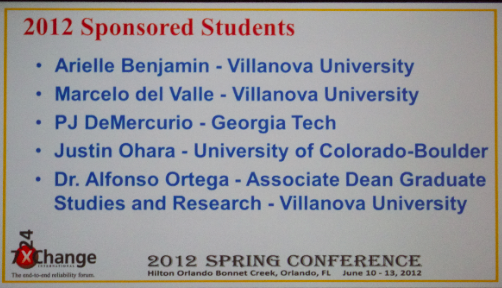
i am going to write a few more posts about my observations of 7x24 Exchange.  One that helps me get a different perspective is 7x24 Exchange has a sponsored student program.  I was able to get my nephew in this year.  Justin just finished his sophomore year in mechanical engineering at U of Colorado-Boulder.  His Dad works at Oracle, not in data centers.  His aunt works at Intuit in the data center group.  And, I do all kinds of fun stuff in data centers.

The one thing I told Justin is where else do you tell me people you are getting your degree in mechanical engineering, and people say "that's cool."  I told Justin when he goes back to school he needs to go talk to the facility operations team, not the data center team to understand mechanical infrastructure on campus for data centers.  The industry terminology can be a bit overwhelming, but getting the context at a place like 7x24 Exchange helps a lot to digest the industry news.

NewImage

I would like to thank the folks at 7x24 Exchange for accepting Justin Ohara in their sponsored student program.

Washington Aluminum Plant celebrates 60 years in Wenatchee

The growth of data centers in the Northwest takes advantage of low cost power that the Aluminum industry used.  Seattletimes publishes an AP article that discusses  the 60 years of one Alcoa plant.

Today, just two plants remain - but one of them celebrates its 60th anniversary Saturday with an open house and an idle plant in Montana is considering a restart thanks in part to abundant power supplies.

It is interesting to know that at one time 40 percent of the USA's aluminum came from 10 plants in the NW.

The Pacific Northwest aluminum industry supplied roughly 40 percent of the nation's aluminum in its heyday in the 1980s, with 10 plants producing the pliable, lightweight metal for everything from war planes to soda cans.

140 MW is available to restart one plant.

In Columbia Falls, Mont., an idle plant is considering a restart, according to the Bonneville Power Administration, the Portland, Ore.-based federal agency that manages much of the Northwest power grid.

Columbia Falls Aluminum, located near the Hungry Horse Dam in northwest Montana, laid off nearly 90 workers when it closed at the end of October 2009.

BPA has told the company it can provide 140 average megawatts of power each year, spokesman Michael Hansen said, which is roughly enough power for two pot lines to operate.

Here is the website for the 60 year old plant in Wenatchee.

NewImage

Construction of Alcoa Wenatchee Works began in May, 1951. The smelting plant, where alumina, or aluminum ore, is reduced to metal, was constructed as a direct result of a request from the Office of Defense Mobilization to increase the domestic production of aluminum in a defense oriented economy.


Alcoa Wenatchee Works opened in 1952. The Wenatchee Works was the first smelter to be built In the Pacific Northwest in the post World War 2 period and the first plant of this type built with private capital in the area since before the war.

Wenatchee Works is located eleven miles south of the city of Wenatchee, Chelan County, Washington, and one and one half miles above Rock Island Dam, the first dam built on the Columbia River. The entire site covers more than 2,700 acres, excluding some 1,700 acres of orchard land donated to Washington State University In 1972. The plant itself covers 100 acres adjacent to the Columbia River.


Here is the dam that the power comes from.

NewImage

Zynga's CIO makes a call for energy efficiency

Zynga's CIO Debra Chrapaty wishes for innovation in server power consumption. Below is a video that can you can watch.

Watch live streaming video from gigaomstructure at livestream.com

And, here is a post on the presentation.

Zynga’s biggest disappointment with running its own data center? Power consumption.

Even though electrical power can account for 40 percent of the cost of running large-scale infrastructure, Chrapaty said Zynga has only seen “slight evolutions” in terms of things like server cooling. “We’ve yet to see true advances like alternative-energy-run data centers,” she said. “It’s certainly a topic worth a couple of hours of discussion.”

Cloud API Fight at GigaOm Structure

One of the more entertaining sessions was on  Cloud APIs.

API WARS: DELIVERING THE DE FACTO STANDARD


OpenStack. CloudStack. Amazon now lets Eucalyptus customers link their private clouds to AWS. The cloud industry has grown up, and after six years, Amazon is still on top. Do the open-source efforts have a chance, or is this recent fragmentation the last straw?

Moderated by:Jo Maitland - Research Director, GigaOM Pro
Speakers:Sameer Dholakia - Group VP and GM, Cloud Platforms Group, Citrix
 
Chris C. Kemp - CEO, Nebula and Co-Founder, OpenStack
 
Marten Mickos - CEO, Eucalyptus Systems 

The video is here.

Watch live streaming video from gigaomstructure at livestream.com

If you don't want to watch the video here is a post on the presentation.

If AWS is the WalMart of cloud, is OpenStack the Soviet Union?

Some of the most dynamic part of the presentation was this discussion..

Kemp took Citrix and Eucalyptus to task for reinforcing Amazon’s dominance rather than embracing the OpenStack project. As you can imagine, Eucalyptus Systems CEO Marten Mickos and Citrix Systems Cloud Platforms Group GM Sameer Dholakia took exception to Kemp’s claims, particularly his characterization of their cloud platforms as closed.

Both pointed out that their platforms are open-source, just like OpenStack, but Kemp refused to accept that definition, saying the companies developed the core of platform internally and then released their software to the open-source community. Kemp contrasted that with the OpenStack, which is developed top-to-bottom by its broad membership with no large company having any outsized influence.