27 Jan 2014 update. Complete original slides are here.
http://www.greenm3.com/gdcblog/2014/1/27/complete-slides-for-urs-hoelzles-openflow-talk-at-2012-open.html
James Hamilton has a post that describes what Urs covered. We need to get James a good camera to take pictures of the slides. It is hard to write and take pictures at the same time though.
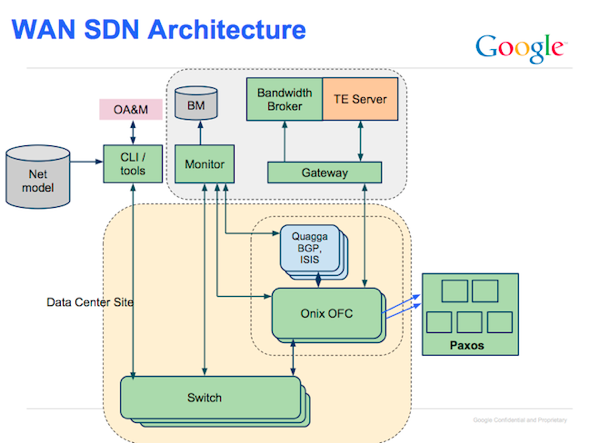
Urs Holzle did the keynote talk at the 2012 Open Networking Summit where he focused on Software Defined Networking in Wide Area Networking. Urs leads the Technical Infrastructure group at Google where he is Senior VP and Technical Fellow. Software defined networking (SDN) is the central management of networking routing decisions rather than depending upon distributed routing algorithms running semi-autonomously on each router. Essentially what is playing out in the networking world is a replay of what we have seen in the server world across many dimensions. The dimension that is central to the SDN discussion is a datacenter full of 10k to 50k servers are not managed individually by an administrator and the nodes making up the networking fabric shouldn’t be either.
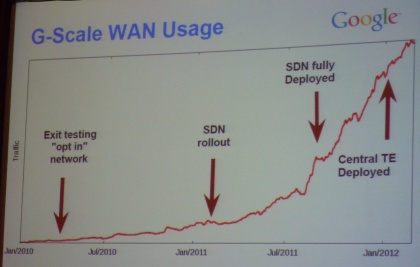
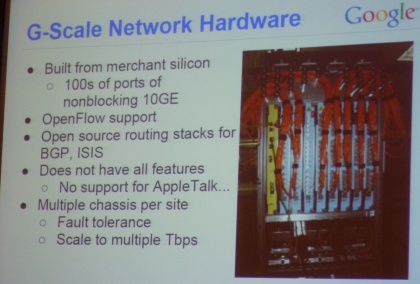
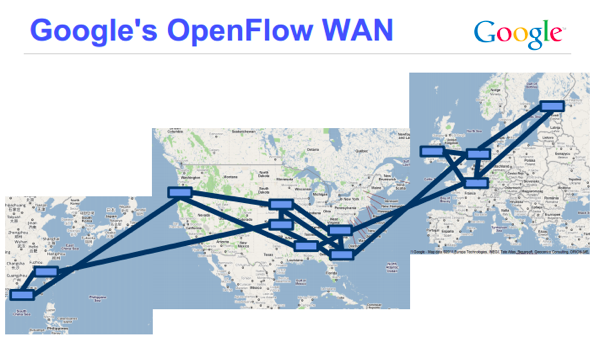
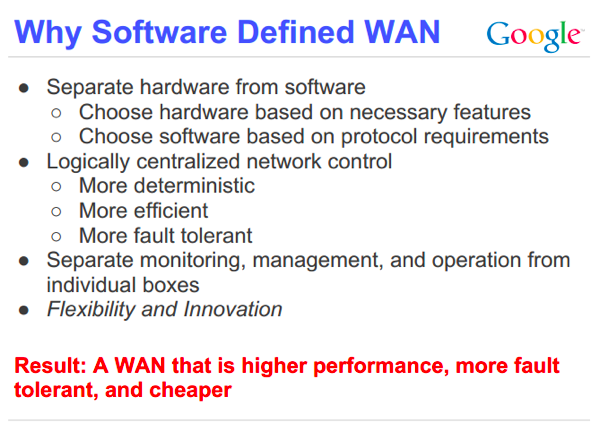
So, I spent some time crawling around to see what slides I could find and throw them together into this blog post. These slides are not in the exact order that Urs presents them in as I wasn’t there and don’t know for sure.
I now understand Urs’s presentantion much better and can watch the video while referring to the below and going back to James Hamilton’s notes.
Why all this effort? Steven Levy’s Wire article says it well.
‘You have all those multiple devices on a network but you’re not really interested in the devices — you’re interested in the fabric, and the functions the network performs for you,’ Hölzle says.
Hölzle says that the idea behind this advance is the most significant change in networking in the entire lifetime of Google.
In the course of his presentation Hölzle will also confirm for the first time that Google — already famous for making its own servers — has been designing and manufacturing much of its own networking equipment as well.
“It’s not hard to build networking hardware,” says Hölzle, in an advance briefing provided exclusively to Wired. “What’s hard is to build the software itself as well.”
In this case, Google has used its software expertise to overturn the current networking paradigm.