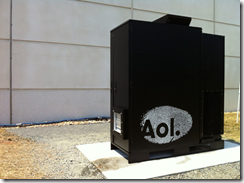
AOL's Mike Manos celebrates the Data Center Independence on 4th of July 2012, freedom via the micro data center

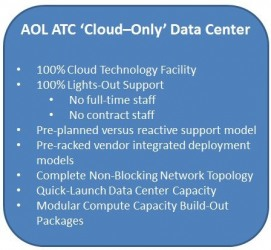
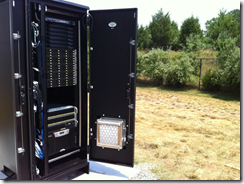
Mike Manos has a post on AOL's Data Center independence.  The micro data center looks like it has a 50KW capacity which could support a configuration like 100 dual proc 128 GB RAM,  dual HD servers, network switch, and storage appliance.  16 processor cores would give the micro data center 1,600 VM cores with 8 GB of RAM.  Slide in some SSD's to make the environment energy efficient and higher performing.  This is a nice cloud environment as modules to deploy.  I think Mike learned that a 40' container is not as flexible.  You can air ship a micro data center and it is much easier to deploy.  Air shipping a 40' container is really really expensive and can be difficult to deploy.

AOL’s Data Center Independence Day

Yesterday we celebrated Independence Day here in the United States.   It’s a day where we embrace the freedoms we enjoy as a country, look back on where we have come, and celebrate the promise of the future.   Yesterday was also a different kind of Independence Day for my teams at AOL.  A Data Center Independence Day, if you will. 

...

NewImage

...

NewImage

...

NewImage

...

NewImage

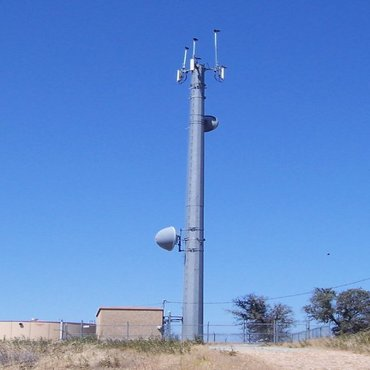
Now you may say where would you put AOL's micro data center.  One place AOL could put them is at cell tower locations.
NewImage

It is reasonable in the future that in major metropolitan areas there will be a local data center presence.  Netflix has been expanding its network WW.  


Open Connect Peering Locations

Private Network Interconnect Sites

CityProviderSite Identifier
Ashburn Equinix DC Campus
Atlanta Telx 56 Marrietta
Chicago Equinix CH1/CH2/CH4
London Telecity Sovereign House
London Telecity Harbour Exchange
Los Angeles Coresite One Wilshire
Los Angeles Equinix LA1
Miami Terremark NAP Of The Americas
New York Telx 111 8th Avenue
San Jose Equinix SV1/SV5

Peering Exchanges

CityExchangeIPv4 AddressIPv6 Address
Ashburn Equinix Internet Exchange 206.223.115.238 2001:504:0:2::2906:1
Atlanta Telx Internet Exchange    
Chicago Equinix Internet Exchange 206.223.119.156 2001:504:0:4::2906:1
London LINX Juniper LAN 195.66.225.101 2001:7f8:4::b5a:1
London LONAP 193.203.5.229 2001:7f8:17::b5a:1
Los Angeles Coresite Any2 206.223.143.215 2001:504:13:0:0:0:0:215
Miami NOTA 198.32.125.71 2001:478:124::1071
New York Telx Internet Exchange    
New York Telehouse NYIIX    
San Jose Equinix Internet Exchange 206.223.116.133 2001:504:0:1::2906:2

One of the top limits for where companies can deploy data centers is the local resource requirement.  Mike's team has an option, where as long as they get power and network, their micro data center will run, managed remotely.

  • It redefines software architecture for greater resiliency
  • It allows us an incredibly flexible platform for driving and addressing privacy laws, regulatory oversight, and other such concerns allowing us to respond rapidly.
  • It further reduces energy consumption and carbon footprint emissions (important as taxation evolves around the world, as well as ongoing operational costs)
  • Gives us the ability to drive Edge Computing delivery to potentially bypass CDNs for certain content.
  • Gives us the capability to drive ‘Community-in-a-box’ whereby we can quickly launch new products in markets, quickly expand existing footprints like Patch in a low cost, but still hyper-local platform, allow the Huffington Post a platform to rapidly partner and enter new markets with minimal cost turn ups.
  • The fact that the technology mix in our SKUs is comprised of compute, storage, and network capacity maximizes the amount of products and services we can deploy to it.  

The race that is going on between the Google, Amazon, Netflix, Microsoft, and Apple is to get the low latency presence to users.  AOL is a player in this game as well.

MacBook Pro Retina vs. Thinkpad T530 vs. Dell M4600, creatives would choose Pro

I just got my MacBook Pro Retina on yesterday and I am so glad I opted for 16GB of memory.  Curious I decided to do a bit of price comparison.

My MacBook Pro Retina is configured with Intel i7 2.6 GHz 4 core, 16 GB of memory and 512 GB SSD with the highest end Retina Display.  These are what I looked for when comparing to a Thinkpad and Dell Laptop. Price $2999

NewImage

NewImage

Dell M4600 Laptop has the enterprise options with multiple drives, etc.  I added equivalent processor, RAM, and SSD.  Price $4,648

NewImage

Lenovo Thinkpad T530 has again many more options, but only allows a 180 GB SSD, so the $3,409 price would be much higher if you could add a 512 GB SSD.

NewImage

Let alone how these machines look.

NewImage

The Dell XPS 15 is $1799, but at this time I could not upgrade the RAM, or SSD.  It's price is $1799 for 8GB and 720 GB HD.

NewImage

The MacBook Pro is being criticized for being too expensive.  It is not for those who the MacBook Air works fine.  Apple was smart in limiting the MacBook Air to 4GB.  

If you want 8-16GB of RAM a 512 GB SSD. And, 4 core i7 is useful, then the MacBook Pro fits.  

NewImage

I used to work at Apple on OS, and Microsoft on Windows.  I run Parallels and Windows 7 on the Macbook Pro which is another reason why 16 GB of memory is nice.

Google's Urs Hoelzle OpenFlow Presentation

27 Jan 2014 update.  Complete original slides are here.

http://www.greenm3.com/gdcblog/2014/1/27/complete-slides-for-urs-hoelzles-openflow-talk-at-2012-open.html


James Hamilton has a post that describes what Urs covered. We need to get James a good camera to take pictures of the slides.  It is hard to write and take pictures at the same time though.

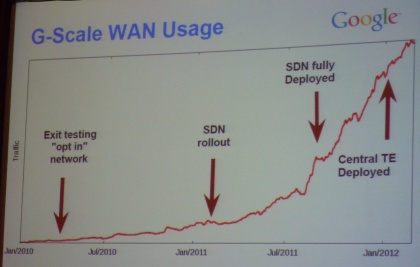
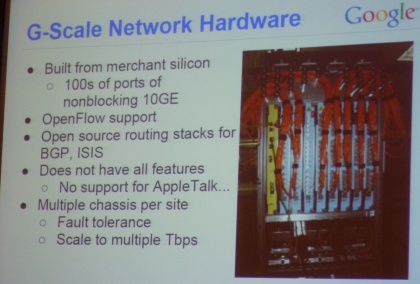
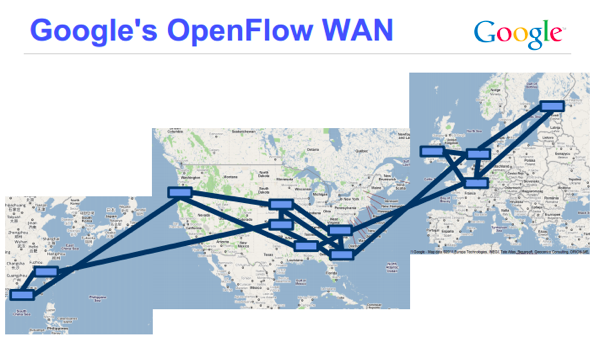
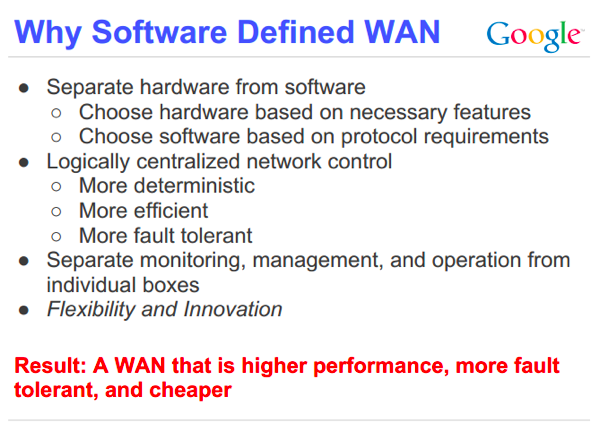
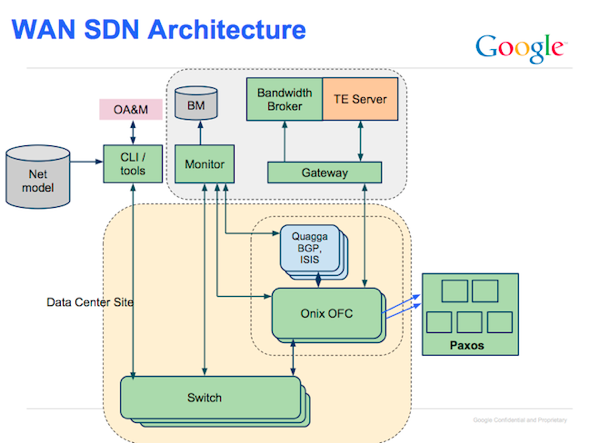
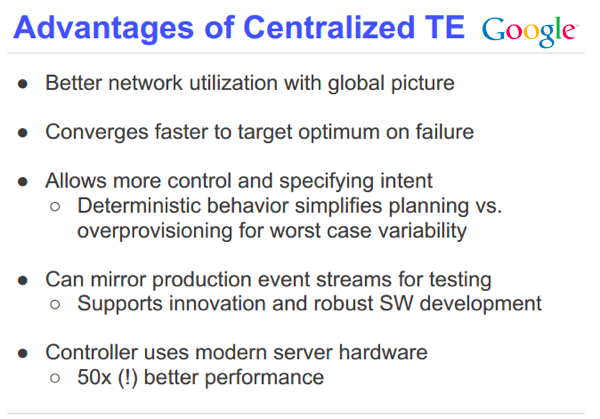
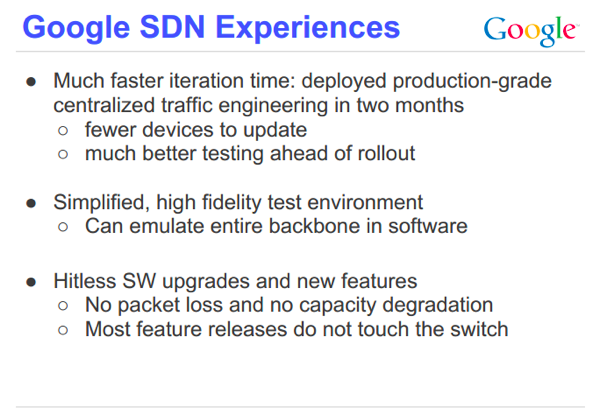
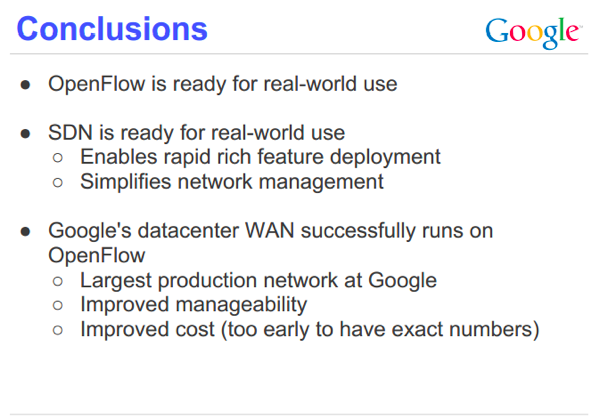
Urs Holzle did the keynote talk at the 2012 Open Networking Summit where he focused on Software Defined Networking in Wide Area Networking. Urs leads the Technical Infrastructure group at Google where he is Senior VP and Technical Fellow. Software defined networking (SDN) is the central management of networking routing decisions rather than depending upon distributed routing algorithms running semi-autonomously on each router.  Essentially what is playing out in the networking world is a replay of what we have seen in the server world across many dimensions. The dimension that is central to the SDN discussion is a datacenter full of 10k to 50k servers are not managed individually by an administrator and the nodes making up the networking fabric shouldn’t be either.

So, I spent some time crawling around to see what slides I could find and throw them together into this blog post.  These slides are not in the exact order that Urs presents them in as I wasn’t there and don’t know for sure. 

I now understand Urs’s presentantion much better and can watch the video while referring to the below and going back to James Hamilton’s notes.

Why all this effort?  Steven Levy’s Wire article says it well.

‘You have all those multiple devices on a network but you’re not really interested in the devices — you’re interested in the fabric, and the functions the network performs for you,’ Hölzle says.

Hölzle says that the idea behind this advance is the most significant change in networking in the entire lifetime of Google.

In the course of his presentation Hölzle will also confirm for the first time that Google — already famous for making its own servers — has been designing and manufacturing much of its own networking equipment as well.

“It’s not hard to build networking hardware,” says Hölzle, in an advance briefing provided exclusively to Wired. “What’s hard is to build the software itself as well.”

In this case, Google has used its software expertise to overturn the current networking paradigm.

NewImage

NewImage

NewImage

NewImage

NewImage

NewImage

NewImage

NewImage

www.instagram.com still down, instagram.com up, DNS problems?

Two days ago Instagramhelp tweeted they are having problems.

We're currently experiencing technical difficulties and we're working to correct the issues. Thanks for your patience