Paul Rand's Design Principles to think about in Data Centers

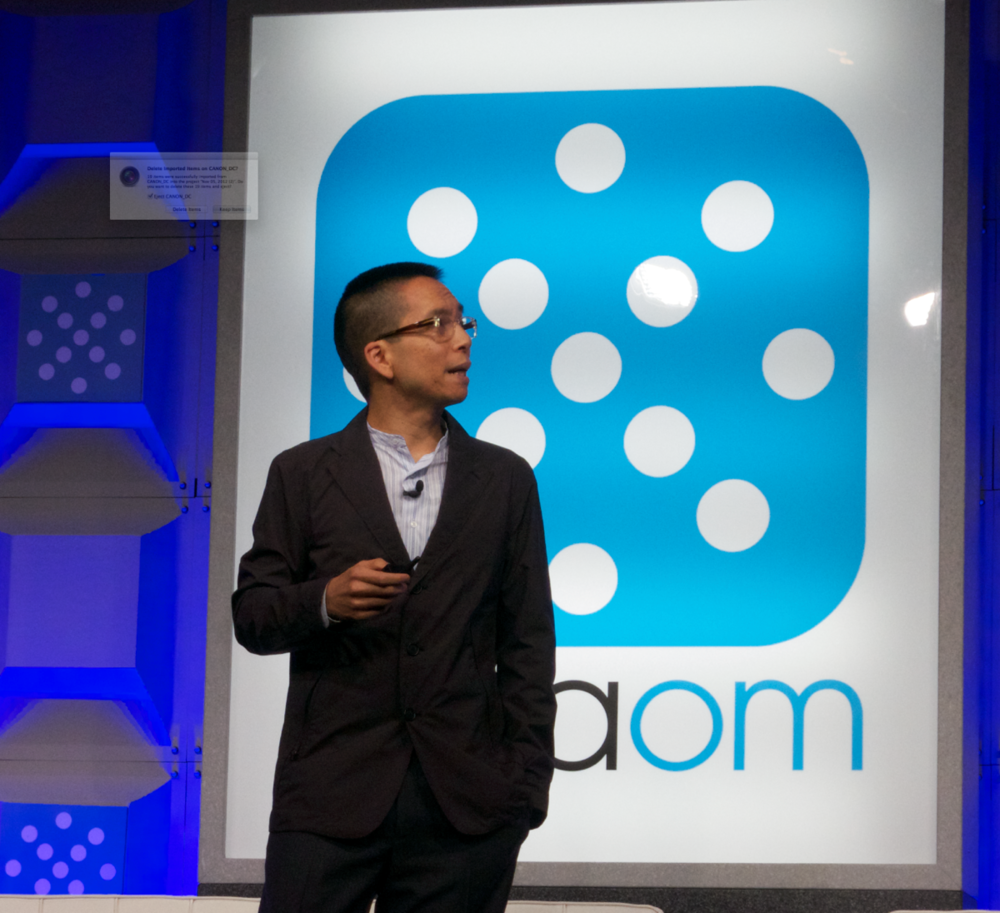
John Maeda, President of RISD gave one of the better design focused presentations at GigaOm Roadmap.
NewImage

One area that John focused on is how he brought Paul Rand to MIT to present.

Who is Paul Rand?

PAUL RAND (BORN PERETZ ROSENBAUM, AUGUST 15, 1914 – NOVEMBER 26, 1996) was a well-known American graphic designer, best known for his corporate logo designs. Rand was educated at the Pratt Institute (1929-1932), the Parsons School of Design (1932-1933), and the Art Students League (1933-1934). He was one of the originators of the Swiss Style of graphic design. From 1956 to 1969, and beginning again in 1974, Rand taught design at Yale University in New Haven, Connecticut. Rand was inducted into the New York Art Directors Club Hall of Fame in 1972. He designed many posters and corporate identities, including the logos for IBM, UPS and ABC. Rand died of cancer in 1996.

Here is what John wrote about Paul Rand's visit and the parts he focused on.

It is ironic that 8 years later, I would return to MITas a professor of design, and that I would host a lecture by Paul Rand at MIT, which I did on November 14 of last year. The time for the lecture was set at 10am. For those familiar with how an American university works, an early lecture is very rare because students usually study late into the night and are less apt to attend events in the morning. But Rand insisted that he speak in the morning. He said, "If someone isn't willing to wake up to hear me to speak, I don't want to speak to them!"

The auditorium was packed beyond capacity with people from all over New England, some waking up as early as 5am to arrive in time for the lecture. The Director of the Media Lab, Professor Nicholas Negroponte, later remarked that during all his career at MIT he had never seen such an overwhelming audience for a morning lecture. Although conditions in the lecture hall were crowded, there was complete silence during the lecture as everyone's attention was completely focused on Rand.

The presentation was a question answer format.

JM: "What is design?"


"Design is the method of putting form and content together. Design, just as art, has multiple defintions, there is no single definition. Design can be art. Design can be aesthetics. Design is so simple, that's why it is so complicated."

What is bad design?


NewImage

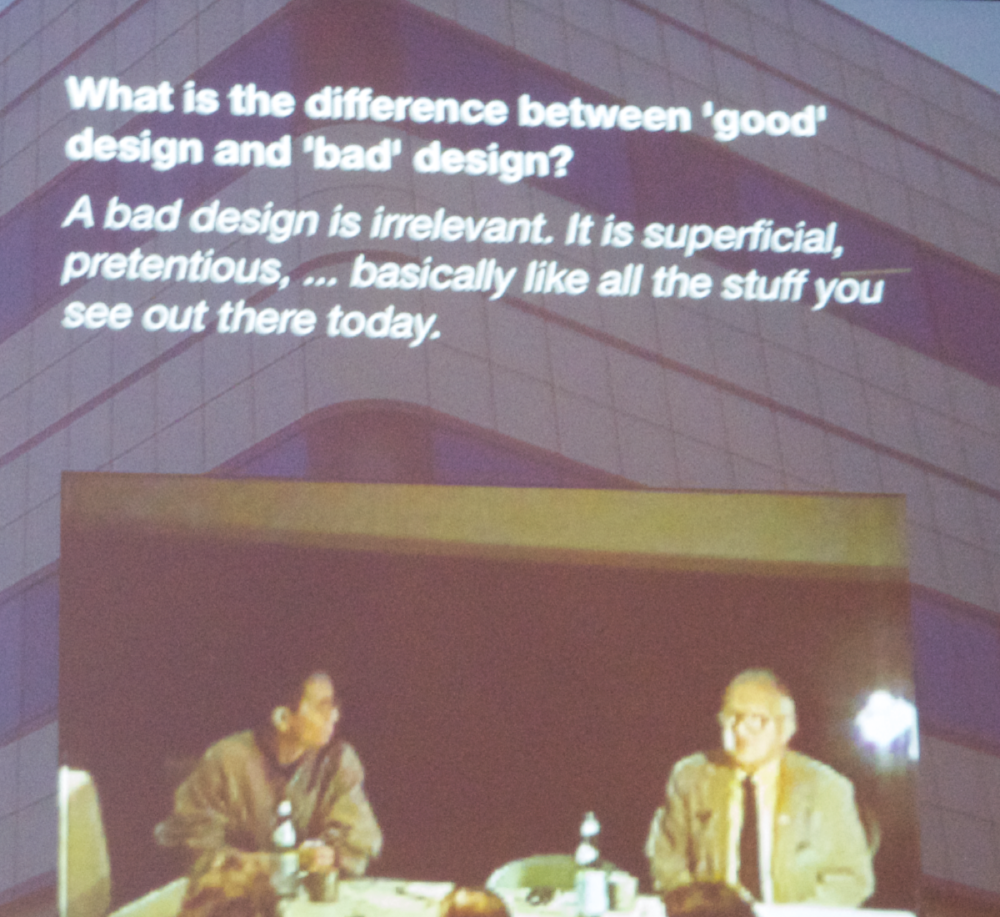
"What is the difference between 'good' design and 'bad' design?"


"A bad design is irrelevant. It is superficial, pretentious, ... basically like all the stuff you see out there today."
 And, here is part that will resonate with some of you who love design.

"Most of your designs have lasted for several decades, what would you say is your secret?"


"Keeping it simple. Being honest, I mean, completely objective about your work. Working very hard at it."

NYTimes's James Glanz writes again, not about Data Centers, but NY ignoring ASCE

The Data Center community is waiting for James Glanz to continue his writing on the data center industry.  But, his latest post is about NY ignoring the recommendations of the American Society of Civil Engineers.

Engineers’ Warnings in 2009 Detailed Storm Surge Threat to the Region

One of the nation’s most influential groups of engineers said it presented detailed warnings that a devastating storm surge in the region was all but inevitable and proposed ways to prepare.

November 5, 2012, Monday
 
Data Barns in a Farm Town, Gobbling Power and Flexing Muscle

When Internet factories come to town, they can feel less like their sleek, clean and convenient image and more like old-time manufacturing.

September 24, 2012, Monday
 
Power, Pollution and the Internet

Helping to process the staggering amount of Internet activity that occurs, data centers waste vast amounts of energy, belying the information industry’s image of environmental friendliness.

September 23, 2012, Sunday
James has found a supportive technical audience.
As the authorities examine how they can protect New York City from extreme weather events like Hurricane Sandy, one of the nation’s most influential groups of engineers is pointing out that more than three years ago, it presented detailed warnings that a devastating storm surge in the region was all but inevitable.
The warnings were voiced at a seminar in New York City convened by the American Society of Civil Engineers, whose findings are so respected that they are often written into building codes around the world. Corporate, academic and government engineers at the meeting presented computer simulations of the storm-surge threat and detailed engineering designs of measures to counter it.
We'll see when James decides to continue his attack on the data center industry.

Container Air Energy Storage coming Q4 2013

GigaOm's Katie Fehrenbacher has a post on LightSail Air Energy Storage.

Peter Thiel, Khosla, Bill Gates back air energy storage startup LightSail

Peter Thiel is leading a large investment into an air energy storage startup called LightSail Energy. Thiel joins Bill Gates and Khosla Ventures as investors. Compressed air energy storage tech pumps air into tanks and releases it on demand to create a sort of air battery.

LigthSail

A startup that makes compressed air energy storage technology called LightSail Energy, has raised a whopping $37.3 million series D round led by Peter Thiel, and also including existing investors Bill Gates and Khosla Ventures. LightSail Energy, based in Berkeley, Calif., has been in stealth for awhile, but the company makes a next-generation technology that compresses air in a tank and efficiently releases it on command, creating a sort of air-based battery for the power grid.

I took a look at the technology section of LightSail and the first versions are 1MW containers.  What came to mind is whether LightSail could be used in a UPS scenario replacing batteries.  If you had a choice between hundreds of lead-acid batteries or a compressed air storage unit, what would you pick?

NewImage

NewImage

Instagram's CEO thinks Cell Phone Data Plans is an obstacle

Watching Kevin Systrom - Co-Founder and CEO, Instagram.

NewImage

800,000 photos were tagged Sandy over the past week.  What was interesting is Kevin's comment that cell phone data plans are an obstacle for sharing more.  Imagine how many more photos would have been shared if the cell coverage wasn't damaged as well.

Kevin thinks Mobile is just starting given it has only existed for a couple of years for many.

Latency is another issue that Kevin touches on for mobile networks.

You can watch Kevin's talk on the GigaOm stream.

http://new.livestream.com/accounts/74987/events/1625459/videos/5782565