Microsoft says Best of Times are ahead which means the past and present are the worst

Microsoft corporate PR has a response to the media coverage of Steve Ballmer's retirement.  Part of what Microsoft says is there are different ways to see the facts of the situation, referencing Tales of Two Cities and Rashomon.  The ending line is where the point is trying to be made.

So when people see the “worst of times” while we see the best still ahead of us, we know it’s simply because we’re not looking through the same frame or the same time horizon.

So, if the best of times are ahead it means that at the present and/or the past is the "worst of times."  And part of what the media has had is an uncontrolled response is pointing out the worst of times at Microsoft during Steve Ballmer's CEO time.

One of the worst times at Microsoft which was before my time at the company. When Microsoft was totally behind OS/2.  Here is the history of David Weise, the god father of Windows 3.0 and savior of Microsoft going down the path of partnering with IBM.

 You see, at this time, Microsoft's systems division was 100% focused on OS/2 1.1.  All of the efforts of the systems division were totally invested in OS/2 development.  We had invested literally tens of millions of dollars on OS/2, because we knew that it was the future for Microsoft. 

Yes Microsoft was committed with hundreds of people developing OS/2.  Windows was not a priority.  Windows was less important than the future bet on OS/2. What saved Microsoft from these dark and worst times of the company was David Weise.  It was sad to see DavidW leave in 2005, but I, DaveO left one year later in 2006.  (One of the geeky left overs from the early days of Microsoft is we called each other by our e-mail aliases.)

DavidW with a small team built Windows 3.0 and beat a team much bigger who was using IBM's software development process.

And here was this little skunkworks project in building three that was sitting on what was clearly the most explosive product Microsoft had ever produced.  It was blindingly obvious, even at that early date - Windows 3.0 ran multiple DOS applications in virtual x86 machines.  It ran Windows applications in protected mode, breaking the 640K memory barrier.  It had a device driver model that allowed for development of true 32bit device drivers.  It supported modern displays with color depths greater than had been available on PC operating systems. 

There was just no comparison between the two platforms - if they had to compete head-to-head, Windows 3.0 would win hands down.

...

The rest was history.  At its release, Windows 3.0 was the most successful software project in history, selling more than 10 million copies a month, and it's directly responsible for Microsoft being where it is today.

And, as I mentioned above, David is responsible for most of that success - if Windows 3.0 hadn't run Windows apps in protected mode, then it wouldn't have been the unmitigated success it was.

David's spent the last several years working in linguistics - speech generation, etc.  He was made a distinguished engineer back in 2002, in recognition of his contribution to the industry. The title of Distinguished Engineer is the title to which all Microsoft developers aspire, it is literally the pinnacle of a developers career at Microsoft when they're named DE - other DE's include Dave Cutler, Butler Lampson, Jim Gray, Anders Hejlsberg.  This is unbelievably rarified company - these are the people who have literally changed the world.

From the worst of Microsoft's times came a heroic brilliant effort to invest in Windows 3.0.  The story of what DavidW did is knows amongst the old time Microsoft and probably remembered as some of the darkest times when the company was young and a servant of IBM to develop a future OS.  If you tried to do what DavidW did it would get you fired at most companies.

It is interesting to see how some of the most innovative products come from those who don't follow the direction of executive leadership.  One way to view how innovative companies are is whether the smart people can survive within the official corporate heirarchy.  If you look at many of the companies like Apple, Google, Facebook, Amazon there is a separate innovative ecosystem that works across boundaries.  Most executives will squash this innovative ecosystem.  If Steve Ballmer and Bill Gates had they would have killed Windows 3.0 to support the development of OS/2.

Case study of Washington Post using AWS

Jeff Bezos bought Washington Post, and there is speculation Washington Post would use amazon.com technology.  Here is a case study that was released a while ago on the Washington Post using AWS.

AWS Case Study: Washington Post

Peter Harkins, a Senior Engineer at The Washington Post, heard the news spread through the editorial department as the National Archives announced the release of Hillary Clinton’s official White House schedule. The data was going to be released to the public on March 19th at 10am. 17,481 pages of data as a non-searchable PDF.
Washington Post


The documents included Hillary Clinton’s daily activities as a First Lady during President Bill Clinton’s two terms in office, from 1993-2001 that were being made public under the Freedom of Information Act after multiple requests from journalists and watchdog organizations.

Harkins knew that reporters would be very interested in this data but it would take hundreds of man hours to pore through the document’s low-quality PDF files. So, about 45 minutes after the release, Harkins started working with the data, trying to find a way to convert the images into usable, searchable text and deliver them to the newsroom within the same news cycle.

Harkins first tested various PDF and Optical Character Recognition (OCR) tools to convert the images into machine-readable text. With these software tools, he estimated that it would take about 30 minutes per page to process the sizable document including reformatting, resizing, and scanning each page.

Working against time, Harkins moved the project to the cloud—Amazon Elastic Compute Cloud (Amazon EC2). With Amazon EC2, he launched 200 server instances to process the images to his specifications. With a processing speed of approximately 60 seconds per page, the project was completed within nine hours and sent to the eager writers who began searching against the data. Then, Harkins and team created a polished web interface and made their searchable database available to the public 26 hours later.

Harkins ruminates, “EC2 made it possible for this project to happen at the speed of breaking news. I used 1,407 hours of virtual machine time for a final expense of $144.62. We consider it a successful proof of concept.”

Practice every day, make mistakes, learn, get better

I write almost every day in this blog. Some think i do this for money.  No, a year's worth of blogging revenue is less than I make in a day with a client.  So, I write for getting my name out there.  No, I don't focus on marketing myself as most people don't even know what I do.  So, why write?  Because it gets me every day spending a bit of time, sometimes more than others, sometimes less, on thinking about what is going on in the industry that is worth writing about.  This every day effort for the past 6 years has made it so it is natural for me to analyze and write what I observe.  Part of observing is understanding how things work.

Reasoning from observations has been important to scientific practice at least since the time of Aristotle who mentions a number of sources of observational evidence including animal dissection (Aristotle(a) 763a/30–b/15, Aristotle(b) 511b/20–25). But philosophers didn't talk about observation as extensively, in as much detail, or in the way we have become accustomed to, until the 20th century when logical empiricists and logical positivists transformed philosophical thinking about it.

The first transformation was accomplished by ignoring the implications of a long standing distinction between observing and experimenting. To experiment is to isolate, prepare, and manipulate things in hopes of producing epistemically useful evidence. It had been customary to think of observing as noticing and attending to interesting details of things perceived under more or less natural conditions, or by extension, things perceived during the course of an experiment.

As a skill I have found being able to document the analysis process for my clients and myself is useful.  Parts leak into this blog when I think it is useful to my friends and there is a public disclosure.  Many times when I write I have specific people I am thinking about like the departed Olivier Sanche.

If you want to get good at something practicing every day, making mistakes, learning, and getting better is powerful.  Here is an article in Fast Company on this idea.

WANT TO CONQUER A NEW SKILL? DO IT EVERY DAY

AT THE INTERSECTION OF PSYCHOLOGY AND PRODUCTIVITY LIES A SIMPLE TRUTH: TO DO SOMETHING WELL, YOU MUST EMBRACE QUANTITY.

 ...

When you're learning a new skill--whether developing dance moves or websites--quantity is way more important than quality.

Why? Over at Medium, entrepreneur-essayist Herbert Lui expounds on expansion:

Quantity should be a higher priority than quality, because it leads to higher quality. The shorter path to maximized quality is in maximized quantity, and executing on the feedback after each finished product.


To put it into startup terms, you're making yourself maximally iterative. To put it into hardware, the idea is to get as many cycles as possible. To put it into workout terms, the idea is to get as many reps as possible. Try fast, fail fast, learn fast.

Why does the do-it-a-bunch technique work? Take it away, science:

Oops, People are finding out that electric cars create a peak load when plugged in

MIT Technology Review has a post on something that is pretty obvious to a data center crowd.  Plugging in electric cars can create stress on a local circuit.  In the data center users don't think about at the local power constraints on a circuit.  Having an even distribution of power use on circuits is ideal.

The trouble arises when electric car owners install dedicated electric vehicle charging circuits. In most parts of California, charging an electric car at one of those is the equivalent of adding one house to the grid, which can be a significant additional burden, since a typical neighborhood circuit has only five to 10 houses. In San Francisco, where the weather is cool and air conditioning is rarely used, the peak demand of a house is much lower than in the hotter parts of California. As a result, the local grid is sized for a much smaller load. A house in San Francisco might only draw two kilowatts of power at times of peak demand, according to Pacific Gas & Electric. In comparison, a new electric vehicle on a dedicated circuit could draw 6.6 kilowatts—and up to 20 kilowatts in the case of an optional home fast charger for a Tesla Model S.

I found another post on the same Southern California Edison report and this one compared to the MIT Technology Review pointed to the SCE report which is here.

NewImage

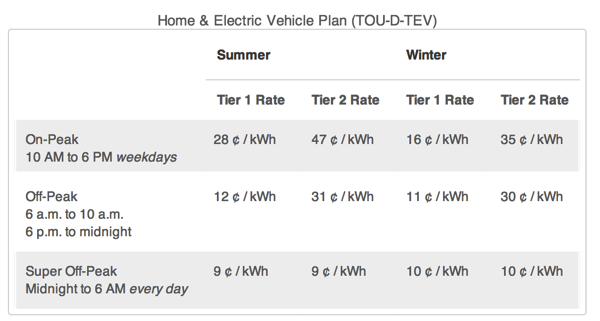
The most useful data I found to give you an idea of what is going on with Southern California Edison's ability to support car charging is the rate structure set up for electric vehicles.  You would expect that the use of electric vehicles pushes most people to the Tier 2 rate.  Charging off-peak vs. midnight -6a is three times more.  Charging during 10a - 6p vs. midnight  - 6a is 5 times more expensive during the summer.

NewImage

I would say the Utility is driving the a more manageable electric load by creating the financial incentives.  When people see their electricity bill it will get them to adapt their behaviors.

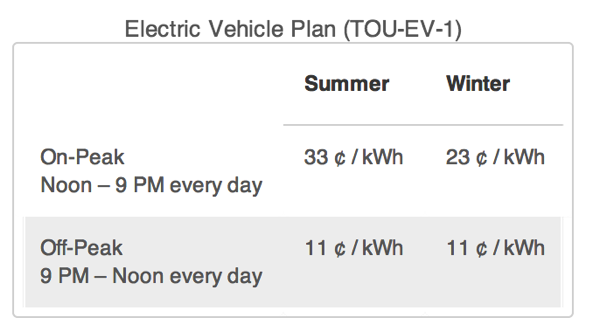
There is also a rate plan just for electric vehicles.

NewImage

Analysis The Next Microsoft CEO

Summary: The next CEO of Microsoft is going to be someone Bill Gates and his advisors trust and respect to fulfill the CEO role over the next 15-20 years. Microsoft is a company built on writing software, therefore the CEO should have the ability to support the vision of developing innovative software that leads the industry in growth.  Satya Nadella is a leading candidate.  What is unknown is what Bill Gates thinks of the other candidates vs. Satya.

Background: I spent 1980 - 1985 at HP and have observed the transition through multiple CEOs after David Packard. I was at Apple from 1985 - 1992 which gave me a perspective of the long series of CEOs until Steve Jobs returned.  From 1992 - 2006 I was at Microsoft and while working on software I saw a wide range of executives rise to senior positions.

Analysis: There is a wide range of media coverage on Steve Ballmer's announced retirement.  What few people state is why Steve Ballmer had the CEO job and what would lead Bill to choose the next CEO.  Bill is the Chairman of the Board, Founder, largest shareholder, and most influential person in Microsoft. Bill supported Steve Ballmer in the CEO job because Bill trusted and respected Steve to be the CEO to the best of his ability, a role that Bill had from the beginning and knows what it takes to be CEO of his company, Microsoft. 

You can find fault in what Steve Ballmer did, but he was always trying to do his best.  

“Peace of mind attained only through self-satisfaction in knowing you made the effort to do the best of which you’re capable.” – John Wooden

Who does Bill Gates trust and respect to be Microsoft's CEO?  Someone he has history with and the selection board agrees is the best candidate to run Microsoft in the best interest of shareholders of which Bill is the largest.  And someone who will make the effort to be best of which they are capable of.

Candidates:

Satya Nadella is mentioned most frequently in the media as a possible future Microsoft CEO.  GigaOm's Barb Darrow covers the range of CEO candidates. I know Barb and like her method of researching a post.

 I have already said I think Satya Nadella,  the executive VP of cloud and enterprise, should be on the very short list or prospective CEOs. One current Microsoft exec, who understandably can’t be quoted on this, agreed and added that Tony Bates, the former head of Skype who now heads up biz dev, should also be considered.

My perspective on Satya is different than many as I remember Satya from days of working on Microsoft's Interactive TV where he was a product manager and I was a program manager. We were chatting a bit back in June 2013 at GigaOm Structure. Satya joined Microsoft in Feb 1992.  I joined in Apr 1992.  Satya has worked in a wide range of roles at Microsoft and has taken the path of being groomed for executive leadership.

Paul Maritz was the #3 man in Microsoft after Bill and Steve.  Paul retired from Microsoft in 2000, and eventually EMC snapped him up to run VMware.  Paul still lives in the Seattle area.  What is unknown is how Bill and Paul get along after 13 years.

"During Paul's 14 years with Microsoft, he has played a key role in virtually every major initiative, from the evolution of Windows and Office to the .NET strategy," said Bill Gates, chairman and chief software architect of Microsoft. "Paul's vision and technological insight has had a major impact not only on Microsoft but on the entire computer industry."

"Microsoft is one of the great places on earth to work," Maritz said. "It has been a real privilege to have worked with so many wonderful and talented people and to have been able to participate in so many interesting and important endeavors. With the recently announced Microsoft .NET strategy now in place, there is an amazing opportunity to fully realize the potential of software and the Internet to change how people communicate and experience information. Microsoft is very fortunate to have a world-class generation of young leaders ready to step up to build on these opportunities and ensure Microsoft's continued success as the global leader in software technology."

Barb mentions Steve Sinofsky and Stephen Elop.  Steve and Stephen didn't leave with a glowing endorsement from Bill.  And it just sounds strange that a Steve/Stephen would take over Steve Ballmer's job.

Others speculate that Steven Sinofsky(pictured at right) who left Microsoft abruptly last year and just joined the board at Andreessen Horowitz would be a candidate.

Then there’s the whole Microsoft-will-buy-Nokia-to-boost-its-smartphone-business theory. That would bring Nokia CEO Stephen Elop, who was formerly Microsoft Business Division president, back into the fold as a potential CEO.

Two other executives who were inside Microsoft and and didn't last are Kevin Johnson and Bill Veghte.  If Kevin and Bill were potential CEOs wouldn't Microsoft had rotated them into other positions in Microsoft.  You could speculate that Kevin and Bill were CEO material, but didn't want to wait until 2017 when Steve Ballmer said he would think about retiring.

The list of executives whose names have been floated for the top job is long, including the likes of Yahoo CEO Marissa Mayer, Facebook COO Sheryl Sandberg and AOL CEO Tim Armstrong. Others mentioned include Nokia CEO Stephen Elop, Juniper CEO Kevin Johnson and Hewlett-Packard COO Bill Veghte.

In regards to Sheryl Sandberg, would Bill have an ex-Facebook/Google executive without software development expertise run Microsoft? not likely.

Speaking of Google executives, another is Vic Gundotra, SR VP of Google social who was a GM at Microsoft.  It would be so embarrassing to have a Google employee be Microsoft CEO, the PR would be tough to bear.

Among the list that Microsoft might consider are two India-born tech executives: Satya Nadella and Vic Gundotra.

You can see how it gets kind of ridiculous who the press thinks could run Microsoft.  Really, ex-Google execs to be Microsoft CEO.  Why not just hire Larry Page, Sergey Brin or Eric Schmidt?

People that Bill is probably talking to about who should be CEO are

Nathan Myhrvold

Nathan Paul Myhrvold (born August 3, 1959), formerly Chief Technology Officer at Microsoft, is co-founder of Intellectual Ventures—one of the largest patent holding companies in the world, as well as the principal author of Modernist Cuisine.

Rick Rashid

Richard (Rick) F. Rashid oversees Microsoft Research's worldwide operations. Previously, he was the director of Microsoft Research. He joined Microsoft Research in 1991, and was promoted to vice president in 1994. In 2000, he became senior vice president. He has authored a number of patents in areas such as data compressionnetworking, and operating systems, and was a major developer of Microsoft's interactive TV system. 

Craig Mundie

Craig James Mundie (born July 1, 1949 in Cleveland, Ohio[1]) is Senior Advisor to the CEO at Microsoft[2] and its former Chief Research and Strategy Officer.[3] He started in the consumer platforms division in 1992, managing the production of Windows CE for hand-held and automotive systems and early console games. In 1997, Mundie oversaw the acquisition of WebTV Networks. He has championed Microsoft Trustworthy Computing and digital rights management. 

Jeff Raikes, CEO of Gates Foundation, ex-Microsoft exec.

Jeffrey Scott "Jeff" Raikes (born May 29, 1958) is the chief executive officer of the Bill & Melinda Gates Foundation. Until early 2008 Raikes was the President of the Microsoft Business Division and oversaw the Information Worker, Server & Tools Business and Microsoft Business Solutions Groups. [1] He joined Microsoft in 1981 as a product manager.[1] He retired from Microsoft in September 2008, after a transitional period, to join the Gates Foundation.[2] Raikes is credited with driving much of Microsoft’s early work in business applications.

Whoever is the next Microsoft CEO it is going to be someone who Bill trusts and respects to run Microsoft.  Bill is the Chairman of the Board, Founder, Largest shareholder and the most influential Microsoft employee.  Bill is still a Microsoft employee he did not retire.  He transitioned away from day to day duties, and is still a Microsoft employee.

William (Bill) H. Gates is chairman of Microsoft Corporation, the worldwide leader in software, services and solutions that help people and businesses realize their full potential.

On June 27, 2008, Gates transitioned out of a day-to-day role in the company to spend more time on his global health and education work at the Bill & Melinda Gates Foundation.

Bill works from a separate office and has a space to think about who should have his old job.

Setting a curious mind free

Bill Gates 2.0 will have three offices: one at Microsoft in Redmond, a second about 15 miles away at the Gates Foundation in downtown Seattle, and a third almost exactly equidistant between the other two (and much closer to home). In typical hyper-systematic fashion, Gates has allocated blocks of time to each location: a day in Redmond, two at the foundation, and two at the personal office, which he suspects will be his real "center of gravity." There will be a lot of overlap among his three roles. That's because the guy's greatest pleasure seems to be in finding connections among things he's interested in.

The biggest change, of course, will be in his workload at Microsoft, which will drop drastically. He'll remain chairman and weigh in here and there. "Other than board meetings and consulting on projects like Internet search technology, the only things I'll do are some company visits when I'm in developing countries," he says. "Or if there's some special award for someone at a company meeting, I'll come and present it. But that's about it." (For more on how Microsoft is coping with Gates' retirement, see the accompanying story.)

...

"The classic CEO needs to be right, or rather needs to appear to be right more than he needs to actually be right - and that's not Bill," says his pal Myhrvold. "Lewis and Clark were lost most of the time. If your idea of exploration is to always know where you are and to be inside your zone of competence, you don't do wild new shit. You have to be confused, upset, think you're stupid. If you're not willing to do that, you can't go outside the box."