With Steve Ballmer's Retirement and Acquisition of Nokia Phone, the Microsoft Hardware will be a priority

Microsoft has made billions of dollars from hardware.  Long before XBOX which makes a meager profit, there was, is the Microsoft Mouse business.  Here is a paper from 1989 on an early Microsoft Mouse.

Paper presented at "Interface 89"

The Sixth Symposium on Human Factors and Industrial Design in Consumer Products

Human Factors Society POBox 1369 Santa Monica California 90406

Microsoft Mouse: Testing for Redesign

Bill Verplank, Kate Oliver, IDTwo

ABSTRACT

As part of the redesign of the Microsoft mouse by Matrix Product Design, a series of user tests were performed by ID Two. We used artificial tasks representative of typical mouse use allowing repeated measures of time and error.


One of the Microsoft old timers told stories of how no matter what he presented in a product review with Steve Ballmer, he could never win.  As there was no way the hardware could achieve the margins of software.  With Xbox, Surface, and now Nokia phones, Microsoft has the reality of having a low margin hardware as part of its revenue stream.

Microsoft has pushed the general purpose software SW licensing model for the longest and made the most amount of money.  Google doesn't sell a one time purchase of SW.  Their service are either free or a subscription service.

Amazon tries to break even or lose as little as possible on a hardware sale, making up the money on services.  Xbox is the same.

Making hardware is hard.  Making money on hardware is even harder.

The technology world is changing and it is just the beginning.
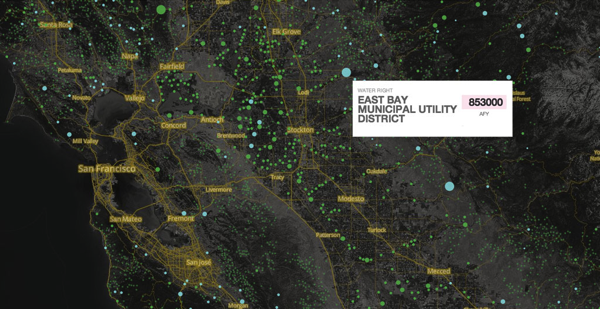
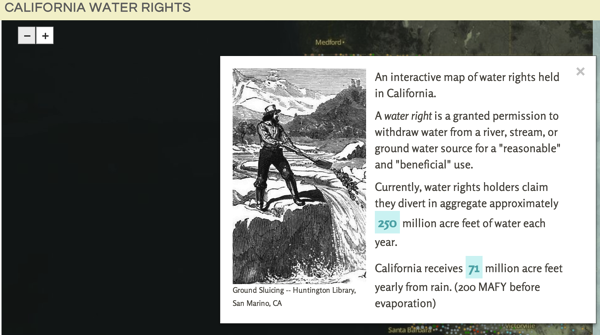
Californian's Know Your Water Rights - A Smart Atlas of Water Governance in CA

Here is a web site to help Californian's understand water in the state.

Understand Water in California

Presenting real-time, interactive visualizations of how we use, manage and understand water in California. By visualizing and promoting water data for the state, we are making it possible to understand our cumulative usage of water and how this effects the many farms, individuals, governments, and businesses that rely on water availablity for healthy economies and ecosystems.

NewImage

As the needs of our state shift with the changing demands placed on us by population growth and climate change, we want to give the gift of broad insight and clear communication to the many professionals and concerned citizens who work so hard to protect and deliver one of our most precious resources.

Water is a shared resource; as such, it is managed by the state on behalf of the people. To achieve our interdependent goals of healthy ecosystems, economies, farms and cities, we strive to bring you up-to-date, clear and accurate information to inform your decisions.

Deliveries
 
The water rights section works.
NewImage

THE RIGHT TO BEAR KNOWLEDGE

“If you can't measure it, you can't manage it.”

Peter Drucker

The primary challenge with water in California is not its scarcity, but rather how we manage it. Many experts have mutually concluded, that a major first step to improving our management of water is by reforming how we account for it. Whether a lack of adequate statements of diversion for surface and subsurface waters, or the existence of a fine grained environmental monitoring network, it is clear that we could do a better job of recording and measuring. New instruments and institutions are necessary to accomplish this. It is not a question of technology, but one of techniques. The technology is available and affordable, but the institutions and practices of how we measure and document our water resources are not fully mature. We must get control of our understanding of what is in the system at any given point. We owe it to ourselves, our economy, and our ecosystem. This effort benefits all stakeholders.

Google Publishes The Guide to Data Center Book, "The Datacenter as a Computer" 2nd edition

For newbies it can be hard to learn about data centers.  One document that is useful is Google published The Datacenter as a Computer paper back in 2009.

Publication Year

2009

Authors

The Datacenter as a Computer: An Introduction to the Design of Warehouse-Scale Machines

Abstract: As computation continues to move into the cloud, the computing platform of interest no longer resembles a pizza box or a refrigerator, but a warehouse full of computers….
 
And in July 2013 the 2nd edition is released. 

Notes for the Second Edition

After nearly four years of substantial academic and industrial developments in warehouse-scale computing, we are delighted to present our first major update to this lecture. The increased popularity of public clouds has made WSC software techniques relevant to a larger pool of programmers since our first edition. Therefore, we expanded Chapter 2 to reflect our better understanding of WSC software systems and the toolbox of software techniques for WSC programming. In Chapter 3, we added to our coverage of the evolving landscape of wimpy vs. brawny server trade-offs, and we now present an overview of WSC interconnects and storage systems that was promised but lacking in the original edition. Thanks largely to the help of our new co-author, Google Distinguished Engineer Jimmy Clidaras, the material on facility mechanical and power distribution design has been updated and greatly extended (see Chapters 4 and 5). Chapters 6 and 7 have also been revamped significantly. We hope this revised edition continues to meet the needs of educators and professionals in this area.

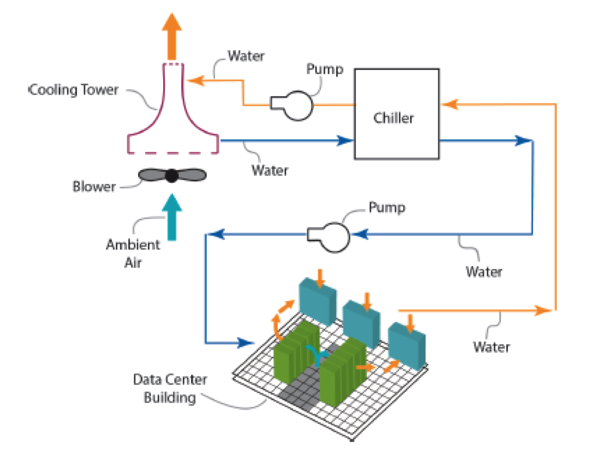
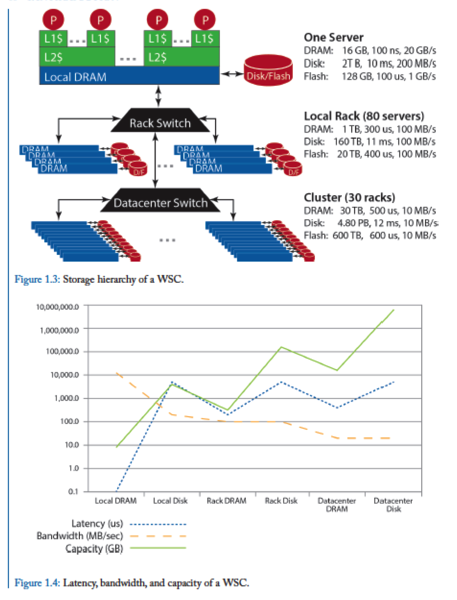
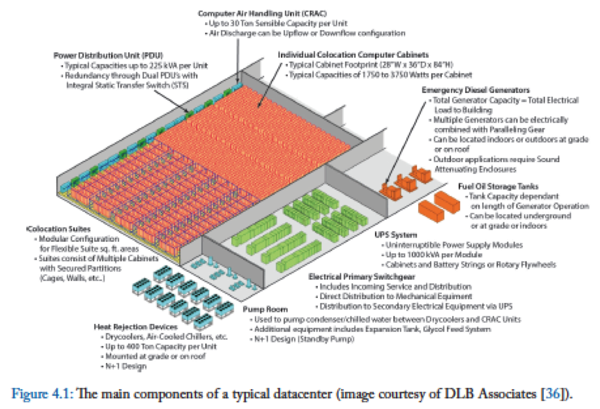
The PDF is here.  And lots of great diagrams.
NewImage
NewImage
NewImage
 
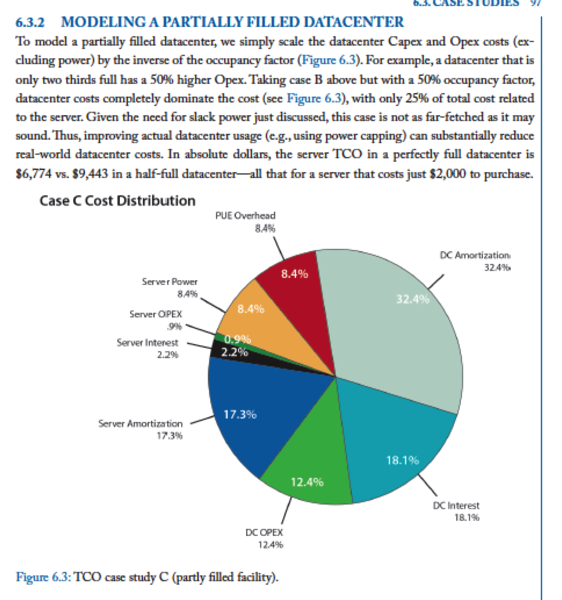
One of the parts I liked was the section on modeling for partially filled data centers.
NewImage
 
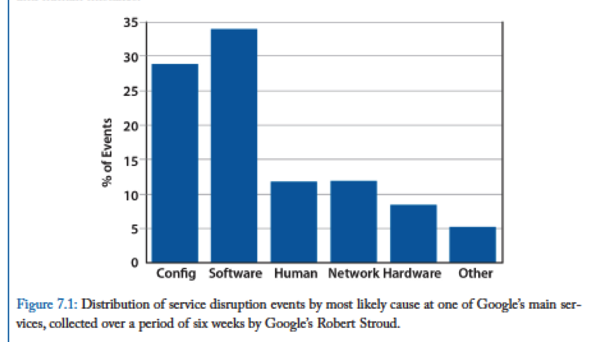
Distribution of service disruption events.
NewImage

 And the closing conclusion.

8.5 CONCLUSIONS

Computation is moving into the cloud, and thus into WSCs. Software and hardware architects

must be aware of the end-to-end systems to design good solutions. We are no longer designing

individual “pizza boxes,” or single-server applications, and we can no longer ignore the physical and

economic mechanisms at play in a warehouse full of computers. At one level, WSCs are simple—

just a few thousand cheap servers connected via a LAN. In reality, building a cost-efficient massive-

scale computing platform that has the necessary reliability and programmability requirements

for the next generation of cloud-computing workloads is as difficult and stimulating a challenge as

any other in computer systems today. We hope that this book will help computer scientists understand

this relatively new area, and we trust that, in the years to come, their combined efforts will

solve many of the fascinating problems arising from warehouse-scale systems.

Mobile Devices set up for a three company competition - Apple, Google, and Microsoft

With Microsoft's acquisition of Nokia phone devices it looks like there is a three company race against Apple and Google.  Phones and Tablets are the growing faster than any other technology device.

One way to think about Mobile device companies is a three company competition.  Here is a post on three company competition and its history.

COMPETITIVE MARKETS AND THE RULE OF THREE 
by Jagdish N. Sheth and Rajendra S. Sisodia 
Strategy 

The “Big Three” no longer have the automobile market to themselves, but almost every market, including the one for cars, is ruled by three dominant firms. That reality does not prevent other firms from being successful. However, all firms, regardless of their market share, must still understand The Rule of Three and how it will affect their strategy and attempt to operate efficiently.

Over the past several years, the world economy, principally in the developed free market economies of Europe and North America, has been characterized by a unique economic phenomena-the combination of mergers and demergers at record levels (demergers are the spin-offs of non-core businesses). As a result, the landscape of just about every major industry has changed in a significant way, moving inexorably toward what we call the “Rule of Three.” The recent economic downturn has slowed but not halted this fundamental evolution, nor has it altered its basic direction.

We note that the Rule of Three is much more than an interesting theoretical construct; it is a powerful empirical reality that must be factored into corporate strategizing. Understanding the likely end-points of market evolution is critical to the ability of executives to develop strategies that will result in success.

Insight into Google Data Center Operations, Site Reliability Presentation at PuppetConf

I was at PuppetConf 2013 in SF for the first time and had a great time.  After the opening Keynote by Luke Kaines, was a presentation by Google Site Reliability Engineer, Gordon Rowell.

Google’s Corporate Engineering SRE team provides infrastructure services used by many of Google’s desktops, laptops and servers. This talk gives an overview of the design philosophy, challenges, technologies and some interesting failures seen while implementing infrastructure at scale.
Speakers

Gordon Rowell

Site Reliability Manager, Google
Gordon Rowell is a site reliability manager at Google, Sydney. His team focuses on delivering services to Googlers around the world. They have migrated major internal services to run on Google technology and are currently focused on removing dependencies on the corporate network. | He enjoys the challenges of building robust systems that scale and has a particular passion for configuration management. 

The presentation is here.

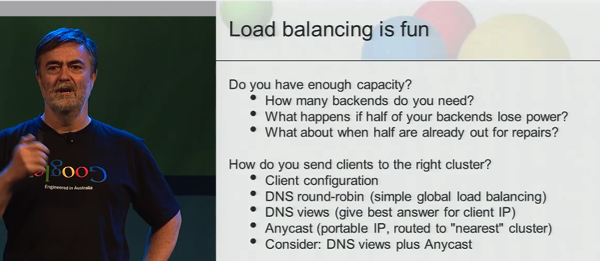
Key takeaways I saw are in these slides.

NewImage

NewImage

NewImage

NewImage